In the quest for sustainable agriculture, the most groundbreaking breakthroughs often emerge from the most unlikely of places. A new study from North Carolina State University (NC State) reveals that a textile originally engineered for military comfort has become a game-changer for strawberry farmers, boosting fruit yields by more than 350% while simultaneously offering a chemical-free defense against pests.
The technology, aptly named "Plant Armor," is a sophisticated, three-dimensional knitted textile that, when draped over strawberry crops, creates an ideal micro-climate for growth. By fostering a protective barrier that excludes insects while permitting essential light, air, and moisture to reach the plants, researchers have unlocked a potential new paradigm for high-efficiency, low-impact farming.
The Genesis of Innovation: A Serendipitous Scientific Journey
The story of Plant Armor is not one of traditional agricultural research, but rather a testament to the power of cross-disciplinary collaboration. The roots of this invention lie in the labs of the Wilson College of Textiles, where researchers were originally tasked with a far more terrestrial goal: enhancing the comfort of soldiers wearing heavy body armor in humid, hostile environments.
The project began as an investigation into how high-performance fabrics could be engineered to improve ventilation and moisture management for military personnel. Scientists were looking for ways to create breathable, protective layers that could keep soldiers cool while protecting them from mosquito bites and other environmental stressors.
As the team refined the three-dimensional knit structures, they realized the textile’s unique properties—high breathability, structural integrity, and the ability to prevent small insects from making contact with the skin—could be applied to a completely different biological challenge: protecting crops. This realization triggered a pivot, moving the research from the barracks to the field, where the textile was repurposed to serve as a physical shield for sensitive agricultural produce.
Structural Ingenuity: How Plant Armor Works
At the heart of Plant Armor is its unique physical architecture. Unlike standard agricultural row covers, which can often be heavy, opaque, or prone to trapping excessive heat, Plant Armor utilizes a 3D porous structure.
The fabric acts as a precision filter. Its gaps are specifically calibrated to allow for the passage of photons—ensuring the plant receives the full spectrum of sunlight required for photosynthesis—while simultaneously preventing the encroachment of pests. In many traditional farming models, growers are forced to choose between physical barriers that block too much light and chemical sprays that provide protection at the cost of environmental health. Plant Armor bypasses this trade-off.
During field trials, the material proved to be remarkably resilient. It does not obstruct the flow of air or the absorption of rain, ensuring that the plant’s natural physiological processes remain undisturbed. By maintaining optimal humidity and light levels, the fabric creates a "goldilocks" environment where the plant does not have to expend excess energy on "shade-avoidance" responses—a phenomenon where plants under-lit grow spindly and focus on leaf growth rather than fruit production.
Chronology of the Field Trials
The journey from the lab to the field involved rigorous testing across three distinct growing seasons. The researchers, led by Gabriel Olawuyi, a graduate research assistant at NC State, conducted trials within tunnel field settings to determine the textile’s efficacy in real-world conditions.
The First Season: Establishing the Baseline
In the initial testing phase, the team focused on the durability of the fabric and its ability to withstand standard agricultural weather patterns. The primary goal was to ensure that the material could endure exposure to UV radiation and moisture without degrading. Researchers observed that the fabric remained intact and effectively excluded common strawberry pests throughout the duration of the cycle.
The Second Season: Monitoring Physiological Impact
During the second phase, the team monitored the health and development of the plants. Contrary to the initial hypothesis that the fabric might reduce light penetration, the data showed that the plants under the textile were thriving. The researchers tracked "growing degree-days"—a metric used to calculate the heat accumulation required for a plant to progress through its phenological stages. They discovered that the fabric provided a consistent, gentle warming effect, allowing the strawberries to reach maturity significantly faster than their uncovered counterparts.
The Third Season: Quantifying the Yield Surge
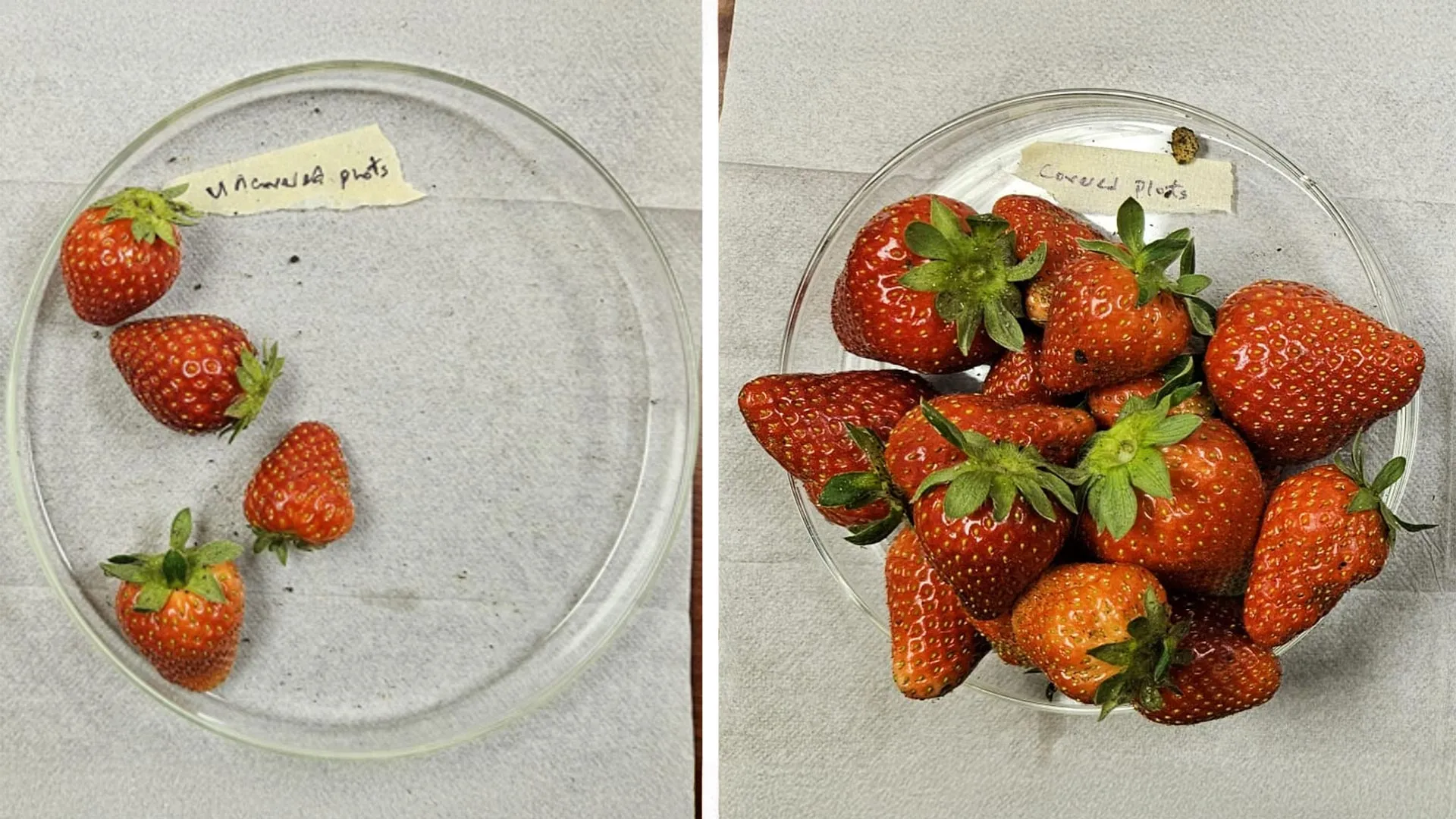
The final phase of the trials provided the most striking results. When the strawberries were harvested, the plants protected by Plant Armor produced yields up to 3.56 times higher than the control group. This massive increase in productivity was not achieved through fertilizers or growth hormones, but through the optimized management of the plant’s micro-environment.
Expert Perspectives: Bridging Science and Agriculture
The success of the project is largely attributed to the collaborative spirit fostered at NC State, involving experts from the College of Natural Resources, the Wilson College of Textiles, and the College of Agriculture and Life Sciences.
"To produce fruit, plants need sunlight," said Gabriel Olawuyi, lead author of the study published in the journal Agriculture. "We expected that Plant Armor’s seemingly opaque fabric would lead to an increase in vegetative biomass at the expense of fruiting—because reduced sunlight would trigger a ‘shade-avoidance’ response. However, we found the fabric did not impede access to light at all, and fruit production increased significantly."
R. Michael Roe, the William Neal Reynolds Distinguished Professor at NC State, views the project as a highlight of his career. "The path to Plant Armor started with trying to make a cloth to go on a soldier’s chest to make body armor more comfortable," Roe noted. "Then, through trial and error, we arrive at a product which could triple the output of strawberry farms here in North Carolina. We couldn’t have predicted that when we started. Without all these people here doing research and following the science, we wouldn’t have arrived at this product."
The Economic and Environmental Implications
The implications of this technology extend far beyond a simple increase in crop yield. As the global population continues to climb, the pressure on agricultural systems to produce more food with fewer resources has reached a breaking point.
Reducing Chemical Dependency
Perhaps the most significant long-term benefit of Plant Armor is its potential to mitigate the reliance on conventional pesticides. By creating a physical, impenetrable barrier, the textile naturally suppresses insect infestations. If widely adopted, this could lead to a substantial reduction in the volume of chemicals introduced into the food chain and the local ecosystem, preserving beneficial insects like pollinators that often suffer from indiscriminate pesticide use.
Water Conservation
In addition to pest control, the micro-climate created by the fabric helps to moderate evaporation rates. By keeping the soil moisture levels more stable, the textile could theoretically allow farmers to reduce their irrigation frequency, a critical advantage in regions prone to drought or water scarcity.
Commercial Viability
The research team has already secured a patent for the "Plant Armor Gen 2" fabric (US Patent No. 11,582,968 B2), and the technology is currently being licensed for commercial development. By making this product available to the wider agricultural community, NC State aims to provide small-scale and commercial farmers with a robust tool to increase their competitiveness and sustainability.
Looking Ahead: The Future of Agricultural Textiles
The success of Plant Armor serves as a roadmap for future agricultural innovation. It underscores the fact that the next "green revolution" may not come from genetic modification or synthetic additives, but from intelligent design and material science.
As the team continues to refine the technology, further research is planned to determine if similar textile structures can be adapted for other crops. Could a variation of the fabric protect peppers, tomatoes, or leafy greens? The potential for scaling the technology is immense, particularly in regions where environmental stressors like extreme heat or pest pressure make traditional farming difficult.
The research was supported by the North Carolina Agricultural Foundation and the U.S. Department of Agriculture’s National Institute of Food and Agriculture, signaling strong institutional backing for the project. With the patent in place and commercial pathways opening, Plant Armor is poised to transition from a successful field experiment into a staple of modern agriculture.
In conclusion, the story of Plant Armor is a powerful reminder of the hidden potential within scientific research. By taking a problem—the discomfort of soldiers—and transforming it into a solution for a global challenge—food security—the researchers at NC State have demonstrated that when scientists from disparate fields are empowered to collaborate, the results can be truly transformative. The strawberry fields of the future may soon be defined not by the chemicals they use, but by the innovative textiles that guard them.