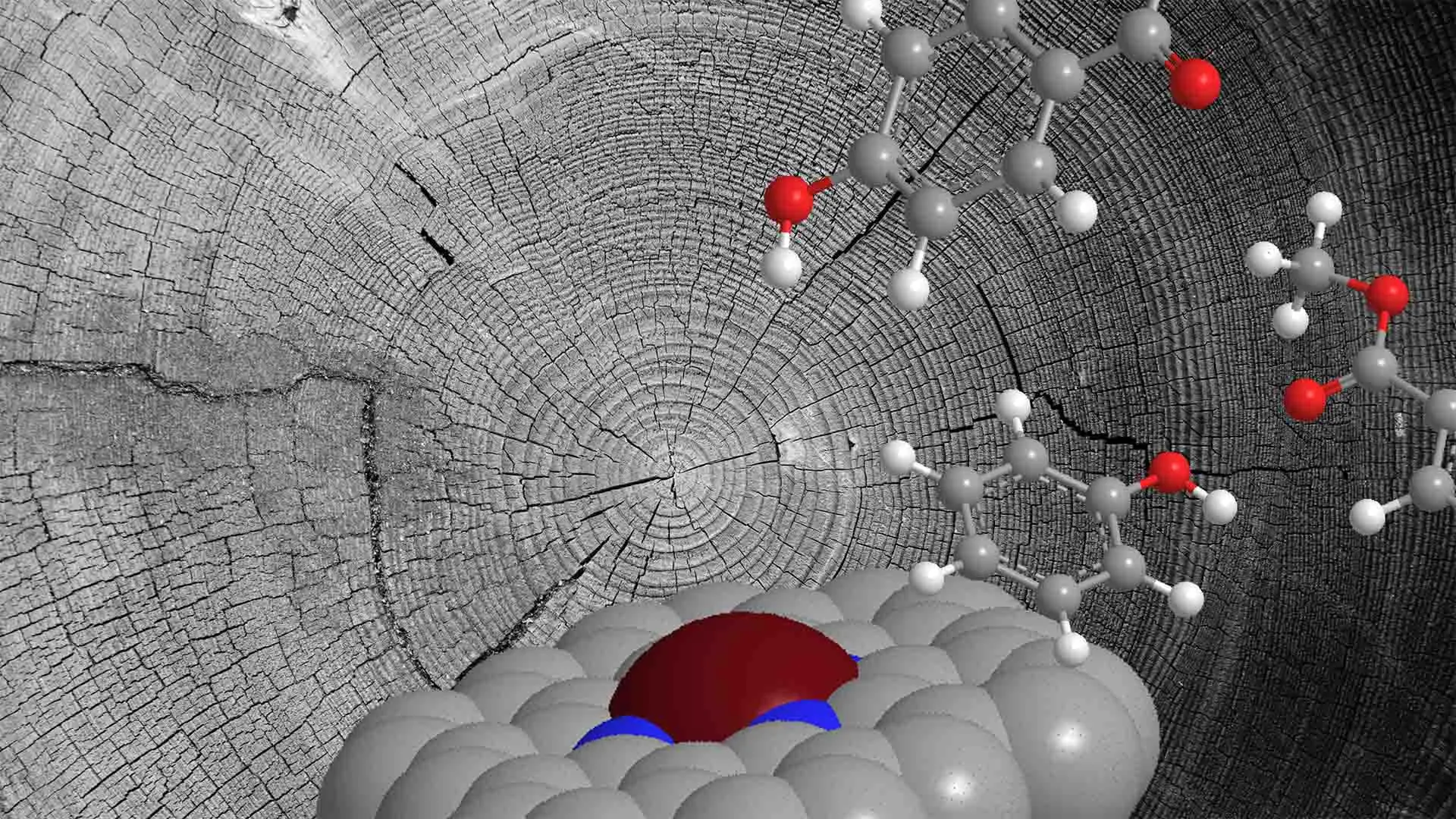
In the quest to move beyond a fossil-fuel-dependent economy, scientists have long looked toward the massive, untapped potential of biomass. Among the most promising—yet frustratingly elusive—resources is lignin. A complex organic polymer that provides structural integrity to plants and trees, lignin accounts for up to 35% of waste biomass generated by the agricultural and forestry industries. Despite its abundance as the largest renewable source of aromatic chemicals in nature, its molecular architecture is so notoriously robust that it has remained a persistent "bottleneck" in sustainable manufacturing.
However, a landmark study published in the journal ACS Catalysis may have finally provided the key to unlocking this resource. An international research team, featuring Dr. Christopher Parlett, Xinyue Zhou, and Yutao Jiang from the Department of Chemical Engineering, has successfully developed a "single-atom catalyst" capable of dismantling lignin with unprecedented precision and efficiency. By revealing the atomic-level mechanics behind this process, the team has paved the way for a more circular, biomass-based industrial future.
The Lignin Challenge: A Molecular Fortress
Lignin is nature’s own scaffolding. It is the material that allows trees to grow tall and grasses to withstand the elements, acting as the "glue" that binds cellulose and hemicellulose fibers together. Because of its irregular, cross-linked, and highly stable chemical structure, lignin is exceptionally difficult to break down.
In industrial biorefineries, lignin is often viewed as a low-value byproduct. While cellulose can be easily converted into biofuels, lignin is frequently burned for low-grade heat, effectively wasting a treasure trove of aromatic compounds—the very building blocks needed to synthesize plastics, pharmaceuticals, and advanced fuels. Conventional methods to break down lignin often require high temperatures, extreme pressures, or corrosive chemical reagents, which are both economically unfeasible and environmentally detrimental.
Chronology of a Breakthrough
The journey to this discovery was one of meticulous design and rigorous validation, spanning several years of collaboration between materials scientists and chemical engineers.
Phase 1: The Design of the Single-Atom Catalyst
The team’s primary innovation lies in their approach to catalysis. Rather than using large, clumpy metal nanoparticles, which often waste precious metal resources and offer unpredictable surface reactivity, the team focused on "single-atom catalysis." By dispersing individual ruthenium atoms within a nitrogen-doped carbon matrix, they created a catalyst that maximizes the utility of every single metal atom. This design allows for high catalytic performance while utilizing a minimal amount of ruthenium, significantly reducing costs and material waste.
Phase 2: Identifying the "Ru-N4" Site
For years, the field struggled to pinpoint which specific features of a catalyst were responsible for the high-efficiency degradation of lignin. The research team utilized advanced spectroscopic techniques and computational modeling to look closer than ever before. They discovered the "Ru-N4 site"—a specific atomic arrangement where a single ruthenium atom is coordinated by four nitrogen atoms within the carbon support. This site acts as the "active engine" that facilitates the reaction.
Phase 3: Unveiling the Mechanism
Through a synthesis of laboratory experimentation and density functional theory (DFT) modeling, the team reconstructed the reaction mechanism. They found that the Ru-N4 site acts as a bridge for oxygen molecules. The catalyst activates oxygen, creating highly reactive species that systematically "attack" the robust carbon-oxygen and carbon-carbon bonds within the lignin polymer. This surgical approach breaks the long, complex chains of lignin into smaller, high-value aromatic molecules.
Phase 4: Scaling to Real-World Biomass
Moving beyond controlled laboratory simulations, the final phase of the study involved testing the catalyst against real-world biomass samples. The team processed lignin extracted from various agricultural waste streams, successfully converting these crude, messy samples into refined aromatic compounds. This final validation proved that the catalyst was not just a theoretical success, but a robust tool for real-world applications.
Supporting Data: Efficiency and Yield
The performance metrics reported in ACS Catalysis highlight the superiority of this new approach compared to conventional catalytic systems:
- Conversion Rates: Under optimized conditions, the catalyst achieved near-total conversion of model lignin compounds.
- Selectivity: The process produced high yields of valuable chemicals, most notably phenol, which is a critical precursor for resins, adhesives, and engineering plastics.
- Mild Reaction Parameters: Unlike traditional methods that require extreme heat and high-pressure hydrogen gas, the new catalyst functions under relatively mild conditions. By eliminating the need for harsh chemicals, the process significantly lowers the carbon footprint and operational costs of the conversion.
- Atom Economy: By isolating ruthenium atoms, the team achieved a "100% utilization" of the active metal sites, contrasting sharply with traditional nanoparticle catalysts where many atoms are buried inside the particle and remain inactive.
Official Responses: Insights from the Lab
Dr. Christopher Parlett, a Lecturer in Chemical Engineering and a lead contributor to the project, emphasizes that the discovery is as much about understanding as it is about invention.
"Understanding exactly how these catalysts work at the atomic level allows us to design better materials for converting renewable resources into valuable chemicals," Dr. Parlett noted. "For too long, we have treated biomass conversion as a ‘black box’ process. By shedding light on the mechanics of the Ru-N4 site, we are providing a blueprint for the next generation of catalytic materials."
The collaborative nature of the study, involving experts from across the globe, underscores the interdisciplinary challenge of the research. Yutao Jiang, a key researcher on the project, highlighted the importance of the computational-experimental feedback loop. "The modeling allowed us to predict the behavior of the catalyst before we even synthesized it," Jiang said. "When the physical experiments matched the computational predictions, we knew we had found a fundamental rule of chemical bonding that we could exploit."
Implications for a Circular Economy
The implications of this research extend far beyond the laboratory, touching upon the urgent need for a transition toward a circular economy.
1. Decoupling from Petroleum
Currently, the chemical industry is heavily reliant on crude oil for the production of aromatic building blocks. By successfully converting lignin—a waste product of paper mills and farms—into these same aromatics, the research provides a viable pathway to decouple chemical manufacturing from fossil fuels.
2. Reducing Waste in Agriculture and Forestry
By giving lignin a high market value, the technology creates an economic incentive to collect and process agricultural waste that is currently left to rot or burned in open fields. This creates a new revenue stream for farmers and forestry managers, turning a disposal burden into a valuable commodity.
3. Sustainable Manufacturing
The use of mild reaction conditions means that chemical plants could potentially operate with lower energy consumption and fewer safety hazards. As manufacturers face increasing pressure to adopt ESG (Environmental, Social, and Governance) standards, technologies that reduce energy intensity and utilize waste streams will become the gold standard for future industrial design.
4. Future Research Directions
The team’s success with ruthenium and nitrogen-doped carbon provides a "template" for future work. Researchers are now looking at whether this Ru-N4 architecture can be applied to other types of biomass or even mixed-plastic waste. The ability to "tune" the atomic environment of a catalyst means that the next generation of materials could be even more selective, potentially producing specific high-value chemicals on demand.
Conclusion: A Turning Point for Green Chemistry
The research published in ACS Catalysis serves as a critical bridge between the theoretical potential of lignin and the practical requirements of the chemical industry. By mastering the art of the "single-atom catalyst," the team has turned one of nature’s most stubborn structures into a versatile asset.
As the global community continues its search for sustainable alternatives to petrochemicals, this study stands as a testament to the power of fundamental chemical engineering. It is a reminder that the solutions to some of our most pressing climate and resource challenges may not lie in creating something entirely new, but in learning how to better dismantle and repurpose the waste that nature has been providing us all along. Through the precision of single-atom engineering, the "lignin revolution" is no longer a distant possibility; it is an emerging industrial reality.