For the vast majority of human history, the 24-hour day has been the bedrock of our existence. It governs our sleep cycles, our global economies, and the very rhythm of civilization. Yet, beneath our feet, a complex, high-stakes physics experiment is constantly unfolding. The Earth does not rotate with the precision of a Swiss watch; instead, it wobbles, shifts, and adjusts, causing the length of our days to fluctuate by mere milliseconds.
While these discrepancies are imperceptible to the average person, they represent a profound mystery that has occupied geophysicists for decades. A new study, published on September 23 in the journal Nature, has finally pulled back the curtain on this subterranean dance, revealing how the planet’s solid inner core and its rocky mantle engage in a gravitational tug-of-war that dictates the pulse of our rotation.
The Core-Mantle Momentum Exchange: A Balancing Act
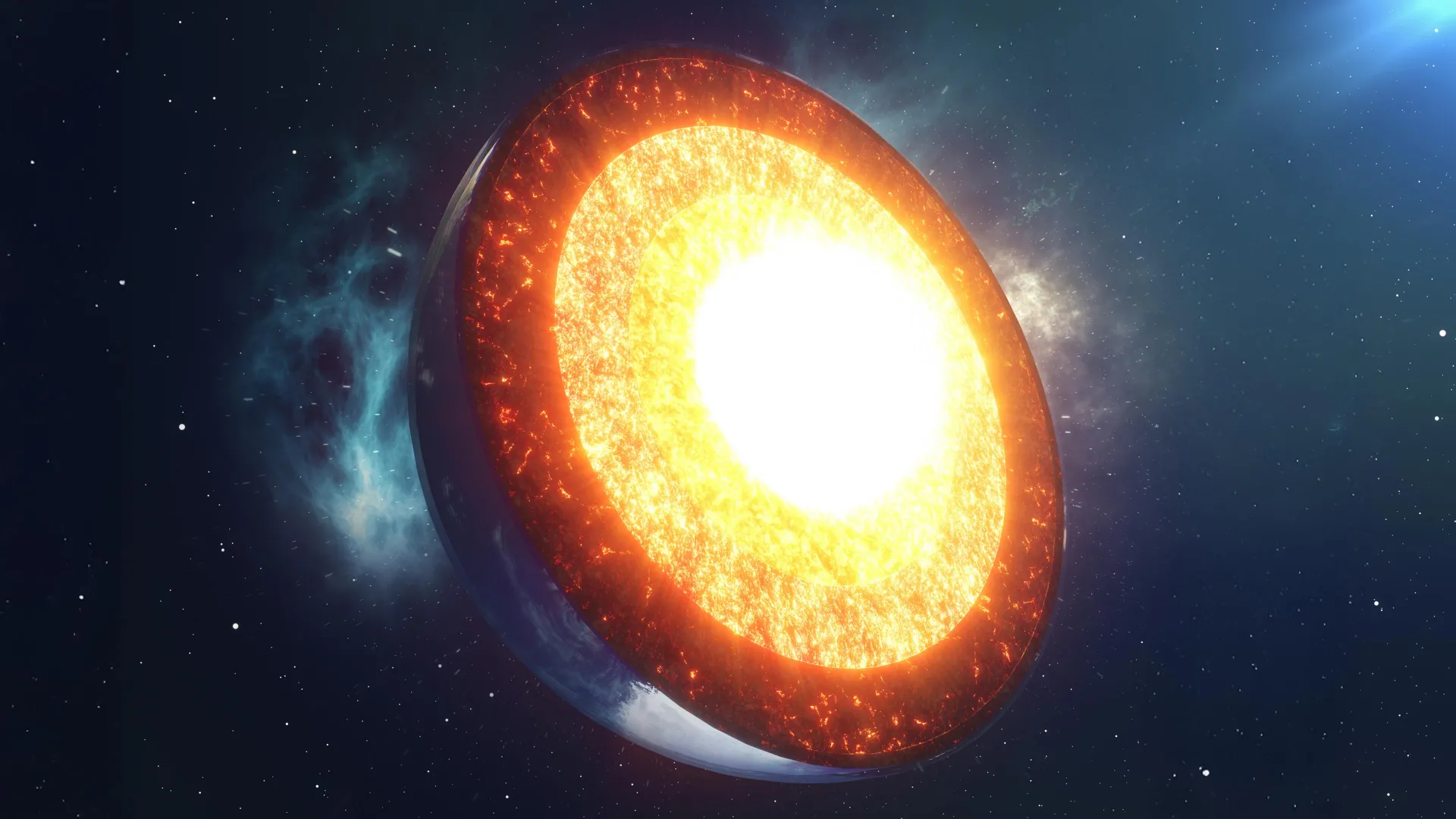
To understand why the length of a day (LOD) shifts, one must first view the Earth not as a static rock, but as a dynamic engine. For roughly thirty years, scientists have observed that the Earth’s liquid outer core—a swirling, turbulent sea of molten iron and nickel—does not rotate in perfect synchronicity with the rest of the planet.
Through meticulous observation of the Earth’s magnetic field, researchers have determined that the liquid core undergoes decadal oscillations. It speeds up over several decades, only to slow down in the years that follow. According to the laws of physics, specifically the principle of the conservation of angular momentum, the Earth must remain balanced. Consequently, when the liquid core accelerates, the mantle—the 3,000-kilometer-thick layer of semi-solid rock that supports our continents—must compensate by slowing down.
Because the mantle provides the frame of reference for our clocks, these subtle adjustments to its rotational speed manifest as microscopic variations in the length of a day. While these changes are measured in mere milliseconds, they provide a rare window into the internal mechanics of a planet that remains, in many ways, more mysterious than the reaches of outer space.
A Hidden Gravitational Tug: The Role of the Inner Core
For years, the mechanism behind this momentum exchange remained a subject of intense debate. How exactly does the core "talk" to the mantle across the vast, deep-seated boundaries of the Earth’s interior?
In their groundbreaking study, Huifeng Zhang, a PhD student, and Professor Mathieu Dumberry of the University of Alberta, have proposed a definitive answer. Their research focuses on the Earth’s innermost region: the solid inner core.
The inner core is not a perfect sphere. It possesses subtle irregularities in its shape and mass distribution. Zhang and Dumberry demonstrate that as the inner core rotates, these irregularities create what is known as a "gravitational torque." Because the inner core is lopsided, its rotation creates a gravitational pull on the uneven mass distribution within the mantle.
This interaction is the missing link in our understanding of Earth’s rotation. When the inner core changes its rotational speed, that gravitational torque exerts a force on the mantle, physically dragging it to speed up or slow down. This discovery marks a shift in how geophysicists model the planet, moving away from viewing the layers as isolated systems toward understanding them as a tightly coupled, interactive machine.
Competing Forces: The Friction of the Deep
However, the Earth’s rotation is not dictated by gravity alone. The researchers point to a second, competing force acting at the boundary between the core and the mantle: the "core-mantle boundary torque."
This force is primarily composed of friction and electromagnetic drag. As the liquid outer core churns, it generates magnetic fields that interact with the base of the mantle. This interaction creates a resistive force that acts in opposition to the gravitational torque generated by the inner core.
The observed variations in the length of a day are essentially the result of a delicate, ongoing negotiation between these two forces. If gravitational torque acts like an accelerator, the core-mantle boundary torque acts like a braking system. The Earth’s rotation speed at any given moment is the net result of this struggle, a constant recalibration that keeps our planet’s rotation within its stable, though not perfectly rigid, limits.
Implications: A More Dynamic Interior
The findings published by Zhang and Dumberry do more than solve a long-standing puzzle regarding our clocks; they fundamentally alter our understanding of the planet’s composition.
One of the most startling revelations of the study is the discovery that the inner core appears to "deform viscously" on a time scale of approximately ten years. In the field of geophysics, "viscous deformation" implies that the solid inner core behaves with a degree of fluidity over long periods, changing its shape to respond to the stresses exerted upon it.
This suggests that the Earth’s deepest interior is far more dynamic than its solid composition might imply. Rather than a static, immutable iron ball, the inner core is a responsive, shifting entity. This fluidity allows it to adapt to the gravitational forces at play, facilitating the transfer of momentum that dictates our day-to-day—or rather, millisecond-to-millisecond—existence.
Chronology of Discovery: From Observation to Theory
The journey to this discovery has been marked by a slow progression of technological and theoretical breakthroughs:
- The 1990s: Scientists first confirm through satellite-based magnetic monitoring that the Earth’s core rotation is not constant, noticing decadal shifts in the magnetic field.
- Early 2000s: Researchers establish the link between these core fluctuations and the variations in the length of a day, though the precise "coupling" mechanism remains theoretical.
- 2010s: Advances in computational modeling allow scientists to simulate the internal stresses between the inner core and the mantle, narrowing down the potential causes of the momentum transfer.
- September 2024: Zhang and Dumberry publish their research in Nature, providing a mathematical framework for the "gravitational torque" theory and identifying the viscous deformation of the inner core.
Expert Analysis and Official Response
The scientific community has received the study with significant interest, noting that it resolves a question that has persisted in the geophysics literature for decades.
"The coupling between the inner core and the mantle has always been a ‘black box’ in our planetary models," said Dr. Elena Rossi, a geophysicist not involved in the study. "By identifying the gravitational torque mechanism, Zhang and Dumberry have provided the missing gear in the clockwork of the Earth. It explains not only the variations in day length but also provides clues about the viscosity and material properties of the core that we simply cannot probe directly with seismic waves."
However, researchers caution that this is only the beginning. The next phase of study will involve integrating these findings into global climate and geophysical models. While a few milliseconds seem negligible, they can have cumulative effects on satellite navigation, global telecommunications, and high-precision timekeeping used in GPS systems.
The Bigger Picture: Why We Measure the Millisecond
Why does the world care about a few milliseconds? In our modern age, precision is everything. Global Positioning Systems (GPS) rely on atomic clocks that are accurate to the nanosecond. When the Earth slows down or speeds up, those small shifts must be accounted for to ensure that satellite signals remain synchronized with the ground.
Organizations like the International Earth Rotation and Reference Systems Service (IERS) are responsible for tracking these shifts and occasionally implementing "leap seconds" to keep our civil time in alignment with the Earth’s actual rotation. Understanding the internal drivers of these shifts, as explained by the interaction between the core and the mantle, allows scientists to better predict these fluctuations rather than simply reacting to them.
Conclusion: A Living, Breathing Planet
The realization that the very length of our day is governed by the viscous, shifting iron core deep beneath our feet is a humbling reminder of our planet’s complexity. We often view the Earth as a solid, stationary stage upon which human history unfolds, but the reality is far more fluid.
The work of Huifeng Zhang and Mathieu Dumberry serves as a bridge between the abstract physics of planetary rotation and the tangible reality of our daily lives. As we continue to probe the depths of the Earth, we are likely to find that the planet is not just a rock, but a living, breathing system of forces—a giant, spinning, oscillating mechanism that, even in its smallest adjustments, reminds us of the power and unpredictability of the natural world.
As technology advances, our ability to observe these minute shifts will only grow, potentially unlocking further secrets about the Earth’s magnetic field, its thermal evolution, and the long-term stability of the ground beneath us. For now, we can rest easy knowing that while the Earth may be shifting its weight, the planet remains, as it has for billions of years, a finely tuned, albeit slightly wobbly, clockwork masterpiece.