In a move designed to dismantle the psychological and bureaucratic barriers of the traditional college application process, Michigan has officially launched a statewide direct-admissions initiative. This fall, a diverse coalition of public and private institutions is rolling out "MI College Match," a program that promises to fundamentally alter how students discover their higher education options.
Michigan now joins a growing cohort of at least 17 states attempting to move away from the traditional, anxiety-inducing "apply-and-wait" model. By proactively reaching out to students with offers of admission—rather than waiting for them to navigate complex, multi-layered applications—the state hopes to reverse stagnant enrollment trends and broaden access to higher education for students who may have otherwise counted themselves out.
The Mechanics of the Michigan Model
Unlike some states that possess robust, centralized data infrastructure allowing them to automatically identify and admit students based on high school transcripts, Michigan’s path is more nuanced. Because the state currently lacks a unified data repository that can seamlessly share student performance metrics with universities, the "MI College Match" program requires a proactive step from the student.
Students must first create a profile on the platform, inputting their grade point average (GPA), intended major, and other relevant academic indicators. Once this digital footprint is established, the platform connects the student with participating colleges that match their criteria. Offers of admission begin to flow in as early as mid-September.
This model is a collaborative effort between the Michigan College Access Network (MCAN), a nonprofit dedicated to increasing college-going rates, and EAB, an enrollment-management firm. EAB previously piloted a similar program in Alabama, where the results were striking: over 12,000 students received admissions and scholarship offers totaling more than $5.1 billion.
A Chronology of the Direct Admissions Movement
The rise of direct admissions is not a sudden trend but the result of years of frustration with declining enrollment rates and a widening equity gap in higher education.
- The Pre-Digital Era: For decades, the college search process was defined by a high-friction, "high-stakes" application culture. Students were expected to research schools, manage disparate deadlines, write multiple essays, and wait months for acceptance letters, often incurring high application fees along the way.
- The Rise of Niche and Common App: In the early 2020s, private entities like Niche and the Common App began experimenting with direct-admissions models. These platforms allowed colleges to "hand-pick" students based on profiles, effectively reversing the traditional power dynamic of admissions.
- The Alabama Proof of Concept: In 2023, EAB launched its statewide initiative in Alabama. The program demonstrated that direct admissions could successfully bridge the gap between institutions and students who were not previously on their radar. A review of five Alabama campuses showed that nearly half of the students who engaged with these direct offers had never appeared on the universities’ original prospect lists.
- The Michigan Pivot (2024–2025): Building on the success of the Michigan Assured Admission Pact—an existing agreement where colleges committed to admitting any Michigan high school graduate with at least a 3.0 GPA—state leaders realized they needed a better delivery mechanism. The launch of MI College Match this fall represents the maturation of this effort, integrating financial aid information with the admissions process to create a holistic value proposition for families.
Supporting Data: Why Geography and Access Matter
The necessity of a localized, state-driven model is supported by geography. According to research from the Institute for College Access & Success (TICAS), approximately seven in 10 U.S. undergraduates attend an institution within 50 miles of their home. This data point underscores why statewide programs like Michigan’s—which prioritize in-state colleges—are critical for student success.
The financial incentive is equally compelling. For many students, particularly first-generation learners, the perceived cost of private education acts as a massive deterrent. By providing students with early, clear information regarding merit scholarships and state financial aid, the program aims to dispel the myth that private institutions are inherently "out of reach."
Data from the Alabama program suggests that this isn’t just a marketing ploy; it is a vital tool for social mobility. By removing the fear of rejection, schools can engage with students who possess the academic ability to succeed but lack the confidence or guidance to initiate the application process themselves.
Official Perspectives: The Institutional and Policy View
For university administrators, the transition to direct admissions is a shift from transactional enrollment to relationship-building.

Shane Lewis, director of admissions at Oakland University, views the program as a remedy to the growing problem of "college-going decay" in Michigan. "In our mind, direct admission is going to remove any of the perceived barriers, so we can make the journey of the college-search process smoother," Lewis noted. "It removes that rejection fear earlier in the process."
The enthusiasm extends to the private sector as well. Mandy Konkle, vice president of enrollment management at Albion College, argues that the program allows colleges to get "the transactional piece" out of the way early. "We want to start building relationships with students, which is our strong suit, earlier in the process," Konkle said.
Similarly, Karlyn Crowley, president of Kalamazoo College, emphasizes the transparency the platform provides regarding career outcomes and return on investment. "Families and students keep telling us they want to know about cost… It allows us to tell them earlier, ‘You actually have an affordable path here that you might not have realized.’"
The Debate: Is the Profile a Barrier?
Despite the optimism, the model faces academic scrutiny. Taylor Odle, an assistant professor of educational policy studies at the University of Wisconsin at Madison, has raised concerns that requiring students to build a profile "goes against the spirit of direct admission."
"We are kind of feeling a little bit of friction against that whole guiding purpose of direct admissions: simplify the process," Odle noted. He worries that as platforms become more complex, they may simply replace the "old application" with a "new portfolio," thereby maintaining an administrative burden that continues to alienate the most vulnerable students.
Ryan Fewins Bliss of MCAN acknowledges this tension but maintains that the current infrastructure in Michigan makes a profile-based system the only viable path forward. To mitigate this, MCAN is leveraging its network of over 300 K–12 schools to ensure that the profile creation process is integrated into the existing school-day workflow, much like the Free Application for Federal Student Aid (FAFSA).
Implications for the Future of Higher Education
The success of the Michigan initiative will likely serve as a litmus test for other states struggling with similar data infrastructure constraints. If the program succeeds in boosting enrollment among underrepresented populations, it will solidify direct admissions as a standard, rather than experimental, practice in American higher education.
The broader implications are profound:
- Normalization of Access: By shifting the burden of initiation from the student to the institution, higher education is signaling that it is a service to be accessed rather than a prize to be earned through exhaustive paperwork.
- Financial Transparency: As these programs evolve, they are increasingly forcing colleges to lead with financial aid offers. This early transparency is essential for "kitchen table" conversations, where families often rule out institutions based on sticker price alone.
- Institutional Survival: For many small to mid-sized colleges, the ability to bypass traditional, competitive application channels is a matter of survival. Direct admissions provides a stable pipeline of students, allowing institutions to focus on retention and graduation rather than just recruitment.
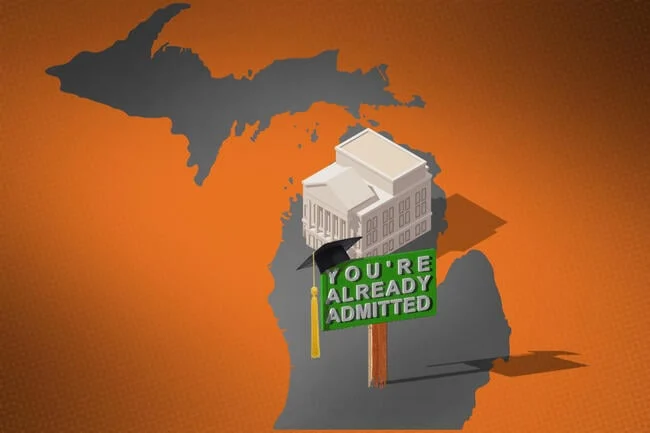
As Michigan embarks on this new phase, the eyes of the higher education sector are watching. The "MI College Match" program is more than just a software platform; it is an attempt to redefine the social contract between the state, its universities, and its students. If it succeeds, the "you’re already admitted" sign—now a symbol of a new era—may become the standard for every high school graduate in the country.