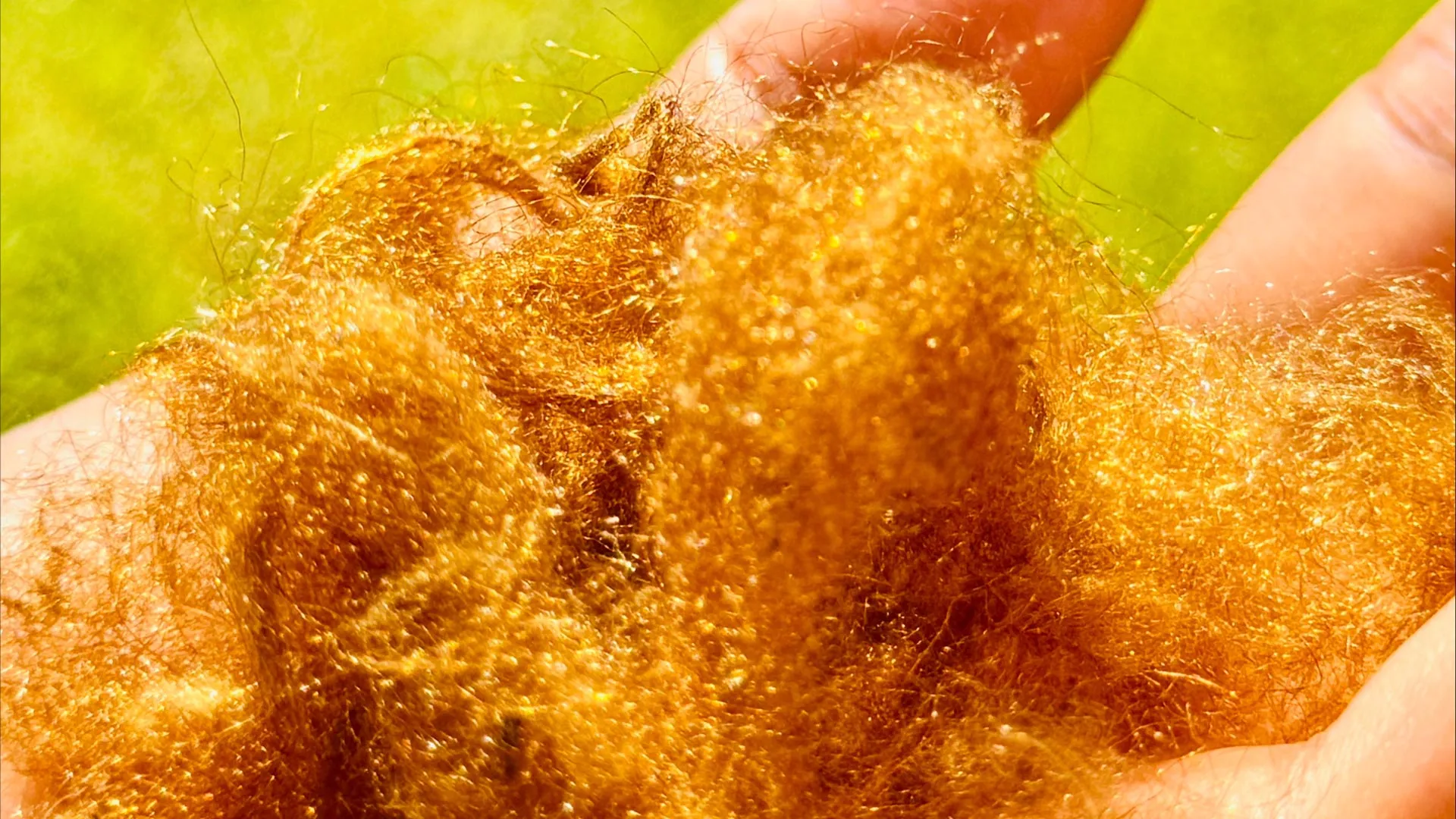
For centuries, a shimmering, ethereal fabric known as "sea silk" sat at the pinnacle of human luxury. Reserved for the vestments of popes, the crowns of emperors, and the wardrobes of the Mediterranean elite, this legendary textile possessed a luster that defied the limitations of natural dyes. It was a material born from the depths of the ocean, whispered about in myths, and prized for its near-supernatural ability to retain its brilliance for millennia.
For a long time, the secret of its creation seemed destined to be lost to history—a victim of environmental collapse and the slow march of time. However, a groundbreaking study from South Korea has not only successfully synthesized this ancient marvel but has also decoded the physical architecture that gives it its iconic, unfading golden glow.
The Main Facts: A Convergence of Marine Biology and Material Science
A research team led by Professor Dong Soo Hwang of the Division of Environmental Science and Engineering and the Division of Interdisciplinary Bioscience & Bioengineering at POSTECH (Pohang University of Science and Technology), in collaboration with Professor Jimin Choi of the Environmental Research Institute, has achieved what was once thought impossible: the artificial recreation of sea silk.
Using the byssus threads of the pen shell (Atrina pectinata)—a species widely cultivated in the coastal waters of Korea—the team has produced a fiber that mirrors the physical and chemical characteristics of the legendary Mediterranean sea silk. Their findings, recently published in the prestigious journal Advanced Materials, represent a landmark achievement in biomimetic material science. Beyond the mere synthesis of the thread, the study reveals that the material’s legendary golden sheen is not the result of pigments or dyes, but rather a sophisticated form of "structural coloration" governed by microscopic protein arrangements.
The Chronology: From Roman Imperialism to Modern Extinction
To understand the magnitude of this discovery, one must look at the long, storied history of sea silk, known in antiquity as byssus.
The Era of Antiquity and the Middle Ages
Sea silk was first documented in the Mediterranean, where it was harvested from the Pinna nobilis, a massive bivalve mollusk. The "threads" are actually the animal’s byssus, a bundle of proteinaceous filaments used to anchor the creature to the rocky seabed. Since the time of the Romans, these fibers were harvested, cleaned, and spun into a textile that was lighter than silk and stronger than wool. Because the yield from a single clam was minuscule, the fabric became a symbol of extreme wealth and status.
The Religious Significance
Perhaps the most famous testament to the durability of sea silk is the "Holy Face of Manoppello," a religious relic in Italy. For centuries, pilgrims have gazed upon this veil, which displays an image that seems to vanish and reappear depending on the lighting. The relic is widely believed to be composed of sea silk, standing as an enduring example of how the material resists the degradation that claims most organic textiles over time.
The Environmental Collapse
In the 20th and 21st centuries, the fortunes of the Pinna nobilis took a catastrophic turn. Due to a combination of marine pollution, climate change, and the spread of invasive pathogens, the species was pushed to the brink of extinction. Today, the European Union classifies the Pinna nobilis as a strictly protected species, banning all harvesting. Consequently, the art of producing traditional sea silk—which requires the delicate extraction of byssus—has all but vanished, practiced by only a handful of artisans in Sardinia and other Mediterranean pockets.
Supporting Data: Decoding the "Photonin" Mechanism
The most significant contribution of the POSTECH research team is the revelation of why sea silk remains gold long after it has been harvested. In conventional textiles, color is added via chemical dyes, which inevitably break down when exposed to ultraviolet light, oxygen, or moisture.
The Physics of Color
The researchers discovered that the color of sea silk is entirely structural. Within the fiber, there exist layered spherical protein structures that the team has dubbed "photonin." These structures function like a natural optical device. Much like the iridescent wings of a butterfly or the thin-film interference seen in a soap bubble, these protein spheres manipulate the wavelength of incoming light.
By precisely controlling the arrangement of these proteins, the fiber forces light to reflect in a way that produces a deep, metallic golden hue. Because this color is a physical property of the material’s structure rather than a chemical additive, it is virtually impervious to the chemical degradation that causes standard dyes to fade. The research team’s data indicates that the tighter and more organized these "photonin" structures are, the more vibrant the resulting gold becomes.
Official Responses and Scientific Perspective
The implications of this study are being viewed with enthusiasm by the global scientific community. Professor Dong Soo Hwang, the lead investigator, emphasized that the project serves a dual purpose: honoring history while advancing sustainable manufacturing.
"Structurally colored textiles are inherently resistant to fading," Professor Hwang noted in a formal statement. "Our technology enables long-lasting color without the use of dyes or metals, opening new possibilities for sustainable fashion and advanced materials."
The researchers highlighted that their method does not rely on the endangered Mediterranean clam. Instead, they utilized Atrina pectinata, a pen shell that is already an established part of the food supply chain in South Korea. By repurposing the byssus threads—which are typically discarded as a byproduct of the seafood industry—the team has successfully turned marine waste into a high-value, culturally significant textile.
Implications: A New Horizon for Sustainable Materials
The successful synthesis of sea silk is more than a nostalgic nod to Roman luxury; it is a blueprint for the future of the textile industry.
Addressing the Dye Crisis
The textile industry is one of the world’s largest consumers of water and a major source of chemical pollution. The use of synthetic dyes and heavy-metal fixatives poses significant risks to aquatic ecosystems. By shifting toward "structural color," where the physical form of the material dictates its appearance, manufacturers could potentially eliminate the need for toxic chemical processes.
Circular Economy and Marine Waste
The repurposing of pen shell byssus is a perfect example of a circular economy. Millions of tons of marine byproducts are discarded annually. The POSTECH study provides a framework for how these waste streams can be upcycled into premium materials. By utilizing existing, non-endangered shellfish, the team has avoided the ethical pitfalls associated with traditional sea silk harvesting, ensuring that the luxury of the past can be enjoyed without sacrificing the biodiversity of the present.
Advanced Applications
Beyond the world of high fashion, the research into "photonin" protein structures could have applications in specialized fields such as optical sensing, camouflage, and long-term data storage. If a protein structure can be engineered to reflect light in a specific way that remains stable for centuries, the technology could eventually be adapted for use in environments where electronic or chemical displays would fail.
Conclusion
The "golden fiber of the sea" has journeyed from the dark, craggy floors of the Mediterranean to the sterile, precise laboratories of South Korean bioengineers. By unmasking the secret of the protein-based structural coloration, Professor Hwang and his team have done more than solve a historical puzzle; they have provided a roadmap for a more sustainable future.
As we look toward an era where the environmental cost of fashion is under intense scrutiny, the resurrection of sea silk reminds us that nature often holds the most elegant solutions to our modern challenges. The threads of the future, it seems, may well be woven from the overlooked remnants of the past, shimmering with a color that is not painted on, but built into the very essence of the fiber.