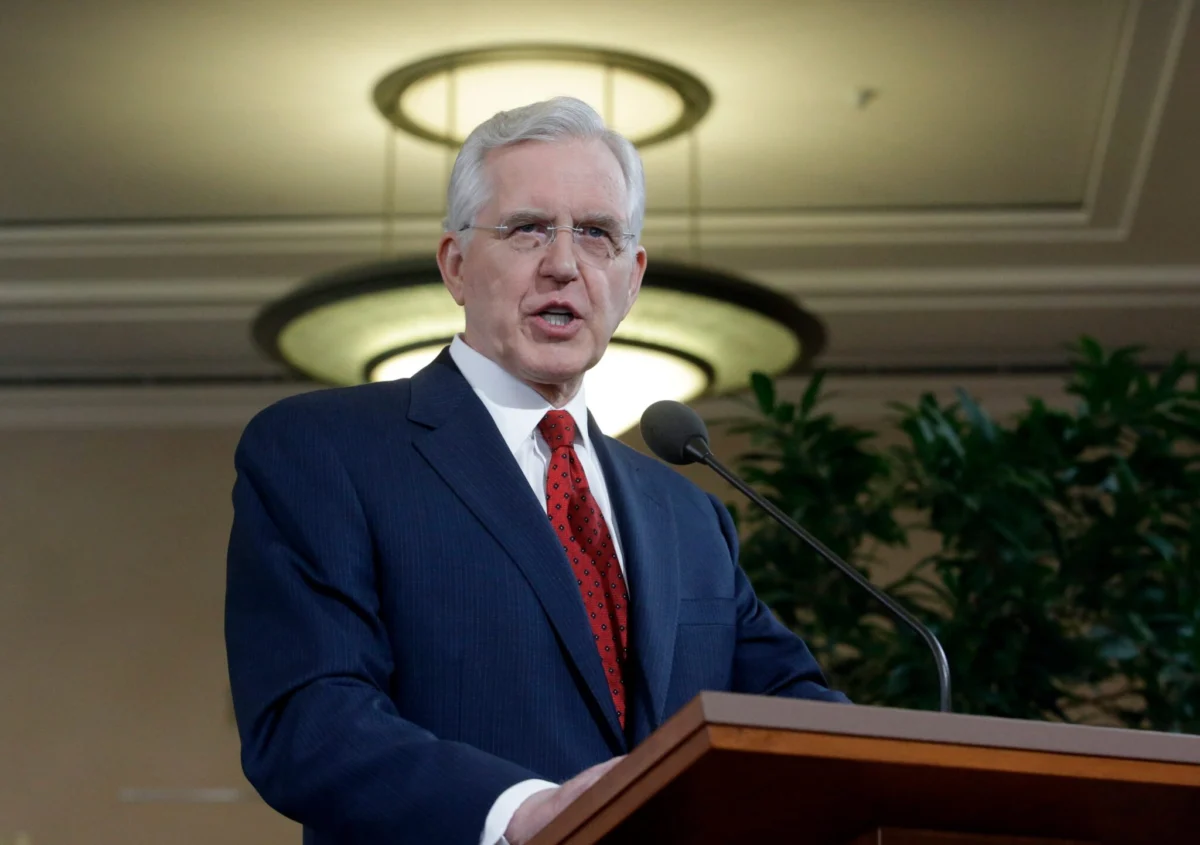
SALT LAKE CITY — In a move that signals a deepening rift between traditional religious morality and the rapidly evolving landscape of digital finance and entertainment, a high-ranking leader of The Church of Jesus Christ of Latter-day Saints (LDS) issued a blistering condemnation of the modern gambling industry on Saturday. Speaking at the faith’s twice-annual general conference, D. Todd Christofferson, a member of the Quorum of the Twelve Apostles, warned that an “explosion in gambling” is currently eroding the moral fabric of society, specifically targeting the younger generation through online prediction markets and sports betting.
Elder Christofferson’s address was not merely a reiteration of long-standing church policy; it was a targeted response to the emergence of "prediction markets"—platforms where users bet on real-world outcomes ranging from political elections to weather patterns. By labeling these platforms as gambling, the church has placed itself in direct opposition to federal trends and specific political arguments that seek to categorize these markets as legitimate financial tools.
Main Facts: The "Something for Nothing" Dilemma
The crux of Elder Christofferson’s message centered on the spiritual and societal hazards of seeking wealth without labor. He argued that the proliferation of gambling, facilitated by the ubiquity of smartphones, is fostering a culture of greed and "nothing of value."
“For us as Latter-day Saints, overarching all other concerns is the fact that gambling is morally wrong,” Christofferson declared to a global audience of millions. “Gambling is built on the desire to obtain something for nothing.”
The Church of Jesus Christ of Latter-day Saints has long maintained a strict prohibition on gambling, but Christofferson’s speech highlighted two modern catalysts: sports betting and prediction markets like Kalshi and Polymarket. These platforms allow users to place wagers on a dizzying array of topics, including the outcome of Supreme Court cases, the timing of interest rate hikes, or even, as Christofferson noted with a touch of irony, the timing of the Second Coming of Christ.
“Where do you go to collect on that bet?” he asked, highlighting the absurdity and spiritual vacuity the church associates with such wagers.
The warning comes at a time when the gambling industry is experiencing unprecedented growth. Since the 2018 Supreme Court decision that cleared the way for states to legalize sports betting, dozens of states have embraced the industry as a source of tax revenue. However, for the LDS Church, the financial windfall for the state does not justify the perceived "menace" to the individual’s character and family stability.
Chronology: From Prop 8 to the Digital Frontier
The LDS Church’s involvement in public policy and moral debates has undergone a significant evolution over the last two decades. Understanding the context of Saturday’s speech requires looking back at the church’s historical and recent interactions with the law.
- 1895–Present: Since its inception as a state, Utah has maintained some of the strictest anti-gambling laws in the United States. The state constitution prohibits all forms of gambling, a stance deeply rooted in the theology of the LDS Church, which views gambling as a violation of the "law of the harvest"—the principle that rewards should come from honest work.
- 2008: The church faced significant public blowback for its direct involvement in California’s Proposition 8, a ballot measure to ban same-sex marriage. This period marked a turning point in how the church approaches political issues, moving away from mobilizing members for direct activism toward more calculated, behind-the-scenes lobbying and high-level public statements.
- May 2018: The U.S. Supreme Court struck down the Professional and Amateur Sports Protection Act (PASPA), allowing states to legalize sports betting. This triggered the "explosion" Christofferson referenced.
- 2023–2024: Prediction markets like Kalshi and Polymarket gained mainstream traction. While the platforms argue they provide valuable data for economists and pollsters, critics argue they are simply "casinos disguised as exchanges."
- August 2024: A federal judge ruled that Utah officials could enforce the state’s strict anti-gambling laws against prediction markets. This was a significant win for state regulators who argued that these markets violated Utah’s comprehensive ban.
- October 2024: Elder Christofferson’s speech marks the church’s formal entry into the debate over prediction markets, coinciding with a shift in leadership under President Dallin H. Oaks, who assumed the top leadership role last October.
Supporting Data: The Rise of the "Pocket Casino"
The data surrounding the gambling boom supports the church’s concerns regarding the scale of the issue. According to the American Gaming Association, commercial gaming revenue in the U.S. reached a record $66.5 billion in 2023. Sports betting alone saw a 44.5% increase in revenue year-over-year.
More concerning to religious leaders is the demographic shift in gambling habits. A study by the National Council on Problem Gambling found that young adults (ages 18–24) are at a higher risk for developing gambling problems than older adults. The integration of gambling into social media and sports broadcasts has "gamified" the experience, making it more attractive to a generation raised on digital interactions.
In Utah, the legislative response has been swift. In 2024, state lawmakers enacted legislation to further tighten gambling definitions, specifically ensuring that prediction markets fall under the state’s prohibition. This move was intended to close any legal loopholes that tech companies might use to argue their platforms are "financial derivatives" rather than "bets."
Official Responses: A Conflict of Ideology
The LDS Church’s stance puts it at odds with the current federal trajectory and the views of former President Donald Trump’s administration. During Trump’s term, federal regulators and legal arguments often leaned toward the deregulation of financial markets, including platforms that provide predictive data. Proponents of Kalshi and Polymarket argue that these markets are more accurate than traditional polling and provide a hedge against real-world risks.
However, the church’s response is echoed by other major religious bodies, creating a rare moment of ecumenical alignment:
- The United Methodist Church: The denomination’s official position describes gambling as “a menace to society” that “deadens the spiritual life.”
- The Southern Baptist Convention: The largest Protestant denomination in the U.S. has repeatedly condemned sports gambling, declaring it "inconsistent with biblical principles" in a 2024 resolution.
- Islam and Hinduism: Gambling is explicitly forbidden in Islam (haraam) and is widely regarded as a significant vice in Hindu scriptures, associated with the loss of self-control.
- The Catholic Church: While not viewing gambling as inherently sinful, the Catholic Catechism warns that it becomes "morally unacceptable when it deprives someone of what is necessary to provide for his needs and those of others."
Matthew Bowman, a professor of religion and history at Claremont Graduate University, noted that the LDS Church’s intervention is part of a broader trend of religious institutions grappling with the ethical implications of "frictionless" technology. "The rise of predictive markets is just really taking off all across the country," Bowman said. "Institutions are finding that the old barriers—physical casinos or racetracks—have been replaced by a smartphone in every pocket."
Implications: The "Oaks Era" and the Future of Utah Law
The speech by Elder Christofferson is also a bellwether for the church’s political strategy under President Dallin H. Oaks. As a former Utah Supreme Court justice, Oaks brings a legalistic and precise approach to the church’s public stances. Under his leadership, the church has waded into specific legal battles, including opposing abortion rights measures in neighboring Idaho and Nevada.
The implications of this heightened rhetoric are several-fold:
- Stricter Enforcement in Utah: With the church’s moral weight behind them, Utah regulators are likely to become even more aggressive in blocking prediction market apps and sports betting platforms from operating within state lines.
- A New "Moral Front" for Youth: The church is signaling to its younger members that the "gamification" of finance is a spiritual trap. This may lead to new curriculum or youth programs focused on digital literacy and the dangers of online betting.
- Lobbying and Legislation: We can expect the LDS Church to use its "calculated" lobbying influence to support federal legislation that would classify prediction markets as gambling, potentially putting them under the jurisdiction of the Federal Trade Commission (FTC) or state gaming commissions rather than the Commodity Futures Trading Commission (CFTC).
- Cultural Divide: The church’s stance reinforces Utah’s status as a "moral outlier" in a country that is increasingly moving toward the full normalization of gambling. This could create friction as major sports leagues and tech giants continue to push for universal access to betting platforms.
As Elder Christofferson concluded his remarks, he reminded the faithful that the pursuit of "easy money" is a distraction from the higher purposes of life—education, service, and family. In the digital age, the church’s battle is no longer just against the neon lights of Las Vegas, but against the silent, high-speed algorithms of the modern smartphone. For the leaders in Salt Lake City, the stakes of this particular "bet" are nothing less than the character of the next generation.