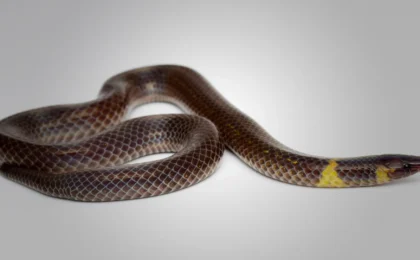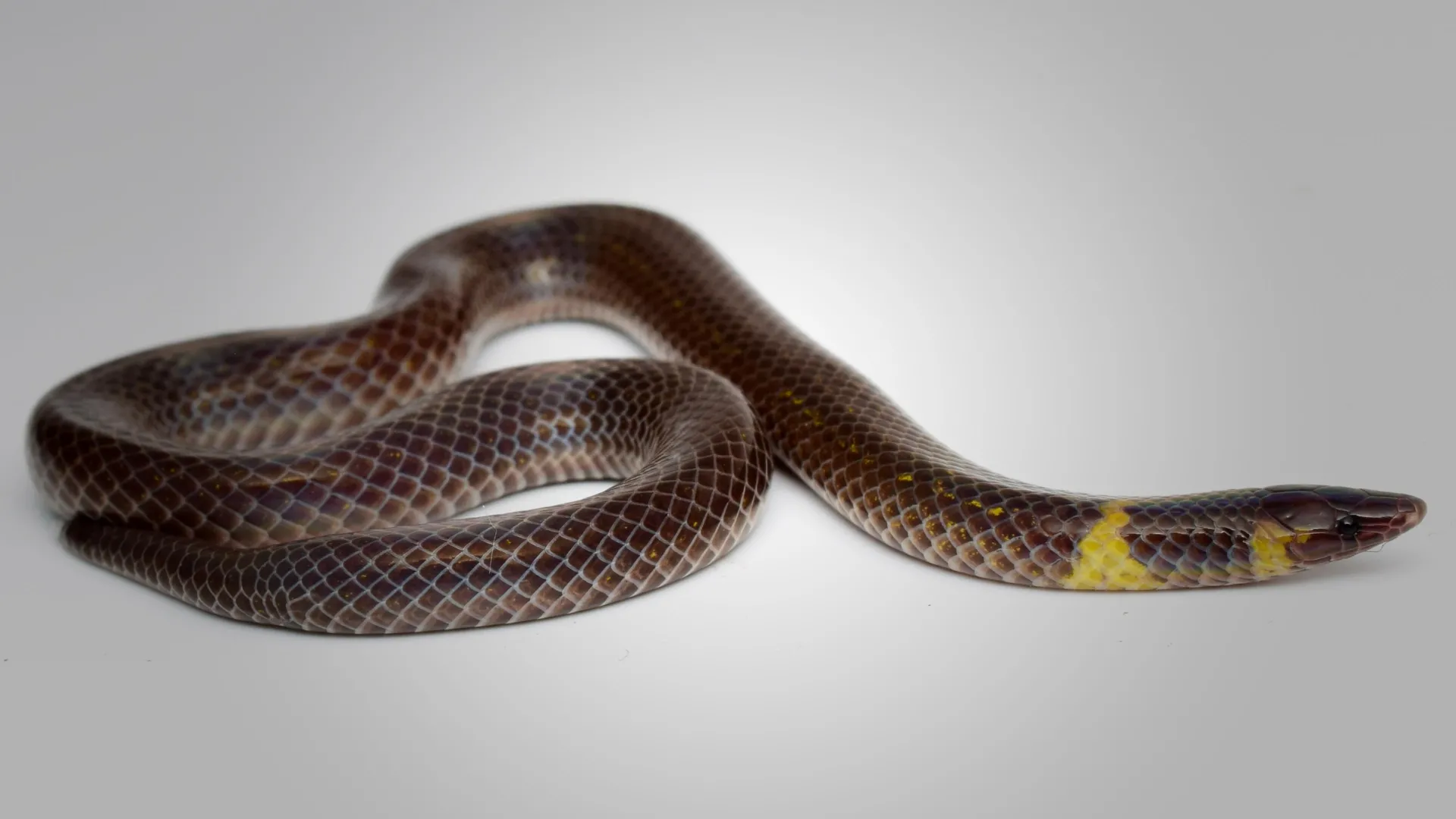
In the dense, leaf-littered undergrowth of Southeast Asia, a diminutive reptile has mastered a form of locomotion that defies the conventional wisdom of evolutionary biology. The dwarf reedsnake (Pseudorabdion), a creature no longer than a pencil, has developed a high-speed escape mechanism that leaves the traditional slithering of its serpentine cousins in the dust. By abandoning the side-to-side undulation typical of most snakes, these tiny predators-turned-prey have evolved the ability to transform their bodies into living wheels, rolling across the forest floor at speeds four times faster than their standard crawl.
This remarkable phenomenon, long observed by field researchers but never fully understood, has finally been decoded by scientists. Through high-speed, multi-angle cinematography, researchers have mapped the precise, rhythmic gymnastics required for a limbless creature to achieve a rolling sprint—a feat that challenges our understanding of animal mechanics.
The Mechanics of Motion: Why Rolling Is an Evolutionary Challenge
To understand the magnitude of the dwarf reedsnake’s accomplishment, one must first consider the physics of the wheel. In human engineering, a wheel is an elegant solution to friction and speed; it spins continuously around a fixed axle, separating the rotating mass from the stationary support structure.
In the animal kingdom, however, this "axle" does not exist. A biological creature is a continuous, integrated system of muscle, bone, and sensory organs. If a standard animal were to attempt to roll, its entire body—including its head, brain, and eyes—would be forced into a continuous spin. This presents a catastrophic problem for navigation: disorientation.
When an animal spins, it loses its equilibrium. Its sensory inputs, such as balance (the vestibular system) and vision, become blurred and rapid, making it impossible to steer or adjust for obstacles. As speed increases, these problems compound, usually resulting in an uncontrolled tumble rather than a directed escape. For most animals, the cost of rolling—loss of directional control and sensory overload—far outweighs the benefits of speed. Yet, the genus Pseudorabdion has evolved a way to circumvent these biological constraints, effectively "decoupling" its head from its rotating torso.
Chronology of Discovery: From Field Guide Anecdote to Scientific Breakthrough
The peculiar behavior of the dwarf reedsnake has been a footnote in herpetological field guides for decades. Early field naturalists reported seeing the snakes "looping" or "rolling" when startled, but these observations were often dismissed as anecdotal or, worse, misinterpretations of erratic thrashing.
The Path to Investigation
- Initial Field Observations: Early 20th-century explorers recorded "rolling" behaviors in Southeast Asian snakes, but the lack of video evidence meant the behavior was rarely studied in a laboratory setting.
- Modern Cinematography: With the advent of high-speed, high-resolution cameras, researchers were finally able to move beyond anecdotal reports. By filming the snakes from multiple angles in a controlled environment, the research team could deconstruct the movement frame by frame.
- Data Synchronization: By aligning the video data with the physical environment (a 20-centimeter-wide racetrack), the team confirmed that the snakes were not just tumbling—they were intentionally steering.
- The Decoding Phase: The most recent breakthrough involved identifying the "stroke" cycle, a specific muscular sequence that allows the snake to switch sides while maintaining a forward trajectory.
Supporting Data: By the Numbers
The quantitative analysis of these snakes reveals a level of performance that is, by any standard, extraordinary for a small reptile.
- Velocity Metrics: In standard lateral undulation (side-to-side slithering), the dwarf reedsnake reaches a modest top speed. When it shifts into its rolling gait, however, it hits peak forward velocities between 1.72 and 3.69 meters per second.
- The Four-Fold Increase: This equates to a roughly 400% increase in speed. For a predator trying to catch a small snake, this sudden burst of velocity acts as a "disappearing act," moving the prey out of the strike zone in a fraction of a second.
- Precision Control: Despite the rapid rotation, the snakes successfully navigated a narrow 20-centimeter racetrack. This precision proves that the rolling is a deliberate, neurologically controlled motor program, not a reflexive seizure or a chaotic panic response.
The secret to this precision lies in the "stroke" pattern. Rather than a continuous, uniform spin, the snake creates a rhythmic cycle. It rolls onto one side, then swings a curved section of its body downward, creating a forceful contact point with the ground. As the cycle progresses, it switches the contact side and the direction of the stroke, creating a continuous, forward-propelling momentum that functions like a makeshift, segmented wheel.
Official Responses and Expert Analysis
Lead researchers on the project have emphasized that the most profound finding was not the speed itself, but the head stabilization.
"The head is the command center," one lead researcher noted during a press briefing. "By decoupling the head from the rotational movement of the body, the snake effectively creates a virtual axle. While the body performs the heavy lifting of rotation, the head remains essentially stationary, pointed forward, maintaining a constant height above the ground."
Experts in biomechanics note that this is a remarkable feat of neuromuscular coordination. The snake must inhibit its natural reflexes to keep its body straight and instead allow it to coil while simultaneously stabilizing its cervical muscles. This separation of function—where the body acts as the engine and the head as the steady navigation system—is a strategy more commonly associated with advanced robotic locomotion than with small squamates.
Evolutionary Implications: Structure Does Not Dictate Destiny
The case of the dwarf reedsnake serves as a powerful case study in evolutionary biology. It challenges the "structure-determines-function" paradigm, which suggests that an animal’s physical form limits its repertoire of movement.
Breaking the Mold
Evolutionary biologists have long argued that specific body plans (like the limbless, elongated body of a snake) dictate a narrow range of possible locomotory strategies. The Pseudorabdion genus proves that behavioral innovation can bridge the gap between body shape and movement.
By employing a sophisticated, learned sequence of muscular contractions, the snake has expanded its physical capabilities without needing to evolve new appendages. This suggests that "innovative behavior" acts as a precursor to evolutionary change. If a behavior provides a significant survival advantage—in this case, escaping predators—the nervous system and muscular architecture will eventually refine that behavior over generations.
The Broader Impact
This discovery also has significant implications for soft-robotics. Engineers designing "snake-bots" for search-and-rescue operations in confined spaces could look to the dwarf reedsnake as a blueprint. The ability to switch between slithering (for navigation in tight gaps) and rolling (for rapid transit across open, flat ground) could revolutionize how we build small-scale autonomous robots.
Conclusion: The Future of Herpetological Research
As researchers continue to study the dwarf reedsnake, the focus will likely shift to the neurological pathways that govern this movement. How does the snake "switch" between these two distinct modes of locomotion? Is it a learned response or a hard-wired survival instinct triggered by specific sensory stimuli?
The rolling reedsnake reminds us that the natural world is full of hidden talents that remain obscured by our own assumptions about how creatures "should" move. It is a testament to the fact that, in the face of survival, nature often finds the most unconventional paths to success. While the dwarf reedsnake may be small, its impact on our understanding of biomechanics is immense, proving that even without a wheel, life can find a way to roll.
[To view the high-speed footage of the dwarf reedsnake’s rolling escape, please visit the official research repository at the link provided below.]