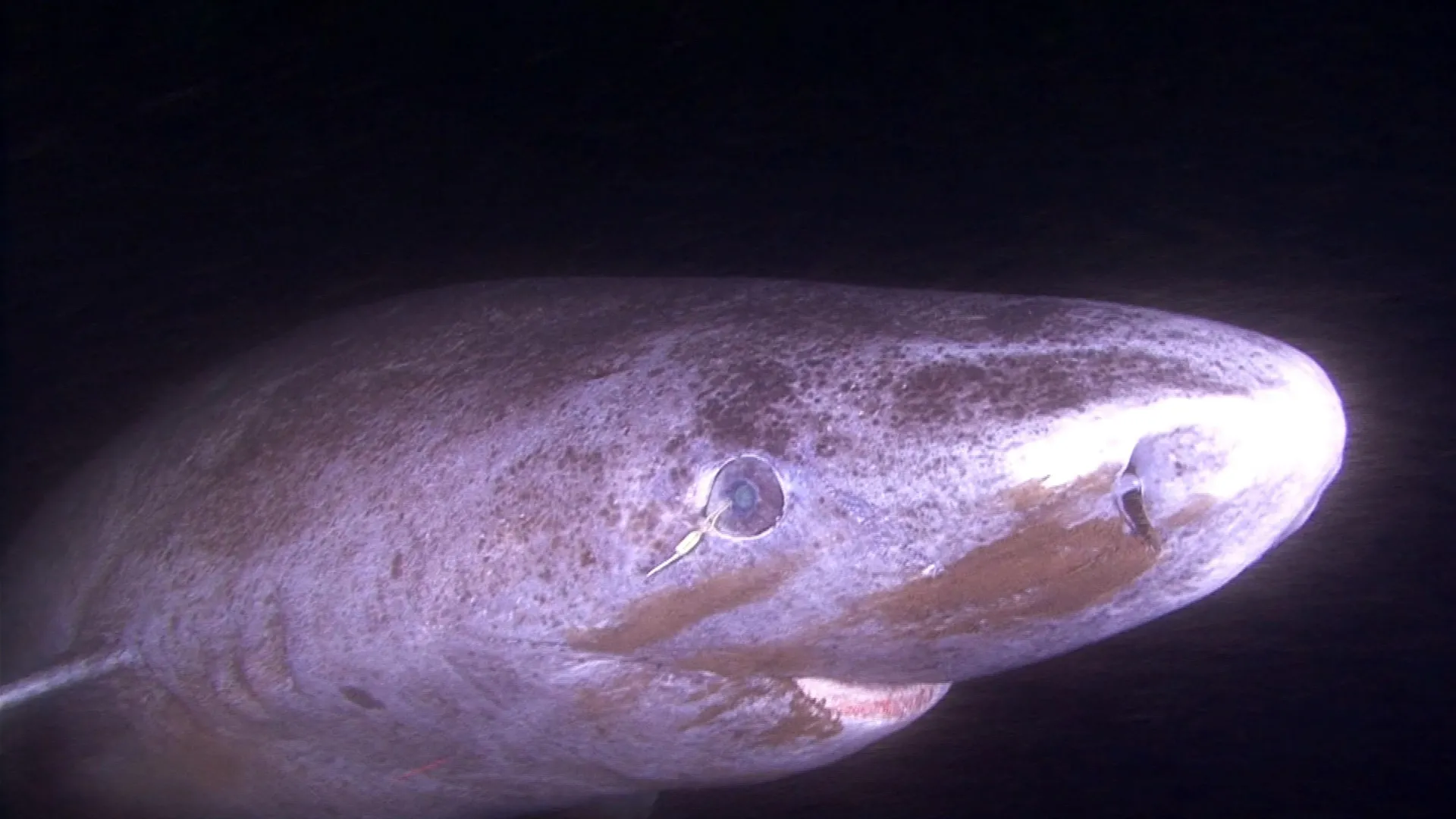
Deep beneath the frigid, ink-black currents of the Arctic, a creature older than the United States Constitution glides through the abyss. The Greenland shark (Somniosus microcephalus) is a biological enigma, a slow-moving phantom that can survive for upwards of 400 years. For decades, marine biologists have been haunted by a singular question: in the absolute darkness of the deep sea, and burdened by parasitic copepods that often cling to their corneas, are these ancient leviathans functionally blind?
New research, led by Dorota Skowronska-Krawczyk, an associate professor of physiology and biophysics at the University of California, Irvine, suggests that we have grossly underestimated the sensory capabilities of these Arctic giants. Far from being sightless wanderers, Greenland sharks possess a sophisticated, resilient visual system that defies the traditional biological rules of aging.
The Myth of the Blind Titan
For years, the scientific consensus regarding Greenland shark vision was largely skeptical. The sharks’ eyes often appear cloudy, obscured by parasitic crustaceans that attach themselves to the ocular surface, effectively turning the eye into a breeding ground for organisms. Coupled with their habitat—the perpetually dark, high-pressure depths of the Arctic Ocean—it was a logical leap to assume that vision was an evolutionary luxury the species had long since abandoned.
"You see it move its eye," says Skowronska-Krawczyk, gesturing to grainy, captivating footage on her computer screen. "The shark is tracking the light. It’s fascinating."
This simple observation—a shark orienting itself toward a light source—was the catalyst for a multi-year, international investigation. If the shark were truly blind, the energetic cost of maintaining such a complex organ would be evolutionarily disadvantageous. As Skowronska-Krawczyk puts it, "Evolutionarily speaking, you don’t keep the organ that you don’t need."
A Chronology of Discovery: From Observation to Laboratory
The journey to understand the Greenland shark’s vision began in earnest following a seminal 2016 paper published in the journal Science by John Fleng Steffensen. That paper confirmed the staggering longevity of the species, but it also highlighted the pervasive eye parasites that led many to conclude the sharks were sightless.
The Collection Phase (2020–2024)
The research team, which included Steffensen of the University of Copenhagen, Peter G. Bushnell of Indiana University South Bend, and Richard W. Brill of the Virginia Institute of Marine Science, conducted field research near the Arctic Station on Disko Island, Greenland. Using scientific long lines, the team carefully captured specimens. The eyes were dissected and immediately preserved in a specialized fixative solution to ensure the integrity of the delicate tissues for transport to laboratories in California and Switzerland.
The Laboratory Analysis
Back at the University of California, Irvine, the challenge of analyzing a "baseball-sized" ancient eyeball fell to the lab team, including Ph.D. student Emily Tom.
"I opened the package, and there was a giant, 200-year-old eyeball sitting on dry ice just staring back at me," Tom recalls. The transition from working on mouse eyes—which are roughly the size of a papaya seed—to a Greenland shark’s eye required a significant shift in methodology. The team had to scale up their histological protocols, ensuring the tissue remained frozen until the exact moment of analysis to prevent degradation.
Biological Resilience: What the Data Reveals
The results of the histological and vision-specific analyses, recently published in Nature Communications, provided a surprising rebuke to the "blind shark" theory.
No Signs of Retinal Degeneration
The most striking finding was the complete absence of cell death in the shark’s retina. In almost all other vertebrates, the aging process is marked by a gradual loss of photoreceptor cells and the accumulation of molecular damage. The Greenland shark, however, appears to have evolved a robust DNA repair mechanism that preserves the health of its retina for centuries.
Specialized Photoreceptors
The researchers discovered that rhodopsin—the essential light-sensitive protein in the retina—remains active and functional even in the oldest specimens. Crucially, this rhodopsin is finely tuned to detect blue light. In the deep-sea Arctic environment, where light is limited to the faintest blue wavelengths, this adaptation is not just useful; it is a critical survival tool that allows the shark to navigate, hunt, and interact with its environment.
Evolutionary Perspectives and Collaborative Science
The study was bolstered by the inclusion of researchers Walter Salzburger and Lily G. Fogg from the University of Basel, Switzerland. Their expertise in the evolutionary aspects of the work provided a broader context for the findings. By comparing the visual systems of the Greenland shark with other deep-sea and long-lived species, the team began to construct a narrative of how specific visual adaptations evolve in response to extreme environmental pressures.
The findings challenge the "wear-and-tear" theory of aging. In most animals, the eye is one of the first organs to show systemic failure. For the Greenland shark, the eye remains a functional, high-performance tool, suggesting that the molecular pathways for longevity are far more complex and efficient than previously understood.
Implications for Human Health
The potential applications of this research extend far beyond marine biology. Skowronska-Krawczyk’s laboratory specializes in age-related eye diseases. By understanding how the Greenland shark prevents retinal cell death over 400 years, researchers hope to uncover new strategies for treating human conditions like macular degeneration and glaucoma.
"We can learn so much about vision and longevity from long-lived species like the Greenland shark," Tom notes. If we can isolate the molecular "shield" that protects these shark cells from the oxidative stress and DNA damage that accompany aging, it could revolutionize ophthalmology. The study raises profound questions about the nature of aging itself: Is cellular senescence inevitable, or is it a process that can be arrested or reversed through the right biological mechanisms?
Official Responses and the Future of Research
Despite the significance of the findings, the path forward is not without hurdles. Skowronska-Krawczyk has been vocal about the uncertainty surrounding federal research funding. In an era where "big science" often requires multi-year commitments, the volatile nature of grant cycles creates an environment of anxiety for researchers working on long-term studies.
However, the team remains undeterred. "What I love about my work is that we are the first in the world to see results—at the forefront, finding new mechanisms, rules and discoveries," Skowronska-Krawczyk says. For her, the joy of the discovery is matched only by the process of mentorship. Training the next generation of physician-scientists, like Emily Tom, is a core component of the lab’s mission.
As the scientific community digests these findings, the image of the Greenland shark has shifted from a blind, scavenging relic to a masterclass in evolutionary adaptation. These sharks are not just survivors; they are time capsules of biological efficiency.
Conclusion: A Window Into Eternity
The study of the Greenland shark serves as a poignant reminder of how much remains hidden in the deep corners of our planet. As we continue to face an aging human population and an increase in age-related pathologies, nature’s most ancient creatures may hold the keys to our own longevity.
By looking into the eye of a 200-year-old shark, researchers have seen a reflection of a future where vision loss is no longer an inevitable byproduct of time. As the footage on Skowronska-Krawczyk’s screen continues to play—the giant shark turning its eye toward the light—it becomes clear that this animal is not just watching the ocean; it is watching us, waiting for us to catch up to the secrets it has held for centuries.
"We will prevail," Skowronska-Krawczyk says with quiet confidence, her eyes fixed on the screen. The shark, meanwhile, continues its silent, centuries-long patrol, its vision clear, its purpose absolute, and its secrets slowly being unraveled by the persistent curiosity of the human mind.