The phrase "the game of life" has permeated our cultural lexicon for over a century. From the parlor games of the Victorian era to the high-stakes, algorithm-driven social comparisons of the 21st century, we have been conditioned to view our existence as a competitive pursuit. We are told to "win," to "get ahead," and to "keep score." But as we become increasingly obsessed with status, career milestones, and the prestige of our social circles, we face a critical question: Have we mistaken a metaphor for reality?
The assertion is simple but profound: Life is not a game. By framing our existence as a zero-sum competition, we are not just missing the point of living—we are actively sabotaging our own well-being.
The Origins of the Metaphor: From Board Games to Boardrooms
To understand our obsession with "winning" at life, one must look at the history of how we gamify our existence. The most iconic representation is Milton Bradley’s The Checkered Game of Life, released in 1860. It was the first popular board game in the United States, designed to teach morality and the pursuit of success. In its original form, the game was remarkably dark, reflecting the rigid Protestant work ethic of the era.
Over the decades, the game evolved through various iterations in the 1960s, 80s, and 90s, shifting from a moral lesson to a commercialized race for wealth, marriage, and retirement accounts. This shift mirrored a broader societal transition. As the 20th century progressed, the "game" became less about virtue and more about tangible, measurable indicators of success: the house in the suburbs, the Ivy League education for one’s children, and the job title that commands respect at a cocktail party.
Today, this board game logic has migrated from our living room tables to our subconscious. We treat our careers, our parenting, and even our leisure time as levels to be conquered. The problem, however, is that while a board game has a rulebook, a clear start, and a definitive winner, the "real world" has no such parameters. The rules are vague, the finish line is non-existent, and the criteria for success are entirely arbitrary.
The Anatomy of a Game vs. The Reality of Life
To understand why this metaphor is flawed, we must define what a game actually is. A game is an activity governed by external rules, where players compete to achieve a goal that has no intrinsic value. It does not fundamentally matter who puts a ball through a hoop more frequently or who captures the most pieces on a chessboard. These activities provide a safe, contained space for competition and fun.
Life, conversely, is an inherently subjective experience. The things that truly constitute a "good life"—ethics, meaningful relationships, intellectual curiosity, and fulfilling work—cannot be quantified or competed over.
The Problem with Quantifiable Success
When we treat life as a game, we naturally prioritize the "scoreable" aspects of our existence. It is easy to compare who has a bigger house, a more expensive car, or a more prestigious professional title. It is impossible, however, to measure who has a "better" relationship or a more "meaningful" sense of fulfillment.
By focusing on the metrics we can measure, we prioritize the trivial over the profound. We sacrifice the depth of our human experience for the sake of the status symbols that act as points on a scoreboard. This creates a culture of "measurable misery," where we are winning the game of status while losing the game of life.
The Corrosion of Connection: Competition as a Barrier
Perhaps the most damaging implication of the "life as a game" mindset is the impact it has on human relationships. Healthy, sustainable relationships are built on mutual support and genuine affection. We should naturally want the people in our lives to succeed, to reach their goals, and to find happiness.
However, when you view life through the lens of competition, everyone else becomes a rival. If your neighbor gets a promotion, it feels like a personal setback. If a friend’s child gets into a top-tier university, it feels like a loss for your own family. This internalizes a zero-sum mentality: if they are winning, you must be losing.
This mindset creates a toxic ambiguity in our relationships. We are forced to balance genuine affection with an underlying sense of envy and defensive rivalry. It becomes impossible to offer unconditional support when you are subconsciously keeping score. This prevents the formation of the deep, vulnerable bonds that are essential to human happiness.
Autonomy and the "Pyrrhic Victory"
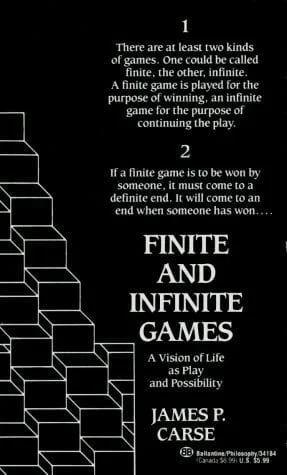
In Finite and Infinite Games, philosopher James Carse posits that there are two types of games: finite games, which are played to be won, and infinite games, which are played to keep the game going. When we treat life as a finite game—a contest to be won—we surrender our autonomy to the "other."
When you define your success by someone else’s standards, you are no longer the author of your own life. You are a player in someone else’s design. If you spend your life chasing money, status, or athletic accolades simply because "society" deems those the metrics of success, you are pursuing a victory that is not your own.
This leads to what historians call a "Pyrrhic victory"—a success that comes at such a devastating cost that it is tantamount to defeat. You may "win" the game by achieving the traditional milestones, but if you have sacrificed your values, your relationships, and your mental health to get there, what have you actually won?
The 99.9% Reality: Preparing for the Inevitable
The most dangerous aspect of the game metaphor is that it guarantees a sense of failure for the vast majority of people. Even in a meritocracy, there is only one top spot. If life is a competition, then 99.9% of the population is, by definition, a "loser."
This creates an environment where failure is treated as a moral failing. In a game, if you lose, you are disqualified or dismissed. In reality, setbacks, frustrations, and failures are not just inevitable; they are the crucible in which we develop character and resilience.
When we view life as a game, every obstacle becomes a source of shame. We feel embarrassed by our lack of progress compared to the "winners." This shame is a paralyzing force. It keeps us from taking risks, from being honest about our struggles, and from finding joy in the simple, quiet moments that actually constitute the majority of our existence.
Implications for Modern Living
The shift away from this competitive framework is not just a philosophical exercise; it is a mental health imperative. To reclaim our lives, we must intentionally pivot our focus:
- Define Success Subjectively: Create a personal "Value Manifesto." What do you prioritize? Is it time with your children? Is it mastery of a craft? Is it service to your community? When you define your own goals, you become immune to the scoreboard of others.
- Practice Radical Support: Actively root for the success of those around you. When a friend succeeds, view it as an expansion of the collective success of your circle, not a subtraction from your own.
- De-gamify Leisure: Ensure that your hobbies remain hobbies. Competition is fun when it is contained. Keep the intensity on the golf course or the basketball court, and leave the scorekeeping out of your marriage, your friendships, and your career path.
- Embrace the "Infinite Game": Focus on processes rather than prizes. Instead of asking, "How do I win this promotion?" ask, "How do I contribute more value and grow in my skills this year?" The former is a finite, competitive pursuit; the latter is an infinite, developmental one.
Conclusion: Living Beyond the Scoreboard
Comparing ourselves to others is a psychological trap with no exit. If you see yourself as inferior, you succumb to insecurity and bitterness. If you see yourself as superior, you succumb to arrogance and disconnection. Neither path leads to a life well-lived.
We must acknowledge that while games are a wonderful way to pass the time and test our mettle in controlled environments, they are a disastrous template for human existence. Your life is not a competition. It is not a series of levels to be passed or a race to the finish line. It is a singular, unrepeatable opportunity to experience the world on your own terms.
Stop playing the game. Start living the life. When you stop looking at the scoreboard, you finally have the freedom to look at the people and the passions that make the journey worth taking.