In the sun-baked, rugged landscape of Central Otago, New Zealand, a silent revolution is taking place beneath the soil. For decades, the St Bathans fossil deposits—the remains of an ancient, sprawling lake system—have served as a treasure trove for paleontologists. Now, a groundbreaking discovery of a previously unknown species of goose is forcing the scientific community to dismantle long-held assumptions about how New Zealand’s iconic and unique bird life first arrived and evolved on these isolated shores.
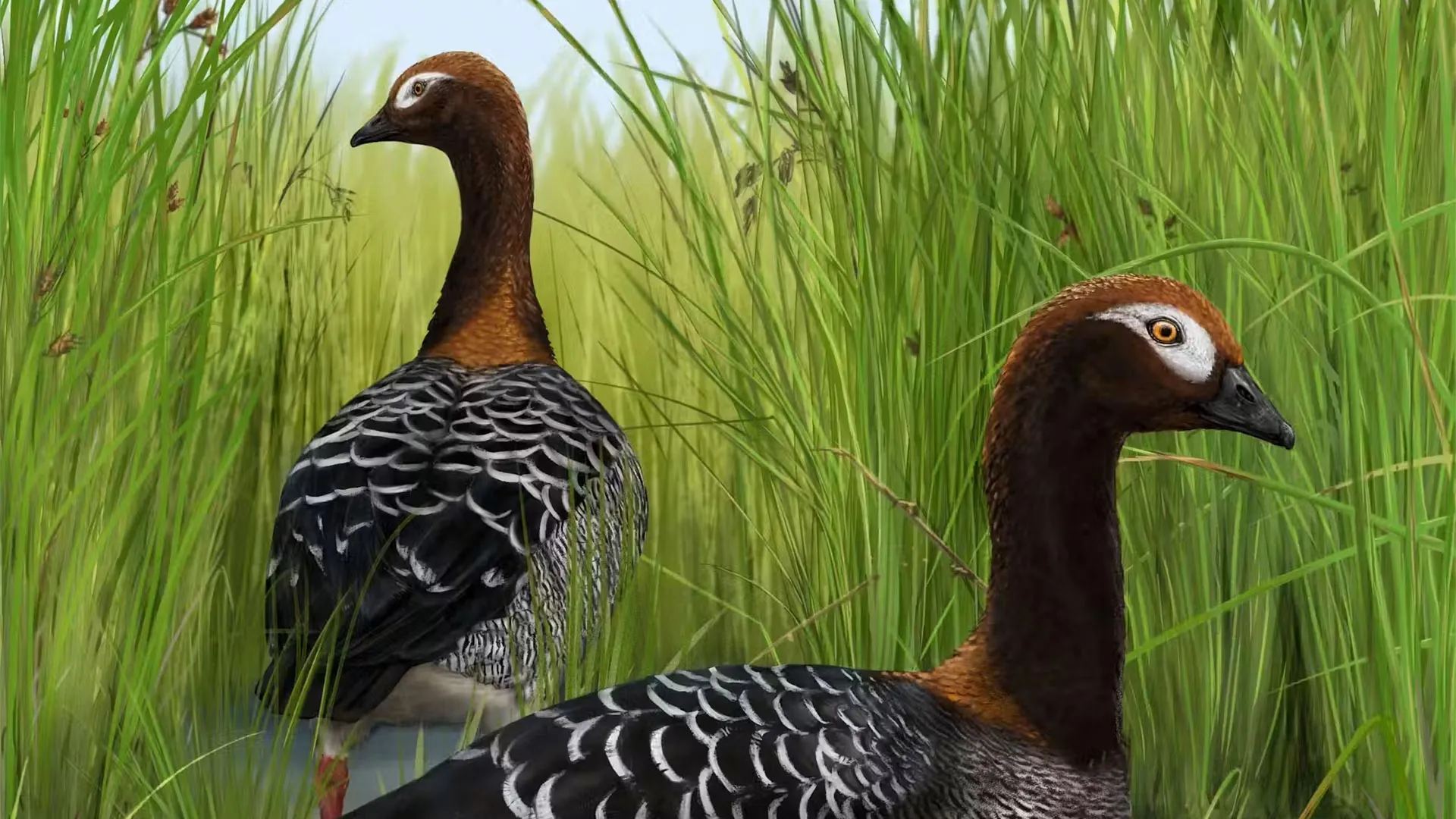
The study, recently published in the journal Historical Biology, reveals the existence of Meterchen luti, a small goose that once waddled through the mud of ancient Zealandia. The identification of this bird, led by an international consortium from the University of Otago, the Museum of New Zealand Te Papa Tongarewa, and the University of Cambridge, suggests that the biological history of Aotearoa is far more fluid, complex, and dynamic than the static models of the past once suggested.
Main Facts: Unearthing Meterchen luti
The discovery of Meterchen luti was not a singular moment of cinematic luck, but rather the result of a rigorous, systematic re-examination of decades of collected data. While waterfowl fossils are relatively common in the St Bathans formation, goose remains are famously elusive.
Researchers, led by Associate Professor Nic Rawlence, Director of the Otago Palaeogenetics Laboratory, took a comprehensive approach to the St Bathans collection. By cross-referencing every fossil bone previously categorized as "goose" against a vast database of both extinct and modern avian skeletons, the team identified a distinct morphological signature that did not match any known species.
The bird has been christened Meterchen luti. The etymology of the name is a whimsical nod to the process of its discovery: Meterchen derives from ancient Greek for "Mother Goose," a tribute to the classic nursery rhyme, while luti is Latin for "of the mud," referencing the ancient lakebed environment where its remains were interred millions of years ago.
Crucially, the study confirms that Meterchen luti is not a direct ancestor to the famous, recently extinct giant flightless geese of New Zealand (Cnemiornis). This separation is the lynchpin of the new findings, effectively severing a link that scientists had relied upon for years to explain the timeline of avian colonization in the region.
Chronology: The Timeline of Arrival
To understand the magnitude of this discovery, one must look at the timeline of New Zealand’s isolation. Zealandia, the largely submerged continent that encompasses New Zealand, broke away from Gondwana approximately 80 million years ago. For a long time, the prevailing theory suggested that many of New Zealand’s bird lineages were ancient "relicts"—species that had been present since the split and evolved in near-total isolation.
However, the "St Bathans timeline" has been under fire for several years. Previously, it was argued that the St Bathans goose lineage was the direct ancestor of the giant flightless Cnemiornis, implying a residence in Zealandia spanning at least 14 million years.
The current study presents a new chronology:
- 14 Million Years Ago: The ancestors of Meterchen luti arrive in Zealandia. This group established a presence but, as the new research indicates, ultimately hit an evolutionary dead end, leaving no modern descendants.
- 7 Million Years Ago: Genetic evidence suggests the true ancestors of the giant flightless Cnemiornis geese arrive from Australia, effectively debunking the idea that they were descendants of the much older St Bathans goose.
- 4 to 5 Million Years Ago: A significant wave of avian arrivals occurs, including the ancestors of the takahē, Forbes’ harrier, and the apex predator Haast’s eagle.
This timeline demonstrates that the "arrival" of New Zealand’s birds was not a single, ancient event, but a staggered, ongoing process of colonization that continued well into the relatively recent geological past.
Supporting Data: The Convergence of Fossil and Genetic Evidence
The power of this research lies in its multi-disciplinary approach. Relying solely on fossil morphology can be deceptive; bones can be worn, fragmented, or misleadingly similar due to convergent evolution. By integrating molecular biology—specifically DNA analysis—with traditional paleontology, the team was able to create a much more robust "toolbox."
Alan Tennyson, lead author and curator of vertebrates at Te Papa, emphasizes that the integration of these fields was essential. "We looked at the fossils, but we also looked at the genetic evidence from modern species," Tennyson explains. "When you align the genetic clock—which tracks mutations over time—with the fossil record, the old theory of a 14-million-year lineage for the giant geese simply doesn’t hold up. The genetic data is quite clear: they are more recent arrivals from Australia."
This synthesis is vital because it addresses the rapid morphological changes seen in island species. The giant Cnemiornis geese, which stood one meter tall and weighed up to 18 kilograms, are the world’s largest known geese. Their existence is a testament to the "island effect," where species arriving on isolated landmasses with few predators and abundant resources undergo rapid changes in size and flight capability. By proving the giant geese arrived only 7 million years ago, the team has identified a much narrower window for this massive evolutionary transition to occur.
Official Responses: Insights from the Field
The research has been met with significant enthusiasm within the international paleontology community, as it provides a clearer lens through which to view island biogeography.
"Using all the tools in the toolbox, including DNA and fossils, we can reconstruct how the dynamic geological, climatic, and human history of Zealandia has shaped the evolution of Aotearoa fauna in ever more detail," says Associate Professor Nic Rawlence. His laboratory has been at the forefront of this work, pushing for a more nuanced understanding of New Zealand’s biodiversity.
Rawlence notes that the discovery of Meterchen luti provides a cautionary tale for paleontologists. "It is easy to see a goose bone and assume it belongs to the lineage you are familiar with," he notes. "But by re-examining every single specimen, we found that our assumptions were obscuring a much more interesting, diverse, and complex history."
The international team, which included researchers from the University of Cambridge, highlights that New Zealand serves as a global laboratory for evolution. Because Zealandia was isolated for so long, the "experiments" of nature—such as the rapid gigantism of geese—are more visible there than almost anywhere else on Earth.
Implications: A New Framework for New Zealand’s Avian History
The implications of the Meterchen luti discovery extend far beyond the classification of one bird. It forces a wholesale rethink of how we categorize New Zealand’s "native" fauna.
1. The Myth of the Ancient Relict
The discovery deals a final blow to the theory that all of New Zealand’s distinct bird life was inherited from the breakup of Gondwana. Instead, it supports the theory of a "dynamic arrivals" model, where the country’s bird populations have been in constant flux due to immigration from Australia and other nearby landmasses over millions of years.
2. Rapid Evolution on Islands
The fact that giant geese could evolve from Australian ancestors in such a short window (geologically speaking) suggests that the environment of Zealandia was a massive catalyst for change. This suggests that the "unique" birds of New Zealand are not just remnants of an ancient past, but the products of a highly efficient and rapid evolutionary engine that was triggered by the unique conditions of the island.
3. Conservation Perspectives
Understanding the true history of these birds is not merely an academic exercise. It helps conservationists understand the ecological roles these birds once played. By distinguishing between ancient lineages that disappeared and more recent arrivals that thrived, scientists can better reconstruct the ecological networks that existed before human arrival. It highlights that New Zealand’s biodiversity is a result of millions of years of experimentation, a process that is highly vulnerable to the rapid environmental shifts caused by human activity.
Conclusion: The Ever-Changing Narrative of Zealandia
The discovery of Meterchen luti is a profound reminder that history is never truly settled. As technology improves and our ability to extract data from fossilized bone increases, the narrative of our planet’s past becomes increasingly intricate.
New Zealand, often viewed as a "frozen" evolutionary landscape, is now revealed to be a place of constant arrival, adaptation, and loss. The St Bathans lake, once a muddy expanse, has yielded a secret that clarifies our view of the past, proving that the giant geese that once roamed these lands were not ancient relics, but daring pioneers that adapted to a new home with remarkable speed.
As the University of Otago-led team continues to probe the St Bathans deposits, one thing remains clear: the mud of Central Otago still holds many more secrets. Each one, like Meterchen luti, brings us one step closer to understanding the complex, beautiful, and ever-changing story of life on the edge of the world.