Approximately 201 million years ago, the Earth underwent a violent transition. As the supercontinent Pangea began its tectonic fracture, the planet was subjected to one of the most cataclysmic volcanic events in geological history. The release of gargantuan volumes of carbon dioxide triggered a runaway greenhouse effect, driving global temperatures upward by 5 to 10 degrees Celsius. Amidst this climate instability, a new study published in Nature Geoscience on July 21, 2026, reveals a terrifying secondary effect: the collapse of global forests and the rise of a "fern-dominated" world that acted as a tinderbox for millennia of infernos.
Led by geologists at Utrecht University, an international research team has reconstructed this ancient "hell on Earth," identifying a destructive feedback loop between climate change, vegetation loss, and recurring, massive wildfires.
The Chronology of a Planetary Collapse
The End-Triassic extinction is a cornerstone event in paleontology, marking the boundary between the Triassic and Jurassic periods. The geological record shows that as temperatures spiked, the complex, forest-dominated ecosystems that had characterized the Triassic began to disintegrate.
In their place, a "fern spike"—a sudden, massive expansion of fern populations—spread across vast swaths of what is now Northwest Europe. For decades, scientists have debated the exact environmental conditions that allowed these plants to dominate for an estimated 40,000 to 300,000 years. The new research clarifies the timeline:
- Volcanic Initiation: The Central Atlantic Magmatic Province (CAMP) began spewing CO2, initiating rapid atmospheric heating.
- Deforestation & Erosion: High temperatures and shifting rainfall patterns caused the collapse of established tree-based forests.
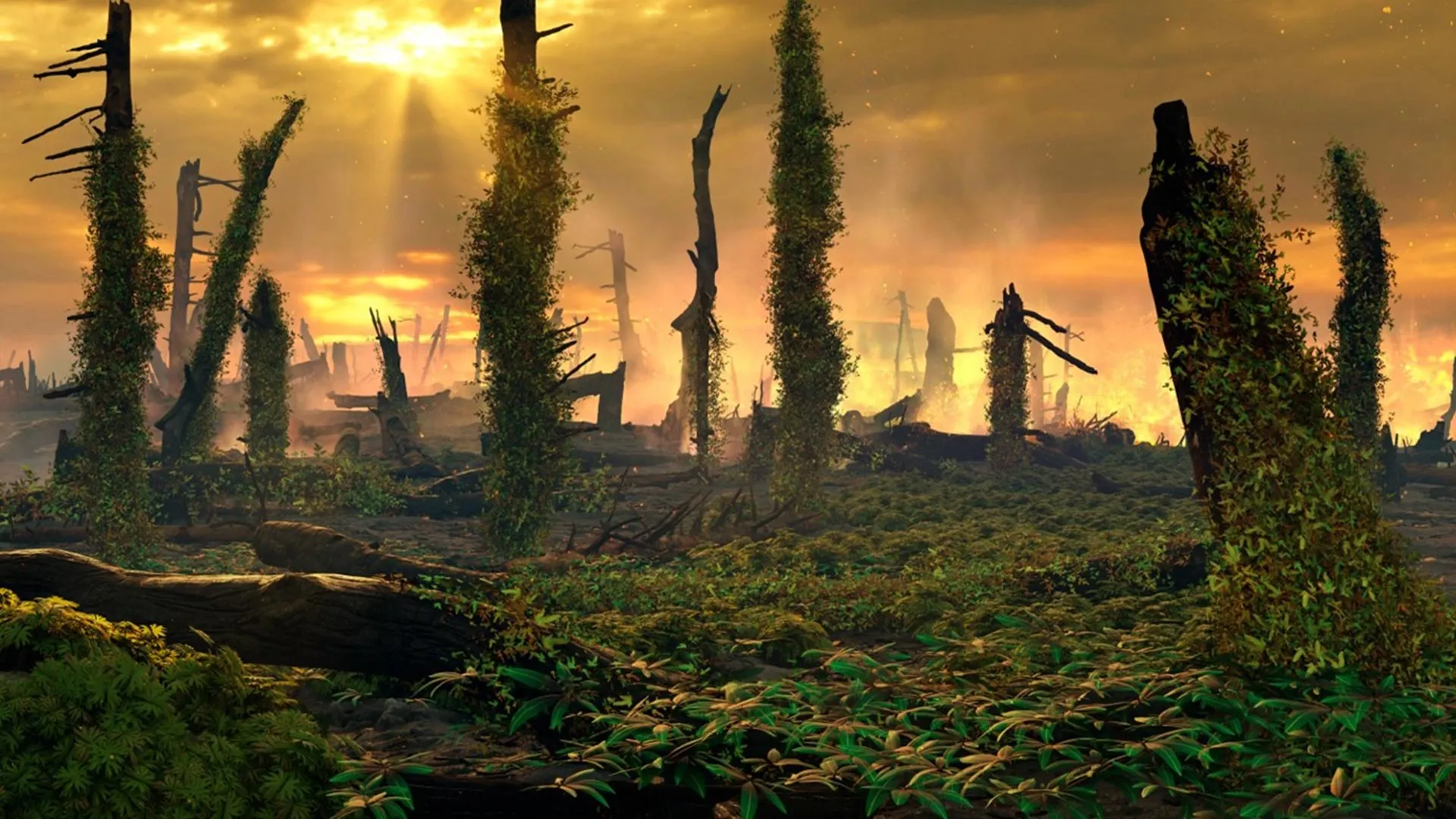
- The Fern Takeover: With the forest canopy gone, hardy, opportunistic ferns colonized the denuded landscape.
- The Fire Feedback: As these ferns spread, they created a uniform, highly flammable savannah-like environment that proved prone to frequent, intense wildfires.
- Recovery: Once the volcanic activity subsided and the climate stabilized, the "dark zone" in the fossil record ends, signaling the return of more diverse, fire-resistant vegetation.
Reconstructing the Inferno: The "Dark Zone" Methodology
To reconstruct the fire history of this era, the research team analyzed 640-meter-long drill cores—including a pristine sample from the United Kingdom. Traditionally, scientists rely on measuring fossil charcoal fragments and polycyclic aromatic hydrocarbons (PAHs), which are byproducts of incomplete combustion. However, these methods are notoriously unreliable; charcoal fragments can fracture into artificial "multiples," and PAHs can be transported by wind or water, leading to inaccurate fire-frequency estimates.
To overcome these limitations, the Utrecht University team pioneered a novel approach: the Palynomorph Darkness Index (PDI).
The Science of Fossil Color
Organic microfossils, such as pollen and spores, are highly sensitive to thermal alteration. Under normal geological circumstances, as sediments are buried deeper, heat and pressure "cook" these organic remains, causing them to darken in a predictable, linear fashion.
"We were quite puzzled by this phenomenon," explains Dr. Bas van de Schootbrugge, a senior author on the study. "In our cores, the oldest and deepest pollen remained light-colored. However, the fossils from the extinction interval became progressively darker, reaching an extremely dark brown, before returning to a pale yellow once the extinction period ended."
By using a light microscope equipped with a digital camera, the team converted the fossil colors into an average grayscale value across 15,000 individual samples. Because this "Dark Zone" occurred simultaneously across four distinct geological basins—despite those basins having different burial histories—the team concluded that the darkening was not a result of burial depth, but an external chemical or thermal stress: specifically, the accumulation of soot and heat-altered material from repeated, localized wildfires.
Supporting Data: Why the Ferns Were the Culprit
A key question for the researchers was whether the darkening was a biological trait of the plants themselves. By comparing tree pollen against fern spores, the team found that all plant groups showed the exact same darkening effect. This uniformity confirmed that an outside force—the fire—was responsible.
When the PDI data was overlaid with the charcoal and PAH records, the correlation was absolute. The "Dark Zone" matched the peak of the fern expansion perfectly.
The Disaster Species
Ferns are often called "disaster species" for their ability to thrive in the wake of ecological catastrophe. They possess subterranean root systems (rhizomes) that allow them to survive fire events that would kill off woody plants.
"Ferns are truly remarkable plants that have withstood many crises throughout Earth history," says Van de Schootbrugge. "They can regrow from the roots much faster than their competitors. In the End-Triassic, they created a massive, uniform ground cover. When those ferns dried out, they acted as the ideal fuel to trigger massive wildfires."
The study suggests that the ferns functioned as "fire ladders." By crowding out other vegetation and creating vast, dry, uniform mats of organic matter, they facilitated the spread of flames across the landscape. This created a lethal cycle: the fires destroyed competing plants, the ferns regrew faster, and the new, dense fern cover then provided more fuel for the next wave of fires.
Implications: A Lesson for a Modern World
The findings carry significant weight for modern climate science. The End-Triassic extinction serves as a grim case study in how global warming does not just change temperatures; it fundamentally alters the structure of the biosphere.
The Perfect Storm
The study identifies three ingredients that, when combined, lead to irreversible ecological collapse:
- Anthropogenic or Volcanic Climate Forcing: Rapid increases in atmospheric CO2.
- Habitat Degradation: The destruction of primary, resilient forests.
- Opportunistic Expansion: The dominance of invasive or pioneer species that thrive in disturbed, fire-prone environments.
The researchers emphasize that the "perfect storm" of the Triassic wasn’t just caused by the volcanoes, but by the ecosystem’s own reaction to the heat. By creating a landscape dominated by a single type of plant—a monoculture of sorts—the environment lost its ability to regulate fire.
"The lesson we can learn from this," Dr. Van de Schootbrugge concludes, "is that the combination of climate change, deforestation, and the spread of opportunistic species can provide all the ingredients for a perfect storm."
Scientific Context and Future Directions
The publication in Nature Geoscience is already being hailed as a major breakthrough in "deep time" analysis. By validating the Palynomorph Darkness Index, the researchers have provided the scientific community with a low-cost, effective, and highly accurate tool for investigating fire history in the distant past.
As the world faces modern climate change, the study provides a sobering look at how "feedback loops" can lead to long-term environmental instability. While the End-Triassic event lasted hundreds of thousands of years, the mechanisms observed—dry vegetation, rapid colonization of opportunistic species, and massive, self-sustaining fire cycles—are processes currently being observed in modern boreal forests and tropical savannas.
The research team plans to continue their work by applying the PDI technique to other extinction events in Earth’s history, hoping to uncover whether this "fire-feedback" cycle is a common feature of global mass extinctions. For now, the 201-million-year-old ferns stand as a testament to the fragile nature of our planet’s ecosystems and the terrifying power of a world pushed past its breaking point.