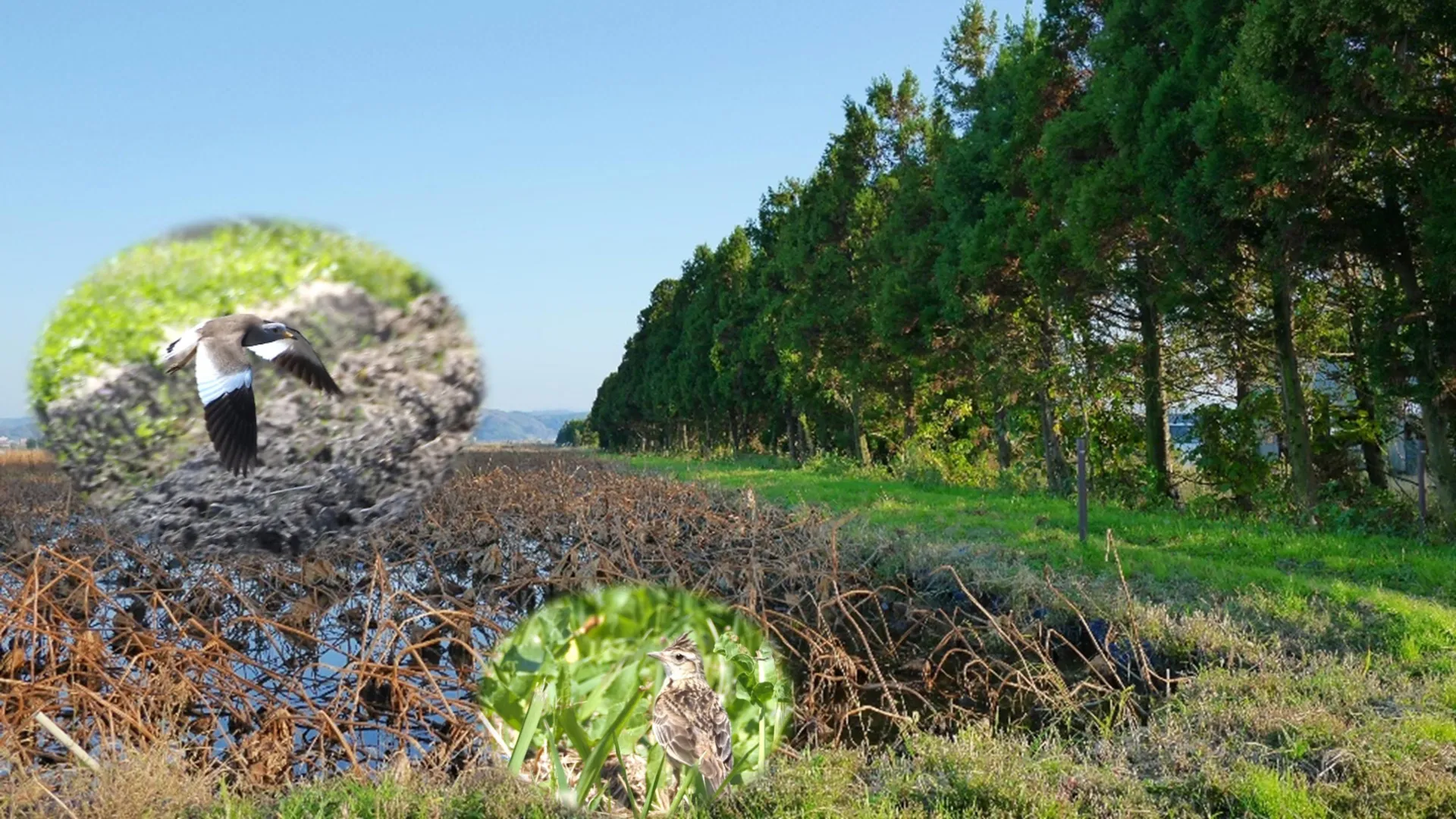
For decades, the standard prescription for ecological restoration in agricultural landscapes has been simple: plant more trees. From the hedgerows of England to the windbreaks of the American Midwest, shelterbelts—rows of trees planted to shield crops from wind and soil erosion—have been heralded as universal panaceas for biodiversity loss. They provide nesting sites, corridors for movement, and a welcome infusion of structure into otherwise sterile, monocultural fields.
However, a groundbreaking study recently published in the Journal of Environmental Management suggests that this "more trees is always better" philosophy may be fundamentally flawed, particularly in the delicate ecosystems of agricultural wetlands. By analyzing the avian populations around Japan’s Lake Kahokugata, researchers have uncovered a complex ecological trade-off: while trees do indeed invite some species in, they effectively displace others, creating "ecological walls" that threaten the survival of birds dependent on open landscapes.
The Myth of the Universal Habitat
The prevailing consensus in agricultural conservation programs is that woody features enhance structural complexity, thereby increasing the number of species a landscape can support. While this holds true in many dry, cropland-dominated regions, it ignores the unique requirements of wetland-dependent species.
"The central question of our study is, ‘Do shelterbelts and other woody linear features benefit all farmland birds equally in agricultural wetland landscapes, or do they create trade-offs by disadvantaging species that depend on open habitats?’" explains Masumi Hisano, the study’s corresponding author and an assistant professor at Hiroshima University’s Graduate School of Advanced Science and Engineering.
The research highlights a glaring gap in the scientific literature. Most of our current understanding of conservation biology is derived from European and North American studies, which often overlook the specific needs of wet farming landscapes like rice paddies. These areas are not just farms; they are critical "substitute wetlands" for migratory birds traveling along major flyways. When we alter these landscapes with massive tree-planting initiatives, we may be unintentionally dismantling the very habitat these migratory birds rely on for survival.
Chronology of a Discovered Trade-Off
The research team, comprised of experts from Hiroshima University, the University of Tokyo, Kyoto University, and several international institutions, focused their investigation on the region surrounding Lake Kahokugata in central Japan. This area serves as a living laboratory for the intersection of human industry and natural biodiversity.
The region is defined by its expansive rice paddies, lotus fields, and pastures. Because the area is prone to brutal winter winds and storms, shelterbelts have been a long-standing agricultural management strategy. Furthermore, Lake Kahokugata is a vital node along the East Asian-Australasian Flyway, a massive migratory corridor that sees nearly 300 different bird species pass through its borders annually.
The Research Timeline:
- Early Planning (2020): The team identifies a lack of data regarding how linear woody features impact wetland birds in Asian agricultural landscapes.
- Phase I Fieldwork (February–March 2021): Researchers conduct bird surveys using a point-count method to capture baseline data on wintering bird abundance and diversity.
- Phase II Fieldwork (June 2023): The team returns to the site during the breeding season to assess how these birds utilize the landscape during warmer months.
- Data Analysis (Late 2023–Early 2024): Quantitative analysis reveals a statistically significant divide between bird populations near shelterbelts and those in open fields.
- Publication (2024): Findings are released in the Journal of Environmental Management, sparking a re-evaluation of current conservation policies.
Unpacking the Data: Winners and Losers
The results of the survey were unambiguous. The shelterbelts acted as a catalyst for a demographic shift in the local bird community.
Birds that thrive in shrubland or woodland edges—species that prefer cover and vertical complexity—saw a marked increase in population density near the tree rows. However, this gain came at a steep cost. The researchers observed a substantial decrease in both the abundance and diversity of birds that rely on large, open grassland and wetland environments.
The most striking data point from the study revealed that the abundance of grassland-dependent birds was more than 70 percent lower at sites situated immediately next to shelterbelts compared to open sites located just one kilometer away.
Why the Decline?
The researchers point to three primary mechanisms driving this decline:
- Habitat Fragmentation: Shelterbelts act as "ecological walls," effectively partitioning large, open fields into smaller, less desirable fragments for species that require vast, uninterrupted landscapes to forage and nest.
- Predatory Exposure: Many open-habitat birds have evolved to scan the horizon for predators. By introducing vertical structures, conservationists may be inadvertently creating "ambush points" for raptors and other predators that use tree lines to stalk their prey.
- Space Competition: The physical footprint of the trees and their root systems can alter the local micro-climate, potentially rendering previously suitable nesting grounds less hospitable for ground-nesting birds.
Implications for Environmental Management
The findings from Lake Kahokugata serve as a cautionary tale for land-use planners and policy makers worldwide. For years, the default strategy for "greening" agricultural land has been the mass planting of windbreaks. This study argues that such policies, while well-intentioned, lack the nuance required to maintain true ecological health.
"Our study provides clear, quantitative evidence that small-scale landscape features can have large ecological consequences," says Hisano. The implications are clear: we must move away from a "one-size-fits-all" approach to habitat restoration. Instead, agricultural policy needs to prioritize site-specific assessments.
If a region is a critical, open-habitat wetland, planting trees might actually be an act of habitat degradation rather than restoration. Conversely, in landscapes that have been historically deforested, shelterbelts remain a valuable tool. The key is in the "landscape-level planning"—a strategy that balances the need for agricultural protection with the preservation of open-habitat integrity.
Toward Evidence-Based Conservation
The team’s work is not a call to stop planting trees, but rather a call to be more deliberate about where and how they are planted. As the global climate shifts, the role of agricultural wetlands as refugia for migratory species will only increase in importance. If these areas are structurally altered to the point where they can no longer support their primary inhabitants, the ripple effects will be felt across the entire flyway.
Future research, according to the team, will focus on the specifics of shelterbelt configuration. They intend to investigate how factors like height, width, species composition, and the permeability of the tree rows influence different avian behaviors. By understanding the "architecture" of these structures, they hope to design shelterbelts that provide wind protection for farmers while minimizing the encroachment on the territories of open-land species.
"Our goal is to help design evidence-based agri-environmental policies that work in wet-farmed landscapes worldwide," Hisano concludes. "Rather than promoting a single solution, such as planting more trees everywhere, we aim to support landscape-level planning that combines open habitats and woody features in ways that sustain diverse bird communities."
Conclusion
The study at Lake Kahokugata provides a critical correction to modern conservation dogma. By highlighting the hidden costs of agricultural tree-planting, the researchers have opened a necessary dialogue about the complexities of ecological management. It is a reminder that nature is not merely a collection of features to be added or subtracted to increase a "biodiversity score." It is a delicate web of specialized habitats, each requiring specific conditions to function. As we navigate a rapidly changing world, our conservation efforts must be as dynamic, informed, and evidence-based as the ecosystems we seek to protect.
The path forward requires a shift in mindset: moving from simple, prescriptive actions toward a sophisticated, landscape-wide vision that values the open sky just as much as the trees that frame it.