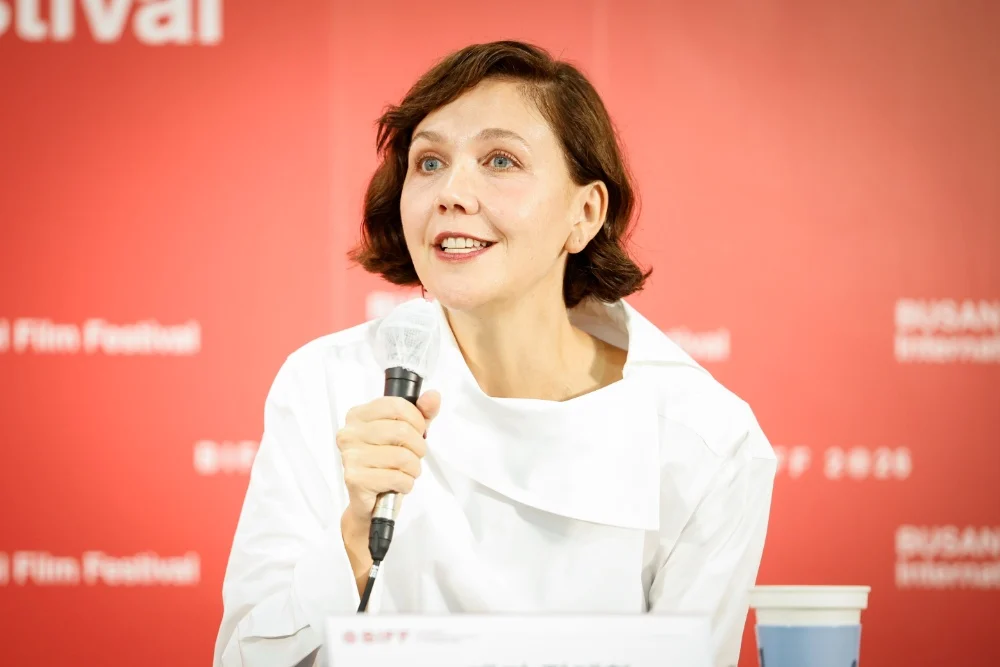
At the Busan International Film Festival this week, Maggie Gyllenhaal—the acclaimed actress turned powerhouse filmmaker—offered a candid masterclass in leadership. Reflecting on her transition from the front of the lens to the director’s chair, Gyllenhaal articulated a philosophy of filmmaking that rejects the "lone genius" myth in favor of a radical, inclusive collaboration. Her message to the industry was clear: the most successful directors are not those who command by silencing others, but those who possess the confidence to synthesize the brilliance of their entire crew.
The Philosophy of the Inclusive Director
During a press conference at the prestigious festival, Gyllenhaal addressed the power dynamics that define a film set. Drawing from her decades of experience as a performer, she noted a distinct correlation between a director’s professional stature and their management style.
"The best directors I worked with as an actress, who were usually also the most successful, understood the value of drawing on the minds of the people around them," she explained. "It was the people who were very scared, or just not very smart, who tried to squash other people’s voices."
Gyllenhaal’s perspective is rooted in the practical reality of modern filmmaking. While she acknowledges that the ultimate responsibility—and the final creative veto—rests with the director, she argues that the "silo" approach to filmmaking is inherently flawed.
"The truth is, it is ultimately up to me as the director. I have the power, so there’s no reason to squash anyone else’s voice," she stated. "It’s just so obvious that the movie that I will make that includes all the minds of the people on my crew—at least as things I can draw from—is going to be exponentially better than the movie I can make trying to recreate something I imagined all alone by myself in my room."
Chronology: From Acting Icon to Directorial Force
Gyllenhaal’s trajectory in the arts has been one of gradual, deliberate evolution. For years, she was one of Hollywood’s most respected character actors, known for her intense, nuanced performances in films like Secretary, The Dark Knight, and Crazy Heart. Yet, she admits that the desire to shape the narrative from its inception had been simmering for a long time.
The Turning Point
Growing up in a household steeped in cinema—with her father, Stephen Gyllenhaal, a director, and her mother, Naomi Foner, a renowned screenwriter—the medium was always a part of her internal landscape. "When I was young, so few women were directing that acting seemed the obvious outlet for a woman who loved movies and wanted to tell stories," she recalled.
However, after years of professional success, Gyllenhaal hit a professional plateau. "It felt satisfying and exciting for a long time, and then I think I hit the edge of what I was able to do as an actress," she noted.
The Directorial Debut: The Lost Daughter
Eight years ago, she began the transition that would redefine her career. Her directorial debut, The Lost Daughter (2021), was not just a successful pivot; it was a critical triumph that signaled her arrival as an auteur. On that set, she made a conscious choice to foster a culture of creative contribution, inviting input from cinematographers, production designers, and actors alike.
Flesh Impact and Beyond
Her latest project, Flesh Impact, serves as a testament to her creative audacity. Commissioned by luxury car brand Genesis to commemorate what would have been Marilyn Monroe’s 100th birthday, the film eschews the standard biopic format. Instead, Gyllenhaal conceptualized a narrative where Ellen Burstyn plays a centenarian Monroe, with Dakota Johnson portraying the icon in her youth.
"I don’t think that when Genesis came to me… they imagined she would actually be 100 years old in the movie," Gyllenhaal quipped. "I thought, ‘Okay, I have this idea. They’re never going to go for it.’" To her surprise, the brand embraced the unconventional pitch, and she completed the script in a single weekend. The film premiered at the Venice Film Festival, cementing her reputation as a director who favors high-concept, human-centric storytelling.
Supporting Data: The Gyllenhaal Creative Network
Gyllenhaal’s creative process is heavily informed by her family’s legacy, though she maintains a distinct voice. Her mother, Naomi Foner, remains a critical sounding board. "My mom directed her first film as a grandmother. I think she might be the only person to have directed her first film as a grandmother," Gyllenhaal noted with admiration, labeling Foner as her most trusted "note-giver."
Similarly, her brother, actor Jake Gyllenhaal, serves as a vital collaborator. She describes their differing creative tastes as a "gift," noting that their ability to challenge one another helps refine her own directorial instincts.
Implications for the Industry
Gyllenhaal’s remarks in Busan arrive at a time when the film industry is undergoing a critical self-assessment regarding gender representation and the democratization of the director’s chair. Her recent tenure as jury president at the Venice Film Festival highlighted a sobering reality: despite the progress made, female directors remain significantly underrepresented in major competition slates.
When asked about these statistics, Gyllenhaal’s response is one of persistent advocacy. She is not merely interested in being a solitary success story; she is focused on systemic shifts that allow for a wider array of voices to be heard.
Future Projects
The future looks promising for Gyllenhaal, who is currently in the early, exciting stages of developing two new projects. While she keeps the details close to the vest, she is clearly in a period of creative expansion. Industry reports have confirmed that she is set to direct and produce an adaptation of Rachel Kushner’s acclaimed novel, Creation Lake, for Warner Bros.
This project, much like her previous work, promises to be a complex, layered endeavor that will likely require the very collaborative spirit she championed in Busan. As she moves from the relative ease of her early career into the complex, high-stakes world of major studio production, Gyllenhaal’s philosophy remains a beacon for how power can be wielded with grace.
Conclusion: The "Best Note-Giver"
Maggie Gyllenhaal’s evolution from an actress seeking a voice to a director fostering the voices of others is a testament to her maturity as an artist. By rejecting the ego-driven model of the "auteur" and embracing the collective intelligence of her crew, she has managed to create work that feels both personal and expansive.
As she continues to navigate the complexities of Hollywood, her influence extends beyond her own filmography. She represents a generation of filmmakers who are proving that the most compelling stories are not the result of one person’s isolated imagination, but the synthesis of many. Whether she is tackling the legacy of an icon like Marilyn Monroe or adapting contemporary literature, Gyllenhaal remains committed to the idea that the director’s greatest tool is not the megaphone, but the ear.