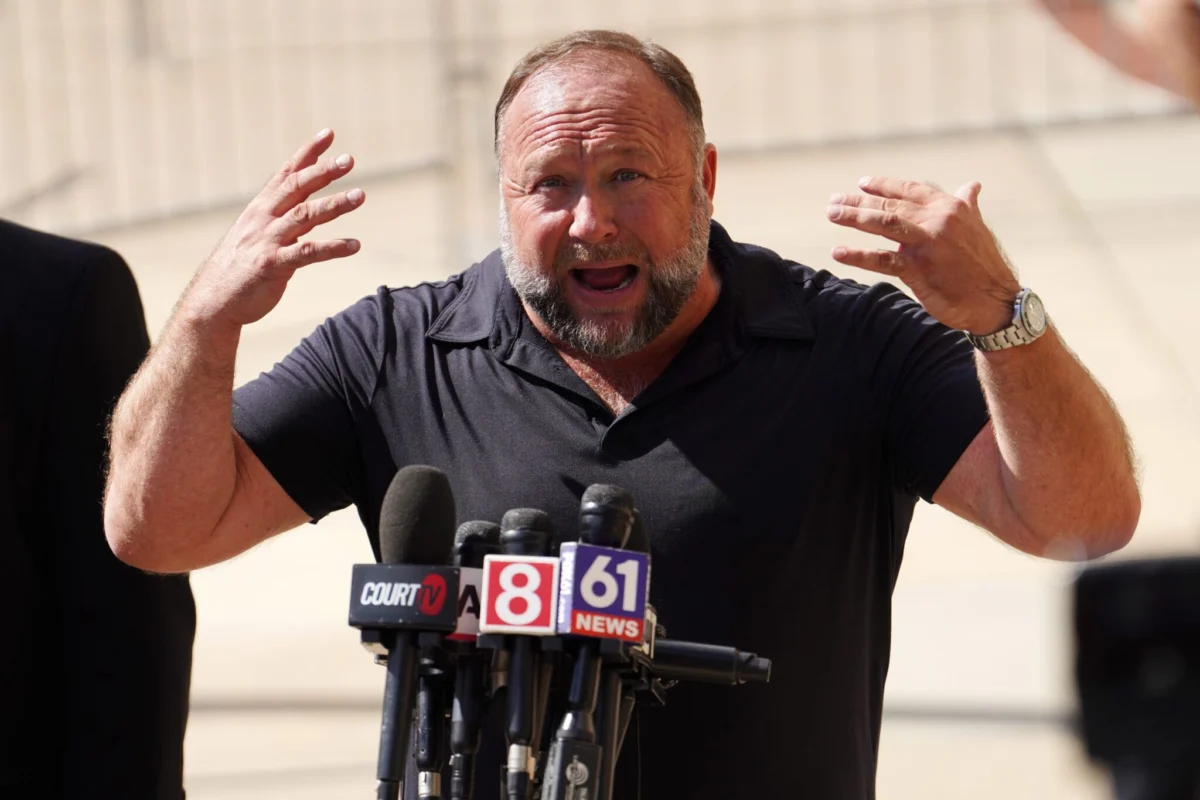
In a significant legal development that underscores the complexities of state-level tort reform, the Texas Third Court of Appeals on Friday dramatically reduced a $50 million defamation judgment against Infowars founder Alex Jones. The court ruled that the punitive damages awarded to the parents of a 2012 Sandy Hook Elementary School massacre victim must be capped in accordance with Texas state law, effectively lowering the total payout to approximately $6 million.
While the ruling represents a mathematical victory for Jones, it does little to alleviate the overwhelming financial pressure facing the conspiracy theorist. Jones remains liable for a staggering $1.25 billion judgment in Connecticut and is currently navigating a complex bankruptcy process that has seen his media empire, Free Speech Systems, move toward liquidation.
I. Main Facts: The Anatomy of the Texas Ruling
The decision by the Austin-based appeals court focused primarily on the distinction between compensatory damages—intended to repay victims for their actual losses and suffering—and punitive damages, which are intended to punish a defendant for egregious behavior.
The New Financial Breakdown
The original 2022 jury verdict in Austin, Texas, awarded Neil Heslin and Scarlett Lewis—whose six-year-old son, Jesse Lewis, was murdered in the Newtown shooting—a total of $49.3 million. The appellate court’s unanimous opinion restructured this award as follows:
- Compensatory Damages Upheld: The court left intact more than $4.1 million in compensatory damages. These funds were awarded for the defamation and intentional infliction of emotional distress caused by Jones’ repeated claims that the shooting was a "hoax" and that the parents were "crisis actors."
- Punitive Damages Slashed: The jury had originally leveled $45.2 million in punitive damages against Jones. However, the appellate court reduced this to just $1.5 million.
- The Statutory Cap: The reduction was mandated by a Texas law that limits punitive damages to $750,000 per plaintiff in cases where no felony was committed. Because there were two plaintiffs in this specific suit, the cap was set at $1.5 million.
Legal Justification
The Texas Third Court of Appeals noted that while the jury’s intent was clearly to punish Jones for his "reprehensible" conduct, the trial court erred by allowing the damages to exceed statutory limits. The appellate judges found that the plaintiffs did not provide sufficient evidence to bypass the cap, which usually requires proving specific felony-level conduct like embezzlement or aggravated kidnapping in conjunction with the defamation. Furthermore, the court ruled that the trial judge improperly allowed the parents to seek higher damages after the trial had already concluded.
II. Chronology: From Tragedy to Legal Reckoning
The legal battle between Alex Jones and the Sandy Hook families has spanned over a decade, evolving from a local tragedy into a national debate over the limits of free speech and the consequences of digital disinformation.
2012–2017: The Propagation of the Hoax Theory
On December 14, 2012, a gunman killed 20 first-graders and six educators at Sandy Hook Elementary School in Newtown, Connecticut. Almost immediately, Alex Jones began using his Infowars platform to suggest the event was staged by the federal government as a pretext for gun control legislation. For years, he broadcasted segments claiming the grieving parents were actors and that no children had actually died.
2018–2021: The Filing of Lawsuits and Default Judgments
Frustrated by years of harassment from Jones’ followers, families of the victims filed multiple defamation lawsuits in Texas and Connecticut. Jones and his legal team famously engaged in "obstructionist" tactics during the discovery phase, failing to produce required financial records and internal analytics. Consequently, judges in both states issued default judgments against Jones, finding him liable for defamation without the need for a trial on the merits of the claims.
2022: The Summer of Verdicts
The year 2022 marked the beginning of the "damages phase" of the litigation.
- August 2022: The Texas trial involving Neil Heslin and Scarlett Lewis resulted in the $50 million verdict.
- October 2022: A Connecticut jury awarded 15 plaintiffs (relatives of eight victims and an FBI agent) nearly $1 billion, a figure that later grew to $1.25 billion with the addition of attorney fees and other costs.
2023–2024: Bankruptcy and The Onion’s Intervention
In late 2022, Jones and Free Speech Systems filed for Chapter 11 bankruptcy. By 2024, the proceedings shifted toward Chapter 7 liquidation. In a surreal turn of events in November 2024, the satirical news outlet The Onion won a bankruptcy auction to acquire Infowars’ assets, including its website, social media accounts, and studio equipment, with the intent of turning the platform into a parody of itself. However, that sale is currently being reviewed by a federal judge following complaints regarding the bidding process.
III. Supporting Data: The Financial and Social Toll
To understand the scale of the litigation, one must look at the data surrounding Jones’ reach and the subsequent impact on the victims.
The Reach of Infowars
At its height, Infowars reached millions of viewers and listeners daily. During the Texas trial, internal documents revealed that Infowars’ revenue often spiked when Jones discussed Sandy Hook. On some days, the platform generated over $800,000 in sales of supplements and survivalist gear, directly correlating with "conspiracy" broadcasts.
The Cost of Harassment
The "data" of the families’ suffering was central to the compensatory awards. Testimonies included:
- Death and Rape Threats: Families received thousands of threats via email and social media.
- Physical Harassment: Neil Heslin testified that people had shot at his home and car. Others reported being confronted in public by "hoaxers" demanding they admit their children never existed.
- Psychological Impact: Scarlett Lewis described a decade of "living in a constant state of fear," which experts testified resulted in complex PTSD.
Comparative Payouts
The Texas reduction highlights a stark disparity in state laws:
- Texas: Strictly enforces caps on punitive damages (approx. $6 million total in this case).
- Connecticut: Does not have the same restrictive caps on defamation damages, leading to the $1.25 billion judgment that remains unaffected by the Texas appellate ruling.
IV. Official Responses: A Divided Legal Front
The reactions to Friday’s ruling reflect the polarized nature of the case, with Jones claiming a constitutional win and the families’ attorneys dismissing the ruling as a minor procedural hiccup.
Alex Jones and the Defense
Following the ruling, Jones took to his current streaming platforms to celebrate. He characterized the decision as a "gigantic victory for the First Amendment" and a vindication of his legal strategy.
"I got lawyers who are good constitutional lawyers and they are not backing down," Jones stated. He confirmed his intention to appeal the remaining $6 million to the Texas Supreme Court, seeking to have the entire judgment vacated on free speech grounds.
The Plaintiffs’ Legal Teams
Mark Bankston, the lead attorney for Heslin and Lewis in the Texas case, was dismissive of the court’s reduction. He argued that the ruling is "irrelevant" in the broader context of Jones’ total liabilities.
"The families care not at all about this irrelevant ruling which affects only two of the 19 claims they all share," Bankston said in a statement. "Jones still faces over a billion dollars of liability, so this changes absolutely nothing. All it does is highlight the absurdity of Texas law."
Similarly, Christopher Mattei, who represents the families in the Connecticut litigation, noted that the Texas appellate decision has no bearing on the ongoing liquidation of Free Speech Systems or the $1.25 billion judgment in the Northeast.
V. Implications: The Future of Accountability in Media
The reduction of the Texas judgment raises several critical questions about the future of defamation law and the ability of the legal system to deter high-profile disinformation.
The Effectiveness of Damage Caps
Critics of the Texas ruling argue that statutory caps on punitive damages undermine the "deterrent" function of the law. If a media personality can generate tens of millions of dollars in revenue by spreading falsehoods, a capped $1.5 million punitive fine may simply be viewed as a "cost of doing business." This case may spark renewed debate in the Texas legislature regarding the adequacy of Chapter 41 caps in the digital age.
The First Amendment vs. Defamation
Jones has consistently framed his legal battles as a fight for free speech. However, every court that has heard the case has maintained that the First Amendment does not protect "defamatory falsehoods" made with "actual malice." The Texas appellate court’s decision to uphold the compensatory damages confirms that Jones’ speech was legally actionable defamation, even if the state’s math limits the punishment.
The Liquidation of an Empire
The most immediate implication is the continued dismantling of Infowars. Despite the reduction in the Texas fine, Jones is insolvent. The bankruptcy court is currently overseeing the sale of his intellectual property and personal assets, including his gun collection and luxury vehicles. Whether The Onion or another entity ultimately takes over the Infowars brand, the "Alex Jones" brand as a corporate powerhouse is effectively over.
Precedent for Future "Hoax" Claims
The Sandy Hook litigation has already served as a warning to other conspiracy theorists. Platforms like YouTube, X (formerly Twitter), and Facebook have significantly tightened their policies on "harassment" and "denial of violent events" in the wake of these verdicts. The families’ persistence has demonstrated that while the legal road is long and fraught with appellate hurdles, there is a path to holding digital broadcasters accountable for the real-world harm caused by their content.
In conclusion, while the Texas Third Court of Appeals has provided Alex Jones with a temporary reprieve in terms of the raw dollar amount owed to two parents, the broader legal and financial walls continue to close in on the Infowars founder. The $1.25 billion Connecticut judgment remains the "sword of Damocles" hanging over his future, ensuring that the families of Sandy Hook remain his primary creditors for years to come.