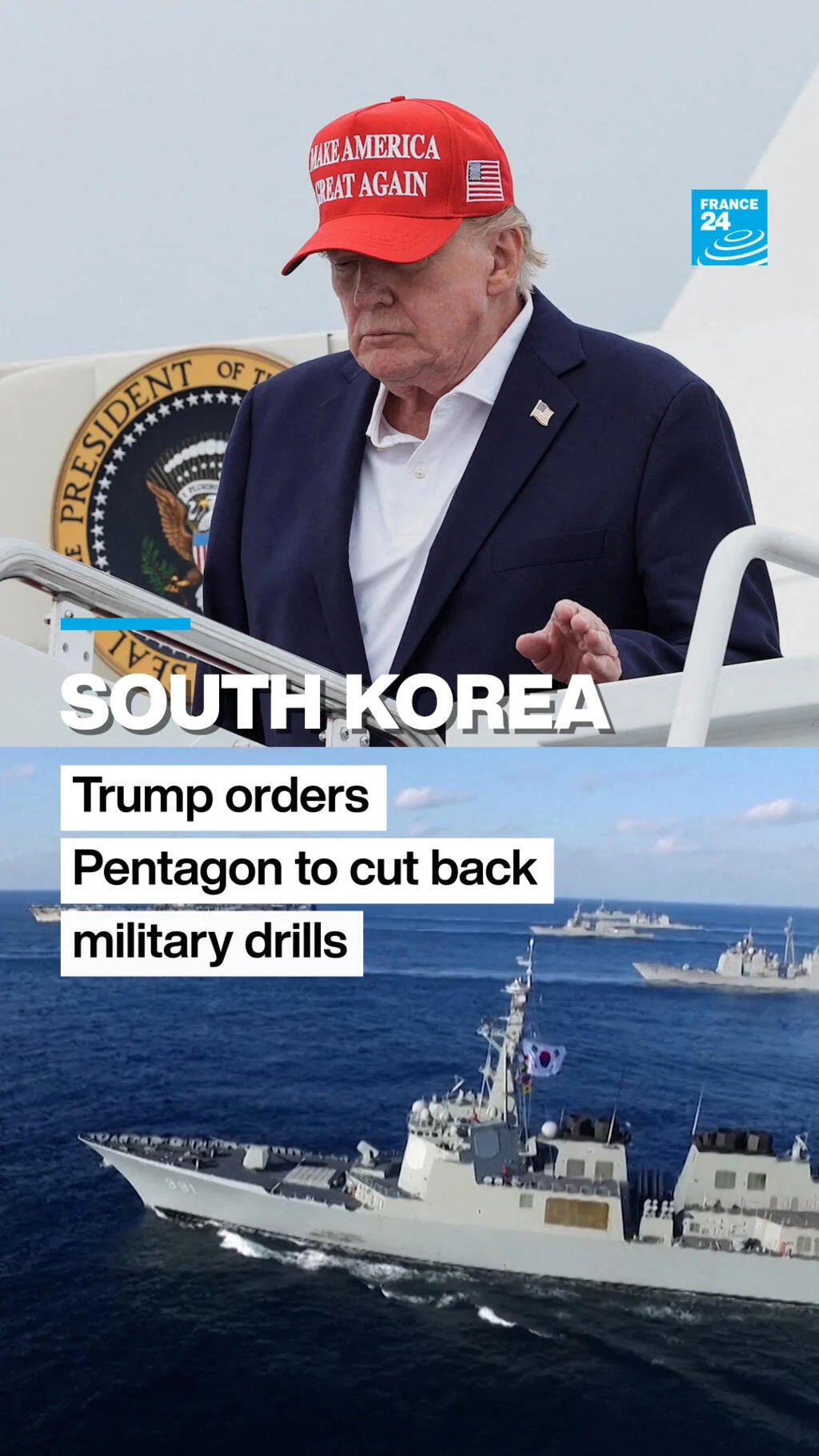
August 17, 2026 – In a move that has sent shockwaves through the geopolitical architecture of the Indo-Pacific, President Donald Trump has issued a direct order to the Pentagon to significantly scale back upcoming joint military exercises with the Republic of Korea (ROK). The directive, issued mere hours before the scheduled commencement of the drills, marks a dramatic shift in the security posture of the Korean Peninsula and has prompted an immediate, frantic scramble among diplomatic and military planners in Washington and Seoul.
The decision, which appears to bypass traditional consultative channels with the South Korean government, revives the contentious “America First” approach to regional security that characterized the President’s earlier tenure. Analysts are now debating whether this move represents a tactical opening for renewed diplomacy with Pyongyang or a dangerous erosion of the ironclad deterrence that has maintained peace on the peninsula for over seven decades.
Main Facts: A Sudden Halt in Readiness
The announcement came early Sunday morning, effectively freezing the mobilization of tens of thousands of troops, advanced naval assets, and air wings that were prepared to engage in complex, multi-domain training simulations. The exercises, traditionally intended to test the interoperability of US and ROK forces against potential North Korean aggression, were designed to be the largest of the calendar year.
According to senior defense officials speaking on condition of anonymity, the President’s order was delivered via a brief memo, citing a desire to "reduce financial waste" and "create space for high-level diplomatic engagement." The abruptness of the order has left the Pentagon’s Joint Chiefs of Staff struggling to communicate the de-escalation protocols to frontline commanders, many of whom were already in the final stages of the "go-no-go" checklist for the commencement of live-fire segments.
Chronology of the Decision
The timeline leading up to this reversal suggests a calculated, if highly unconventional, decision-making process.
- August 14, 2026: The Pentagon reaffirms its commitment to the joint drills, emphasizing the importance of "readiness and resolve" in the face of recent missile testing cycles in the North.
- August 16, 2026, 22:00 EST: Intelligence briefings are held at the White House. While the nature of the specific intelligence remains classified, sources indicate a focus on North Korean signaling regarding upcoming diplomatic overtures.
- August 17, 2026, 06:00 EST: The President tweets his intention to "reassess the burden" of military training on the American taxpayer.
- August 17, 2026, 08:30 EST: The formal directive is transmitted to the Secretary of Defense, ordering a "significant scaling back" of operational tempo.
- August 17, 2026, 12:56 GMT: The official notification is acknowledged, and military units are ordered to stand down or transition to "administrative monitoring" status.
Supporting Data: The Scale of the Disruption
The exercises were set to involve approximately 30,000 US troops and an even larger contingent of South Korean personnel. The logistical footprint of these operations is immense, involving the deployment of carrier strike groups, stealth fighter squadrons, and complex cyber-warfare simulations.
Key metrics of the cancelled operations include:
- Naval Assets: Three Aegis-class destroyers and a nuclear-powered submarine were scheduled for maritime interdiction drills in the Sea of Japan.
- Air Assets: Deployment of B-21 Raider strategic bombers for long-range strike simulation, intended to demonstrate the US "nuclear umbrella" over Seoul.
- Economic Impact: The Pentagon estimates that these large-scale drills cost upwards of $150 million in fuel, maintenance, and personnel deployment costs per cycle—a figure the President has frequently cited as "excessive."
The cancellation of such exercises is not unprecedented—most notably, the suspension of large-scale drills in 2018—but the timing, coming only hours before the launch, is highly irregular and suggests a lack of coordination with the South Korean Ministry of National Defense.
Official Responses: A Tense Diplomatic Landscape
The White House Stance
In a brief statement, the White House Press Office emphasized that the President is "always open to a deal" and that the suspension of the drills is a "gesture of goodwill" intended to signal to Pyongyang that Washington is serious about reducing tensions. The administration maintains that the US remains fully capable of defending the ROK and that the decision does not constitute a withdrawal or a reduction of total troop levels in the country.

Seoul’s Reaction
The South Korean government, led by the Blue House, has remained uncharacteristically tight-lipped. An emergency meeting of the National Security Council was convened in Seoul within minutes of the announcement. While official statements emphasize the "strength of the ROK-US Alliance," sources in the South Korean defense establishment privately express profound frustration. There is a prevailing fear that by unilaterally cutting the drills, the US is undermining the ROK’s own military readiness and potentially signaling weakness to the leadership in Pyongyang.
The Pentagon’s Position
Secretary of Defense spokespeople have attempted to frame the move as a "reconfiguration" rather than a cancellation. "We are adapting our training schedule to ensure maximum flexibility," said one spokesperson, though the lack of detail regarding what, if any, training will remain has fueled speculation about the total erosion of the exercise’s effectiveness.
Implications: The Geopolitical Fallout
1. Erosion of Deterrence
The most immediate concern among regional security experts is the potential for North Korea to interpret this move as a strategic capitulation. For decades, the US-ROK alliance has relied on the visible, massive display of force to deter the North. When the US pulls back these exercises, it creates a "security vacuum" that Pyongyang may look to exploit through increased provocations or by demanding further concessions.
2. The China Factor
The reduction of US military presence in the region is a victory for Beijing. China has long advocated for the cessation of these drills, viewing them as a destabilizing factor that encourages regional instability. By scaling back, the US may be inadvertently aligning its policy with Beijing’s long-standing regional objectives, potentially weakening the US-led coalition of democratic nations in the Pacific.
3. The Future of the US-ROK Alliance
The relationship between Washington and Seoul is currently at a delicate juncture. If the South Korean public perceives that the US is no longer a reliable partner, it could trigger a domestic political crisis. We are already seeing the early signs of a debate in the South Korean National Assembly regarding whether the country needs to pursue an independent nuclear deterrent—a prospect that would fundamentally shatter the global non-proliferation regime.
4. Diplomatic Prospects
On the optimistic side, some observers argue that this is the necessary "shock" required to break the diplomatic stalemate with North Korea. If the President’s goal is to secure a permanent summit or a verifiable freeze on North Korea’s long-range missile program, this could be the leverage point. However, history suggests that North Korea often accepts such gestures as signs of weakness rather than as incentives for reciprocal disarmament.
Conclusion
The President’s decision to curtail military drills with South Korea is a gamble of the highest order. By prioritizing short-term diplomatic flexibility over established military preparedness, the administration has introduced a new layer of volatility into an already unstable region. As the world watches to see how Pyongyang responds—whether with silence, a diplomatic outreach, or a provocative missile test—the burden now falls on the State Department to manage the fallout and reassure allies that the United States’ commitment to the defense of the Korean Peninsula remains as firm as the ink on the treaty that guarantees it.
As of this writing, the Pentagon continues to stand down its assets, and the silence from Pyongyang is as deafening as it is predictable. The coming days will be critical in determining whether this move leads to a breakthrough in regional security or a long-term destabilization of the Indo-Pacific order.