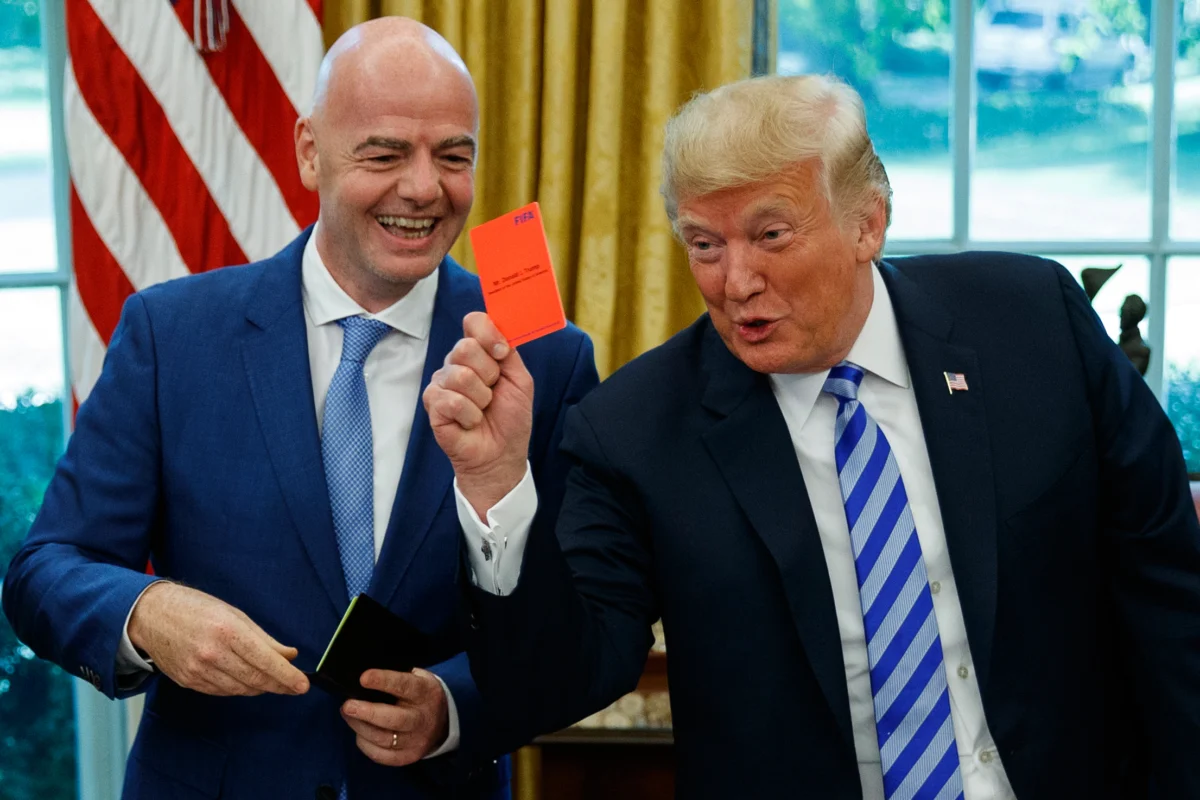
BRUSSELS – A growing coalition of European Union lawmakers has launched a formal challenge against the leadership of FIFA, the global governing body of football, alleging that political interference reached the highest levels of the sport’s administration. The controversy centers on FIFA President Gianni Infantino and a decision to rescind a mandatory suspension for United States national team striker Folarin Balogun following a direct intervention by U.S. President Donald Trump.
The move by members of the European Parliament (MEPs) signals a deepening rift between European political institutions and FIFA, an organization long dogged by allegations of corruption and opaque decision-making. At the heart of the dispute is whether the fundamental principle of sporting neutrality has been sacrificed for diplomatic expediency.
Main Facts: A Crisis of Governance
The current storm began following a contentious match between the United States and Bosnia-Herzegovina on July 1, during which Folarin Balogun, the 25-year-old rising star of the U.S. squad, was issued a straight red card. Under standard FIFA disciplinary codes, a red card carries an automatic minimum one-match suspension, which would have sidelined Balogun for the team’s subsequent high-stakes fixture on the following Monday.
However, in a move that has stunned the international football community, FIFA’s disciplinary committee announced that the suspension had been lifted, rendering Balogun eligible for selection. This reversal occurred shortly after a reported communication between President Donald Trump and Gianni Infantino.
The backlash from the European Parliament was swift. A group of 35 lawmakers, led by Barry Andrews (Ireland), Lara Wolters (Netherlands), and Niels Fuglsang (Denmark), has formally called for an investigation into Infantino’s conduct. The MEPs are urging national football associations across the EU to pressure the FIFA Ethics Committee to examine whether the decision was a "perversion of justice" spurred by political pressure.
The allegations go beyond a single match. The lawmakers are also questioning "other potential breaches of political neutrality," specifically citing the controversial awarding of a "FIFA Peace Prize" to Donald Trump—an accolade that critics argue further blurs the line between global sports governance and international partisan politics.
Chronology: From the Pitch to the Parliament
To understand the gravity of the current situation, one must look at the rapid sequence of events that transformed a routine disciplinary matter into a geopolitical scandal.
July 1: The Incident
During a physical encounter between the U.S. and Bosnia-Herzegovina, Folarin Balogun was involved in an altercation that resulted in a red card. The referee’s report cited violent conduct, which typically triggers an immediate ban. In the immediate aftermath, the U.S. Soccer Federation appeared to accept the ruling, preparing for their next match without their leading striker.
July 2–3: The Intervention
Reports began to circulate in diplomatic circles that the U.S. administration was dissatisfied with the ruling, viewing the suspension as a blow to the national team’s momentum. Sources indicate that President Trump contacted Gianni Infantino directly to discuss the "fairness" of the red card. While FIFA initially maintained that its committees operate independently, the narrative shifted rapidly following this high-level contact.
July 5 (Monday morning): The Reversal
Just hours before the U.S. team’s next scheduled match, FIFA issued a statement confirming that the disciplinary committee had reviewed the Balogun case and decided to lift the suspension. The justification provided was vague, citing "extenuating circumstances" and a "re-evaluation of the match footage," despite the original referee’s decision being widely viewed as consistent with standard officiating.
July 6–7: The European Backlash
As news of the reversal spread, European lawmakers began coordinating a response. By midweek, Barry Andrews, Lara Wolters, and Niels Fuglsang had drafted a joint statement and a letter to national football associations. Within 48 hours, the number of signatories reached 35, representing a broad spectrum of political groups within the European Parliament.
Supporting Data: FIFA’s History and the Legal Framework
The frustration of the MEPs is rooted in a long history of concerns regarding FIFA’s autonomy. FIFA’s own statutes (specifically Article 15) emphasize the independence of its member associations and the necessity of remaining "neutral in matters of politics and religion."
The Precedent of Disciplinary Independence
In the last decade, FIFA has rarely overturned red card suspensions unless there was a clear case of mistaken identity—a scenario where the wrong player was sent off. Statistical data from the last five World Cup cycles and major regional tournaments shows that 98% of straight red cards for violent conduct are upheld by the disciplinary committee. The Balogun reversal, therefore, represents a statistical anomaly that critics say cannot be explained by sporting logic alone.
The Role of the European Parliament
While FIFA is headquartered in Zurich, Switzerland (outside the EU), the European Parliament wields significant influence over the national football associations of its 27 member states. By targeting these associations, the MEPs are attempting to create a "bottom-up" pressure campaign. The EU has increasingly viewed sport as a matter of public interest, particularly following the European Court of Justice rulings on the "European Model of Sport," which emphasizes integrity, transparency, and fair competition.
The "Peace Prize" Controversy
The lawmakers’ letter specifically mentions the FIFA Peace Prize awarded to Trump. While FIFA has occasionally engaged in "Football for Hope" and other social responsibility initiatives, the creation of a Peace Prize for a sitting head of state is unprecedented in the organization’s 120-year history. Critics argue this serves as a "soft power" tool, creating a transactional relationship between the football body and world leaders.
Official Responses: Defenses and Accusations
The rhetoric surrounding the investigation has been sharp, reflecting the high stakes for both the future of FIFA and the reputation of European sports oversight.
The Lawmakers’ Stance
In their joint statement, Andrews, Wolters, and Fuglsang were unequivocal:
"The beauty of sport is that it is based on impartial and transparent rules. When Infantino allows political pressure to determine who gets to play, this sense of fairness goes out the window. We’ve seen Infantino and FIFA surrender to the demands of the Trump administration. This is a disgrace and a perversion of justice."
The lawmakers argue that if the rules of the game can be changed mid-tournament at the behest of a powerful politician, the integrity of all international competitions is compromised.
FIFA’s Defense
FIFA has sought to distance Infantino from the decision. A spokesperson for the organization stated:
"The lifting of the suspension for Folarin Balogun was a decision reached independently by the FIFA Disciplinary Committee. This body operates with full autonomy and bases its rulings on the technical merits of each case. FIFA remains committed to the highest standards of neutrality and sporting integrity."
However, the organization has not provided a detailed technical explanation for why the red card was rescinded, nor has it commented directly on the alleged phone call between Infantino and the U.S. President.
National Associations
So far, national football associations in countries like Germany, France, and Denmark have acknowledged receipt of the MEPs’ letter. While they have been cautious in their public comments to avoid sanctions from FIFA (which forbids government interference in football), several officials have privately expressed "grave concern" over the precedent set by the Balogun case.
Implications: The Future of Global Sport
The investigation launched by European lawmakers could have far-reaching consequences for the structure of international football.
1. The Erosion of Sporting Integrity
The most immediate concern is the "slippery slope" of political interference. If the U.S. can successfully lobby for a player’s reinstatement, other powerful nations may feel emboldened to do the same. This threatens to transform the football pitch into an extension of the diplomatic arena, where the "rules of the game" are negotiable based on the stature of the participants.
2. A Challenge to Infantino’s Leadership
Gianni Infantino has positioned himself as a reformer who cleaned up FIFA after the Sepp Blatter era. However, this incident, combined with the "Peace Prize" controversy, provides fresh ammunition for his detractors. If the FIFA Ethics Committee—under pressure from EU member associations—finds evidence of undue influence, Infantino could face a formal challenge to his presidency.
3. EU-FIFA Relations
The European Parliament’s intervention marks a more assertive stance by the EU in the governance of global sports. This could lead to stricter regulations on how European clubs and associations interact with international bodies. There is already talk in Brussels of a "Sports Integrity Act" that would mandate transparency in dealings between sporting officials and political figures.
4. Impact on Folarin Balogun and U.S. Soccer
For Balogun, a talented young striker, the controversy casts a shadow over his international career. While he benefited from the decision, he is now at the center of a geopolitical firestorm. For U.S. Soccer, the incident risks alienating international peers who may view the team as receiving preferential treatment due to the country’s political weight.
Conclusion
The demand for an investigation into Gianni Infantino is more than a dispute over a red card; it is a battle for the soul of international sport. As 35 MEPs lead the charge for transparency, the world of football awaits a resolution that will determine whether the "beautiful game" remains governed by the whistle or by the halls of power. If the European lawmakers succeed in their quest, it may well signal the end of an era of unchecked executive power within FIFA.