
In a week defined by geopolitical tension, market volatility, and the launch of high-priced consumer technologies, the global economic landscape of September 2026 is facing a crisis of clarity. From the White House’s questionable energy statistics to Vanguard’s warnings of a "near-zero" labor growth environment, the gap between official narratives and data-driven reality is widening. This report examines the core discrepancies in energy reporting, the underlying frailty of the American labor market, and the shifting dynamics of global finance and technology.
Main Facts: The Discrepancy in Global Energy Data
The primary point of contention this week centers on U.S. Energy Secretary Chris Wright, whose recent public statements regarding oil shipments from the Middle East have been met with skepticism by energy analysts. On Wednesday, Secretary Wright claimed that more oil is currently exiting the Middle East—specifically through the Strait of Hormuz and various bypass pipelines—than was being exported prior to the onset of the current regional conflict.
Wright asserted that on Monday, August 31, over 17 million barrels of oil flowed through the Strait of Hormuz, marking a record for the duration of the conflict. However, independent tracking firms, most notably TankerTrackers.com, have characterized these figures as "mathemagics." According to Samir Madani, co-founder of the tracking service, the actual volume exiting the Arabian Sea on that day was approximately 9.14 million barrels—nearly half of what the White House reported.
This statistical inflation has significant implications. With oil prices stubbornly hovering above $95 per barrel, the White House’s attempt to project a sense of energy security appears to be an effort to calm markets that remain on edge due to supply chain disruptions. The discrepancy suggests that the "bypass" routes and alternative pipelines are not compensating for the risks associated with the Strait of Hormuz as effectively as the administration claims.
Chronology: A Week of Economic and Technological Shifts
The events of late August and early September 2026 provide a snapshot of an economy in transition:
- August 31, 2026: Oil export data from the Middle East shows a significant bottleneck, with only 9.14 million barrels exiting the region, despite White House claims of record-breaking flows.
- September 1, 2026: Vanguard releases its internal 401(k) database analysis, revealing that employment growth has effectively stalled among its 2,500 client companies.
- September 2, 2026: Secretary Chris Wright delivers his controversial "17 million barrel" speech, prompting immediate pushback from market analysts. Simultaneously, the S&P 500 closes up as bond yields begin a slight retreat from record highs.
- September 3, 2026: James Dyson announces the launch of a $499 camera-equipped toothbrush, while rumors of a $2,500 "iPhone Ultra" foldable device dominate tech circles. On the geopolitical front, the Dutch central bank begins moving gold reserves out of New York, citing "geopolitical unrest."
Supporting Data: Labor Market Realities and Market Normalization
The Labor Force "Vanishing Act"
While the official unemployment rate remains relatively stable at 4.1%, the underlying data from Vanguard tells a more concerning story. Adam Schickling, Senior Economist at Vanguard, notes that the labor force participation rate for "prime-age" workers (25–54 years old) has declined by approximately 50 basis points year-to-date. This represents one of the largest non-recessionary drops in recorded history.
Since January 2026, there has been a cumulative decline of 833,000 in household employment. Schickling argues that the unemployment rate is only staying low because workers are dropping out of the labor force entirely rather than searching for new roles. If participation had remained at 2025 levels, the unemployment rate would currently sit at 4.4%. Vanguard predicts that as these "dropouts" eventually re-enter the workforce, the unemployment rate will face significant upward pressure.

The "Higher-Rate Era" and Bond Yields
In the financial markets, the global selloff in government bonds has pushed yields to levels not seen in years. The 30-year Treasury yield recently peaked at 5.31%, while the 10-year yield remains near 4.78%.
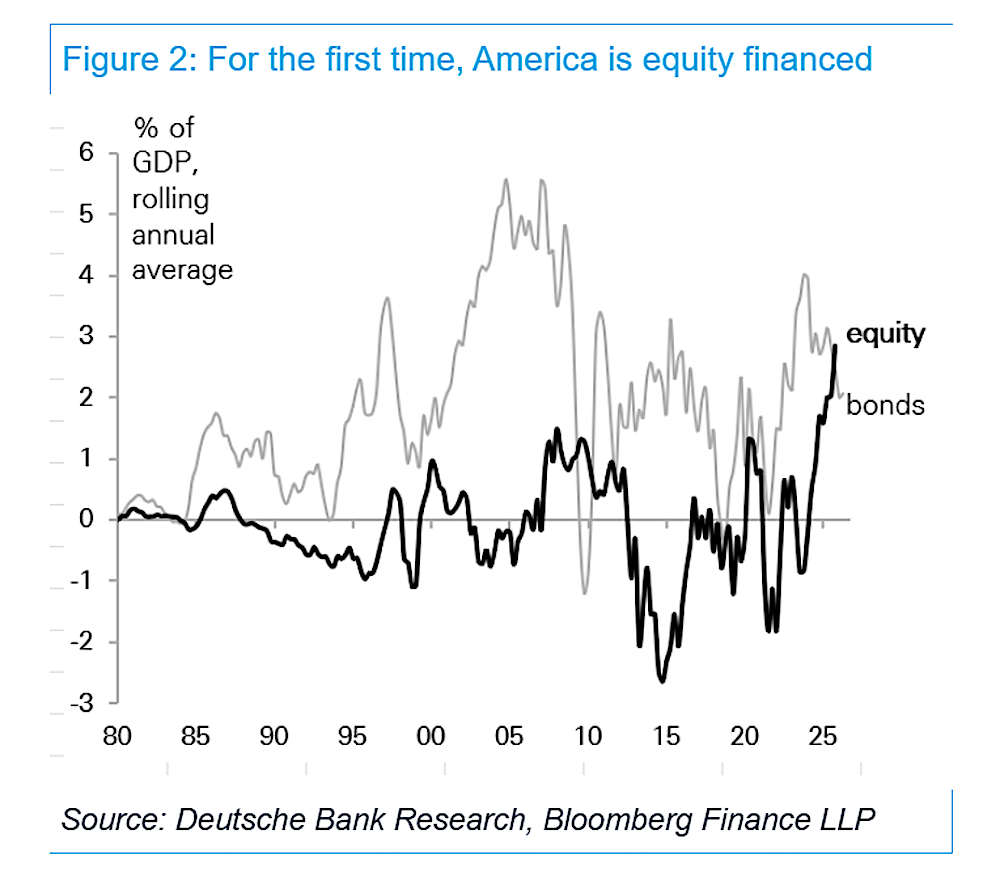
Jim Reid, Global Head of Macro Research at Deutsche Bank, suggests that this is not necessarily a reaction to the $40 trillion U.S. national debt, but rather a "normalization" following the "financial repression" of the 2010s. However, the data shows a fascinating pivot: for the first time since the 2008 Great Financial Crisis, foreign equity inflows into the U.S. have overtaken fixed-income (bond) inflows. Investors appear to be betting on the American private sector—driven by AI and record profit margins—while simultaneously shunning the public sector’s worsening balance sheet and 6% deficits.
Technological Dominance and Luxury Pricing
In the tech sector, SpaceX’s Starlink continues to consolidate its monopoly. Deutsche Bank reports that Starlink now owns 54% of all satellites in orbit, with an expected 17 million subscribers by the end of 2026. This dominance is bolstered by SpaceX’s ability to lower hardware costs while increasing speeds, creating a barrier to entry that competitors are struggling to overcome.
Simultaneously, Apple is preparing to test the limits of consumer spending with the rumored "iPhone Ultra." Priced between $2,000 and $2,500, the device is viewed by analysts at J.P. Morgan not as a mass-market product, but as a "proof of concept" for a new platform. This mirrors the strategy of Dyson, whose $499 toothbrush highlights a trend toward ultra-premium, niche "solution" products in a cooling economy.
Official Responses: Defense and Deflection
The responses from various leaders and institutions reflect a mix of defensive posturing and cautious realism.
The White House and Energy Department:
Secretary Chris Wright has stood by his assessment of energy flows, though the Department of Energy has yet to provide a granular breakdown of the "bypass export pipelines" that supposedly account for the 8-million-barrel discrepancy. The administration’s narrative remains focused on "energy independence" and "resilience," even as oil prices suggest a different market reality.
Vanguard’s Economic Outlook:
Adam Schickling’s analysis serves as a warning to policymakers. By highlighting the "near-zero" growth in August, Vanguard is signaling that the post-pandemic labor boom has officially ended. Their prediction of a "retention crunch" among federal workers—exacerbated by the 2027 budget proposal that denies raises to most roles—suggests a brewing crisis in public sector staffing.
The Corporate View (James Dyson):
In an interview with the Wall Street Journal, James Dyson offered a candid, if eccentric, defense of his company’s high-priced innovations. Regarding the $499 toothbrush, Dyson remarked, "The board doesn’t all get sacked because we did something silly." He admitted to having "no clue" if a market exists for the product, emphasizing a philosophy of engineering-led risk-taking over market-tested safety.
Implications: A Fragile Path Forward
The convergence of these trends suggests several critical implications for the final quarter of 2026 and the 2027 fiscal year:
1. Geopolitical Trust and the "Gold Exit"
The decision by the Dutch central bank to move gold bars out of New York is a symbolic and practical blow to the status of the U.S. as a "safe haven." When combined with the U.S.-China spat at the G20—which reportedly stalled over a dispute regarding a single word in a joint communique—it is clear that the global order is fracturing. Energy security will remain the primary lever of power, and if the U.S. administration continues to provide misleading data, it may lose the trust of the very markets it seeks to stabilize.
2. The Cost of Living vs. Romantic Expectations
A surprising social implication of the current economy was highlighted in a recent Fortune study on dating. U.S. Millennials now ideally expect a romantic partner to earn $160,000—more than double the median annual earnings of $72,020 for that age group. This "expectation gap" mirrors the broader economic disconnect: as the cost of "luxury" goods (like $2,500 iPhones and $500 toothbrushes) rises, the ability of the average worker to meet those costs—or the social expectations attached to them—is diminishing.
3. The Trade War and Household Essentials
The looming threat of retaliatory tariffs from Canada in response to U.S. trade policies could bring back a familiar crisis: a toilet paper shortage. As trade tensions escalate, everyday household items are becoming "kitchen table issues" once again. This highlights the vulnerability of the U.S. consumer to shifts in trade policy, particularly when the domestic manufacturing base for such goods remains susceptible to supply chain shocks.
4. The Federal Workforce Crisis
With the Trump administration’s 2027 budget proposal aiming to curb federal pay raises, agencies are warning of a "retention crunch." As critical employees in sectors like air traffic control and energy regulation reach retirement age, the lack of competitive pay and the "DOGE" (Department of Government Efficiency) initiatives may lead to a massive brain drain, further hampering the government’s ability to manage the complex economic and energy issues detailed in this report.
In conclusion, while the stock market shows signs of resilience and private sector balance sheets remain strong due to the AI boom, the public sector and the broader labor market are showing signs of significant strain. The reliance on "mathemagics" to paint a rosy picture of energy security may provide temporary relief, but the underlying data suggests a period of prolonged volatility and "normalization" that will test the limits of both consumers and policymakers.