By John Talty
Updated: September 13, 2026
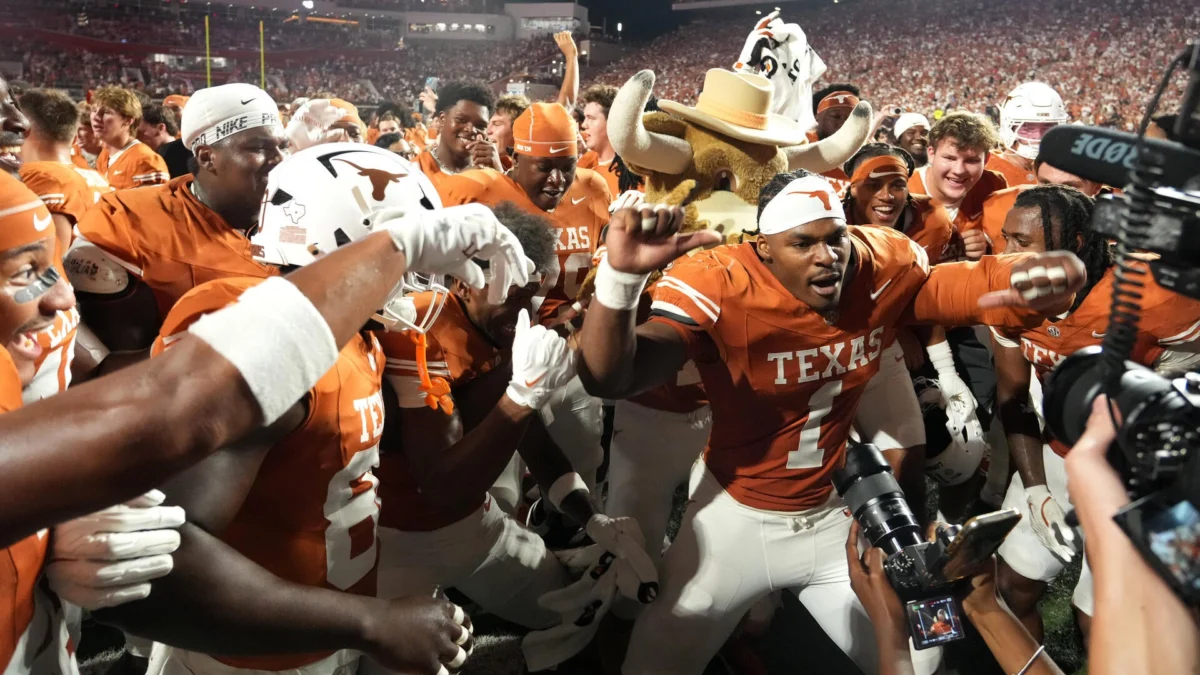
The landscape of college football shifted violently on Saturday night, leaving the sport’s hierarchy fundamentally altered. In a contest that will be etched into the annals of gridiron lore, the University of Texas Longhorns staged a desperate, high-octane fourth-quarter comeback to dismantle the top-ranked Ohio State Buckeyes, securing a 24-23 victory that has propelled them to the summit of the Associated Press Top 25 poll.
The win was not merely a result; it was a statement. For the Buckeyes, the loss represents a historic collapse, as they became the first No. 1 team in the nation since 1988 to surrender a 20-point lead. As the dust settles in Austin, the fallout from this weekend’s chaos is rippling across the collegiate landscape, with traditional powers reeling and the national title picture becoming clearer—and more volatile—than ever.
The Anatomy of an All-Time Comeback
To understand the magnitude of Texas’s ascension, one must look at the grim reality the Longhorns faced for three quarters. Ohio State entered the game with the swagger of a team destined for a national championship run. Their defense, touted as the most suffocating unit in the Big Ten, held the Texas offense in a stranglehold for 45 minutes of game time.
By the midway point of the third quarter, the Buckeyes had established a commanding 20-0 lead. The atmosphere in the stadium had shifted from electric anticipation to a hushed, agonizing tension. Texas appeared outmatched, out-schemed, and out-executed.
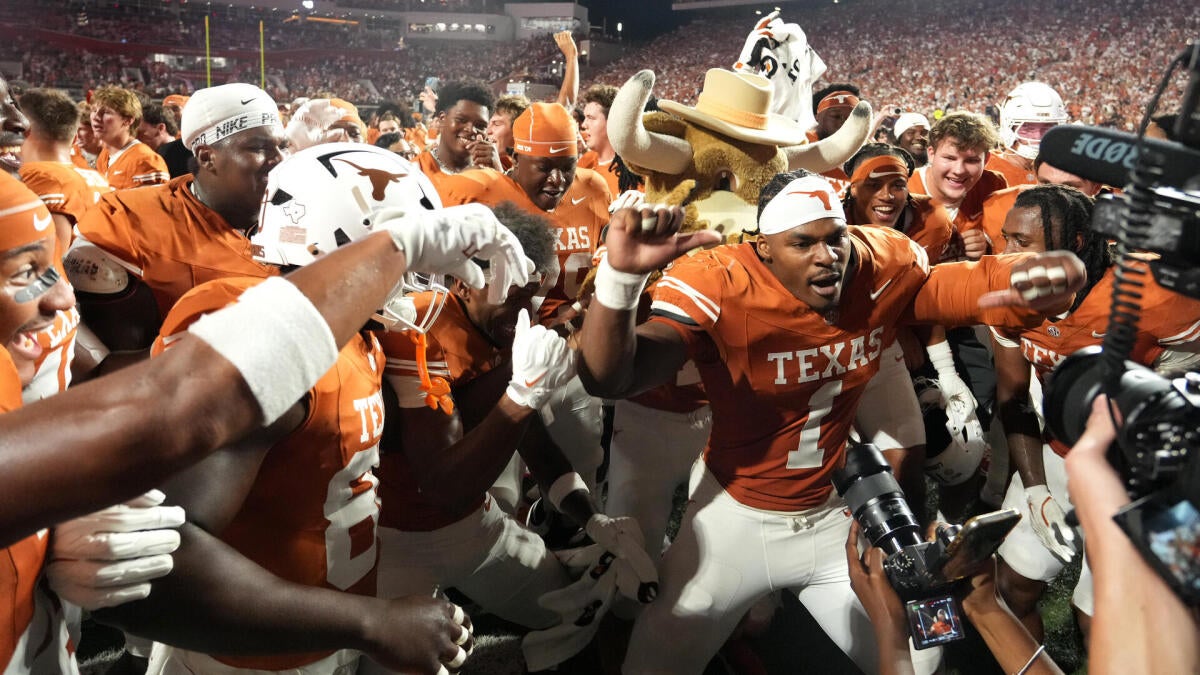
However, the final fifteen minutes of play catalyzed a shift that few observers saw coming. The Longhorns’ offense, dormant for the majority of the evening, suddenly found its rhythm. Through a combination of precise aerial attacks and a revitalized ground game, Texas punched in three unanswered touchdowns in the final frame. The final blow, a drive orchestrated with surgical precision, culminated in a game-winning score that sent the capacity crowd into a frenzy, officially unseating the Buckeyes from their perch.
Chronology of a Collapse
The statistical collapse of Ohio State is as remarkable as the Texas rally.
- First Quarter: Ohio State asserted dominance early, capitalizing on two Texas turnovers to build a 10-0 lead. The Buckeye defense forced consecutive three-and-outs, stifling the Longhorns’ momentum before it could materialize.
- Second Quarter: The Buckeyes extended their lead to 17-0 heading into halftime. The Texas offense struggled to find space against a relentless Ohio State pass rush, failing to convert on critical third downs.
- Third Quarter: Ohio State tacked on a field goal to make it 20-0. At this juncture, the win probability for Ohio State sat at over 98%.
- Fourth Quarter: The turning point arrived with 12:44 remaining. A Texas touchdown pass ignited the offense. Following a defensive stop, the Longhorns marched 80 yards in under three minutes. With time ticking away, the Texas defense forced a turnover on downs, giving the offense one last chance. They converted on a high-stakes fourth-and-eight, eventually finding the endzone to seal the 24-23 victory with mere seconds remaining on the clock.
The Big Ten’s Tumultuous Weekend
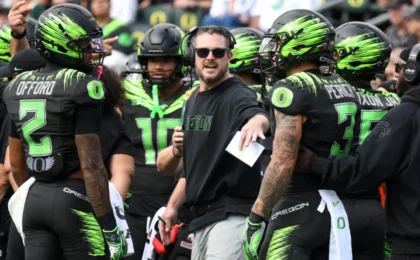
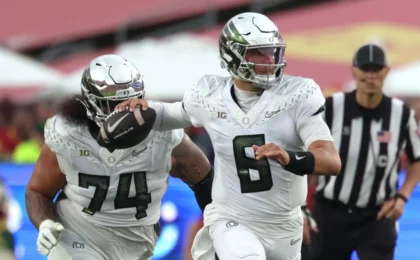
While the Ohio State loss grabbed the headlines, the conference as a whole suffered a bruising Saturday. The Oregon Ducks, who entered the season as a national title favorite and were ranked No. 6 heading into the weekend, experienced a humiliating decline.
Following a shocking road loss to Oklahoma State, the Ducks plummeted from the upper echelon of the rankings to No. 21. The defeat exposed significant vulnerabilities in Oregon’s roster, particularly regarding their offensive consistency and defensive discipline. The fallout from the loss has already prompted intense scrutiny regarding the team’s coaching staff and their ability to compete in high-pressure road environments.
The combined losses of Ohio State and Oregon have left the Big Ten in a state of flux. While the conference remains among the most competitive in the nation, the perceived dominance of its top-tier programs has been challenged, opening the door for SEC and Big 12 programs to seize control of the College Football Playoff narrative.

Supporting Data: A League in Transition
The current AP Top 25 reflects the volatility of the 2026 season. With Texas now sitting at No. 1, the surrounding landscape is filled with teams eager to capitalize on the instability.
| Rank | Team | Record | Trend |
|---|---|---|---|
| 1 | Texas | 2-0 | ↑ |
| 6 | Ohio State | 1-1 | ↓ |
| 7 | LSU | 2-0 | – |
| 8 | Ole Miss | 2-0 | – |
| 21 | Oregon | 1-1 | ↓↓ |
The "Also Receiving Votes" section of the poll is particularly crowded this week, signaling that voters are struggling to identify the legitimate contenders from the pretenders. Programs like Washington, Florida, and Boise State are lurking just outside the top tier, waiting for the inevitable upsets that accompany the grueling nature of the mid-season schedule.
Official Responses and Tactical Implications
In the post-game press conference, Texas head coach expressed his pride in his team’s resilience, noting that "the character of this group was tested in the most extreme way possible, and they responded with championship-level composure."
Conversely, the mood in the Ohio State locker room was described as "somber and introspective." Head coach Ryan Day faced pointed questions regarding the team’s inability to close out the game, emphasizing the need for better situational football. "We had the game in our hands," Day admitted. "To let a lead of that magnitude slip away requires a total team failure, and we have to own that accountability."
Tactically, the game has provided a blueprint for how to attack the Ohio State defense. By utilizing tempo and spreading the field, Texas was able to tire out the Buckeyes’ front seven, a weakness that future opponents will undoubtedly look to exploit in the coming weeks.

The Road Ahead: The Oxford Showdown
As the dust settles, the college football world is already turning its gaze toward next weekend. The marquee matchup will take place in Oxford, where No. 7 LSU will travel to face No. 8 Ole Miss.
This game carries immense weight for the SEC hierarchy. It marks a homecoming for Ole Miss head coach Lane Kiffin, whose tenure at his former institution remains a point of intense interest. The winner will likely vault into the top five, putting themselves in prime position for a playoff berth. For the loser, the path to the postseason becomes significantly more arduous.
Implications for the National Championship
The victory for Texas is more than a win over a high-ranked opponent; it is a signal that the Longhorns have arrived as a definitive national title contender. The ability to overcome a 20-point deficit against a program like Ohio State is a trait typically reserved for championship teams.
However, the season is still in its nascent stages. The 2026 campaign has proven that rankings in September are ephemeral. The expanded College Football Playoff format means that even with a loss, Ohio State remains very much in the conversation. The Buckeyes’ ability to bounce back from this emotional gut-punch will define their season. If they can rectify their defensive lapses and regain their offensive efficiency, a rematch or a deep playoff run remains a distinct possibility.
For now, however, the spotlight belongs to Austin. Texas has answered the call, survived the fire, and emerged as the team to beat. The road to the national title will run through the Longhorns, and as the rest of the nation witnessed on Saturday, they are more than prepared to defend their new position at the top.