WASHINGTON, D.C. — A high-speed multi-jurisdictional police pursuit originating in Maryland culminated in a dramatic foot chase and arrest on Capitol Hill on Thursday morning, August 20, 2026. The incident unfolded directly outside major national newsroom headquarters near Union Station, sending shockwaves through the district’s media corridor and causing severe traffic gridlock during the tail end of the morning commute.
The pursuit, which involved a suspect linked to a violent shooting in Prince George’s County, Maryland, saw a white commercial van hurtle through Washington’s North of Massachusetts Avenue (NoMa) neighborhood at speeds topping 70 miles per hour before the suspect abandoned the vehicle near Louisiana Avenue NW. The suspect fled on foot into an alley adjacent to the Hall of the States—home to prominent media organizations including NBC News, Fox News, C-SPAN, CNBC, NewsNation, and MS NOW—where heavily armed law enforcement officers neutralized the threat and took the individual into custody.
The incident drew a massive response from the District of Columbia Metropolitan Police Department (MPD), the U.S. Capitol Police (USCP), and the U.S. Park Police (USPP). Combined with pre-existing road closures for the upcoming Freedom 250 Grand Prix, the tactical response paralyzed traffic, delayed public transit, and disrupted routine operations across the nation’s capital.
Main Facts: High-Speed Pursuit Terminates in D.C.’s Press Hub
The dramatic event began during the morning rush hour when Maryland authorities identified a vehicle tied to an ongoing shooting investigation in Prince George’s County. When the driver refused to pull over, a cross-border pursuit ensued, crossing the District line and threading through high-density commercial and residential corridors.
Key Details of the Operation:
- Origin and Termination: Initiated in Prince George’s County, Maryland; terminated in the alley connecting the Kimpton George Hotel and Kelly’s Irish Times on E Street NW in Washington, D.C.
- Agencies Involved: Prince George’s County Police Department (PGPD), D.C. Metropolitan Police Department (MPD), U.S. Capitol Police (USCP), and U.S. Park Police (USPP).
- Suspect Vehicle: A white utility van operated at extreme speeds through urban traffic.
- Location Context: The apprehension occurred yards from the Hall of the States (444 N. Capitol St. NW), a central operational hub for national political broadcast journalism.
- Public Impact: Delays on the Washington Metropolitan Area Transit Authority (WMATA) Red Line, localized blockades near Union Station, and severe vehicular bottlenecks across Capitol Hill.
While the pursuit ended without major physical injuries to bystanders or law enforcement officers, the suspect was transported via emergency medical services under heavy police escort for evaluation and processing.
Chronology of Events: From Suburban Pursuit to Capitol Hill Arrest
Reconstructing the sequence of events reveals a fast-moving, high-stakes tactical scenario that moved rapidly across jurisdictional lines within minutes.
08:45 AM – Shooting suspect identified in Prince George's County, MD; vehicle flees police.
09:15 AM – High-speed pursuit crosses Maryland line into Washington, D.C. (NoMa district).
09:25 AM – White van travels southbound on First St. NE at 70 mph; airborne over K St. bump.
09:35 AM – Suspect abandons vehicle on Louisiana Ave. NW near Union Station; flees on foot.
09:40 AM – Multi-agency foot pursuit converges on E Street NW alleyway.
09:50 AM – Suspect apprehended near Kimpton George Hotel; officers sweep area for evidence.
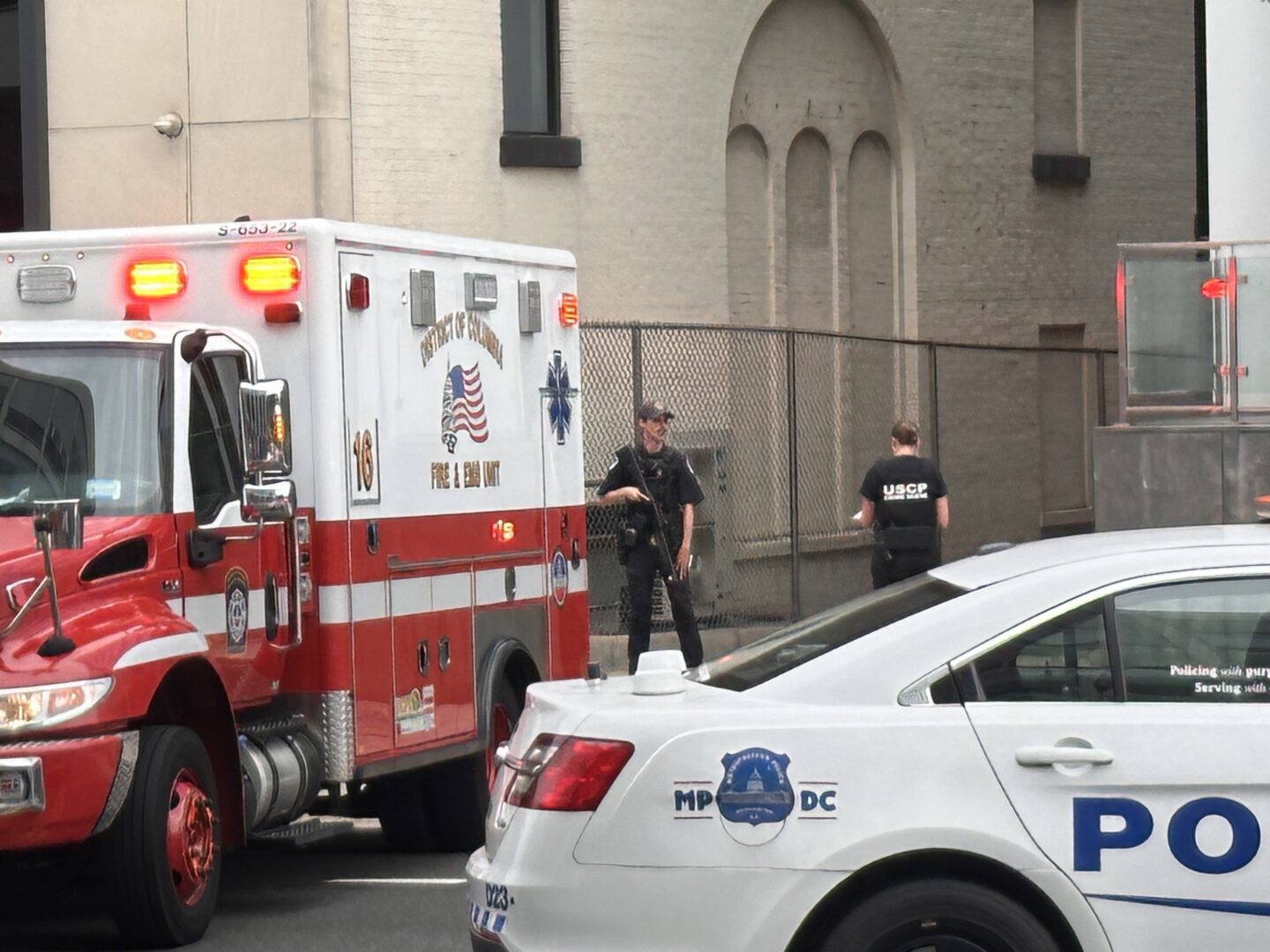
10:00 AM – Suspect loaded into ambulance; perimeter maintained for evidence recovery.
1. The Maryland Origin and Border Crossing
The emergency sequence began in Prince George’s County, Maryland, where law enforcement attempted to stop a white utility van tied to a reported shooting incident. The driver evaded officers, accelerating down regional transit corridors heading southwest toward the District of Columbia border. As the pursuit crossed state lines, Maryland authorities alerted Washington-area regional communications centers, triggering joint operational protocols between D.C. Metropolitan Police, U.S. Park Police, and federal authorities protecting the Capitol precinct.
2. High-Speed Dash Through NoMa
Upon entering D.C., the suspect navigated into the densely populated NoMa district. Eyewitnesses reported seeing a white van travelling southbound on First Avenue NE at approximately 70 miles per hour, aggressively weaving through traffic with police cruisers and motor units in close pursuit.
Near the intersection of First Street and K Street NE—just outside former press offices and near CNN’s Washington bureau—the van struck a prominent roadway elevation at high speed, momentarily lifting off the asphalt before violently slamming back down and continuing toward Union Station.
3. Abandonment on Louisiana Avenue
Reaching the congested intersections framing Union Station, the suspect found forward movement blocked by traffic and police maneuvers. On Louisiana Avenue NW, the driver brought the damaged van to a halt, exited the vehicle, and fled on foot toward the commercial blocks bordering North Capitol Street.
4. Foot Pursuit and Apprehension on E Street NW
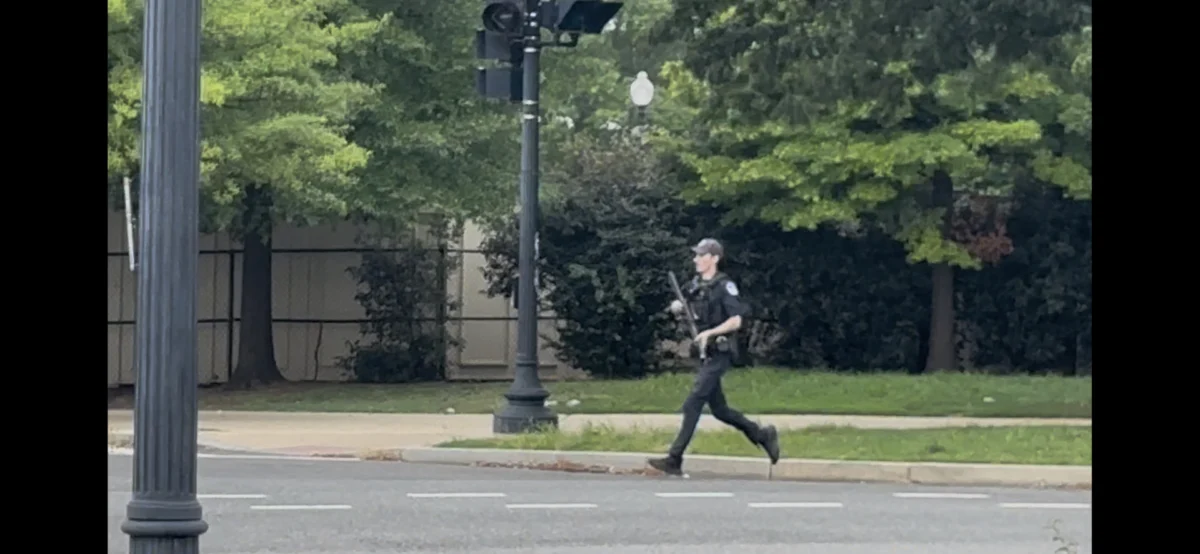
Dozens of officers from MPD, USCP, and U.S. Park Police descended on the area with handguns and long long-guns drawn, surrounding the block. Tourists, political staff, and newsroom personnel watched as officers pursued the suspect into an alleyway connecting the Kimpton George Hotel and Kelly’s Irish Times pub on E Street NW.
By 9:50 a.m., law enforcement officers cornered and subdued the suspect in the alley. Emergency medical crews were immediately called to the scene to evaluate the suspect before transport to a secure facility.
+-------------------------------------------------------------------------------+
|                           CRIME SCENE GEOGRAPHY                               |
|                                                                               |
|  [ K Street NE ] ---> High-speed airborne bump near CNN / Press offices      |
|         |                                                                     |
|  [ First Street NE ] ---> Southbound chase at ~70 MPH                         |
|         |                                                                     |
|  [ Louisiana Ave NW ] ---> Suspect abandons white van near Union Station      |
|         |                                                                     |
|  [ E Street NW Alley ] ---> Foot chase, arrest near Kimpton George Hotel     |
|         |                                                                     |
|  [ Hall of the States ] ---> Media HQ (NBC, Fox News, C-SPAN, CNBC, MS NOW)  |
+-------------------------------------------------------------------------------+
Supporting Data and Tactical Response
The multi-agency intervention required rapid real-time coordination among distinct law enforcement bodies within the complex federal layout of Washington, D.C.
Multi-Agency Police Force Deployment
| Agency | Primary Role in Incident | Key Assets Deployed |
|---|---|---|
| Prince George’s County Police (PGPD) | Initial pursuit, primary offense investigation | Patrol units, regional alert communications |
| D.C. Metropolitan Police (MPD) | Lead urban tactical jurisdiction, perimeter control | Marked/unmarked cruisers, canine units, forensic teams |
| U.S. Capitol Police (USCP) | Perimeter security, high-risk tactical support | Armed foot patrols, specialized long-gun units |
| U.S. Park Police (USPP) | Inter-jurisdictional motor response | Motorcycle units, tactical vehicle support |
Gridlock Compound: The Freedom 250 Grand Prix
The urban disruption was amplified by existing traffic restrictions across downtown D.C. Large swaths of major arteries—including Pennsylvania Avenue, Independence Avenue, and Constitution Avenue—had already been cordoned off by city authorities in preparation for the weekend’s Freedom 250 Grand Prix.
When police closed off sections of Louisiana Avenue, North Capitol Street, and E Street NW to secure the crime scene, traffic was forced into choked detours, cascading gridlock throughout the Capitol Hill and Penn Quarter neighborhoods.
       [Downtown D.C. Traffic Bottleneck Matrix]

       Freedom 250 Grand Prix Closures (Penn/Ind. Aves)
                           +
       Emergency Police Cordon (Union Station / E St NW)
                           =
       Severe Commute Disruptions & WMATA Red Line Delays
Transit System Delays
The pursuit affected public transportation systems across the city center. The Washington Metropolitan Area Transit Authority (WMATA) briefly held Red Line trains at the NoMa-Gallaudet University Station due to police tactical operations near the tracks and surrounding street level. Commuters experienced cascading delays across the system during the height of the morning commute.
Official Responses and Eyewitness Accounts
The event unfolded in full view of national journalists, press photographers, and news directors, creating a surreal scene where the press corps witnessed breaking news occurring right outside their office windows.
Statements from Media Personnel and Eyewitnesses
-
Tom Williams, Senior Photographer, CQ Roll Call:
"I was in the middle of my morning jog near 77 K Street NE when I saw a white van going southbound at about 70 miles per hour, pursued by a cop car and a cop motorcycle. The van hit some kind of bump and came off the ground before speeding off toward Louisiana Avenue."
-
Anonymous Cable Television News Producer (Hall of the States):
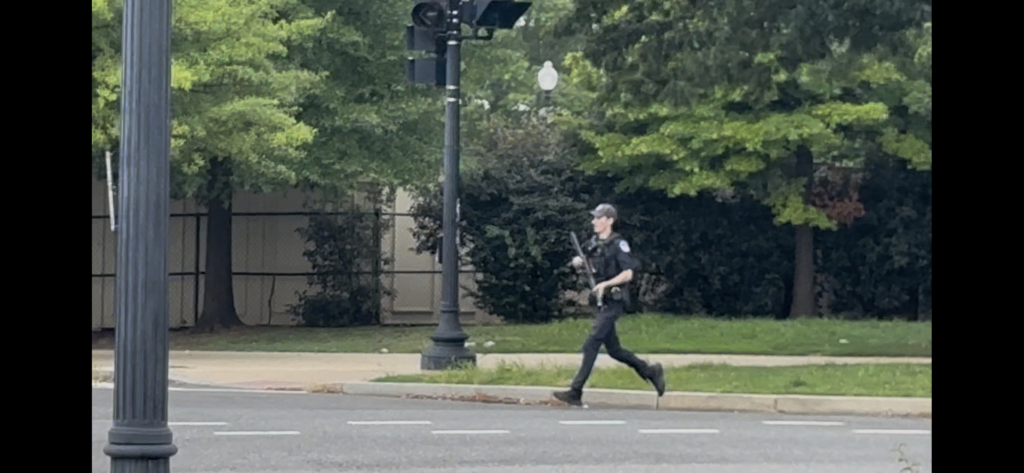
"A lot of 10 a.m. meetings are about to get blown up. You look out the window and see Capitol Police and MPD running with long guns drawn down the alley—it instantly shifted every newsroom in the building into full breaking news coverage."
-
Commercial Property Security Staffing:
Following the arrest, forensic officers meticulously searched flower beds, storm drains, and sidewalks along E Street NW near the Corner Bakery to locate discarded evidence, including potential weapons. Security personnel instructed gathering crowds of reporters and onlookers to remain behind established police tape lines.
Law Enforcement Statements
By 10:15 a.m., MPD officials confirmed that the suspect was in custody and that no active threat remained to the public. Forensic technicians remained on scene on Louisiana Avenue NW and E Street NW to document the abandoned vehicle and collect physical evidence.
Implications and Broader Analysis
Thursday morning’s events highlight long-standing administrative, operational, and strategic dynamics within the National Capital Region (NCR).
1. Inter-Jurisdictional Policing Complexity
Washington, D.C. features one of the most complex law enforcement environments in the nation, with dozens of federal, local, and specialized police agencies operating within overlapping boundaries.
The seamless transition of the chase from Maryland state jurisdiction into D.C. municipal territory—and subsequently onto land protected by federal Capitol Police and Park Police—demonstrates the operational necessity of inter-agency radio interoperability. While cross-border pursuits carry inherent risks, multi-agency protocols established under the Metropolitan Washington Council of Governments (MWCOG) enabled rapid perimeter containment, limiting potential civilian casualties.
2. High-Speed Pursuit Regulations in Dense Urban Centers
High-speed vehicular chases in densely populated metropolitan areas remain a subject of debate among law enforcement analysts. Balancing the immediate imperative to apprehend a violent suspect against the risk posed to pedestrians and motorists requires split-second tactical calculations.
+-------------------------------------------------------------------------------+
|                      URBAN PURSUIT RISK ASSESSMENT                            |
|                                                                               |
|   PUBLIC SAFETY RISK                         LAW ENFORCEMENT IMPERATIVE       |
|   * High pedestrian density near transit     * Apprehension of violent suspect|
|   * Airborne vehicle dynamics in NoMa        * Inter-state flight evasion     |
|   * Pre-existing street closures/gridlock    * Prevention of secondary crime  |
+-------------------------------------------------------------------------------+
The fact that a 70-mph chase occurred through NoMa during peak morning hours underscores the ongoing debate over vehicular pursuit policies. Police commanders must continually evaluate whether pursuit conditions present a greater public danger than allowing a suspect to temporarily escape.
3. Urban Grid Resilience Under Compound Stress
The systemic traffic failure caused by the pursuit, combined with pre-planned closures for the Freedom 250 Grand Prix, exposes the vulnerability of D.C.’s roadway network. When primary east-west and north-south arteries are closed simultaneously, even minor tactical disruptions can paralyze transit throughout the core of the city. Transportation planners and emergency planning management officials continue to study these compound events to improve detour strategies and maintain emergency vehicle routing during major city events.
Conclusion
By mid-morning Thursday, the immediate threat had ended. The suspect was transported for medical evaluation and formal charging, vehicle traffic slowly resumed through cleared corridors, and the media outlets inside the Hall of the States returned to covering national politics—having just witnessed high-stakes national capital policing unfold directly outside their doors.