Main Facts
As the 2026 midterm election cycle enters its crucial autumn stretch, the national political environment presents a complex, high-stakes battleground for both parties. Recent national polling indicates that President Donald Trump’s job approval rating has dropped to historic lows, driven by public dissatisfaction over persistent inflation, average retail gasoline prices surpassing $4 a gallon, an unpopular military conflict with Iran, and the cascading economic effects of aggressive international tariff policies.
Despite these headwinds, national Republican organizers and grassroots leaders gathered in Dallas, Texas, at the American Airlines Center for a two-day midterm convention designed to energize the party faithful. Dubbed by critics as a "Trumpapalooza," the mini-convention prioritized turn-out strategies for the MAGA base, who historically show lower participation rates during midterm cycles when Trump is not personally at the top of the ballot.
Key developments shaping the midterm ecosystem include:
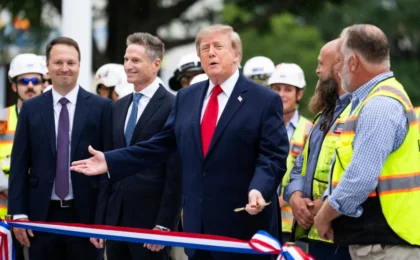
- Presidential Strategy: During a nearly two-hour keynote address in Dallas, President Trump acknowledged historical trends that typically penalize the incumbent president’s party during midterms. To counter this, he urged supporters to act as if he were directly on the ballot, while pitching a headline-grabbing proposal to provide a $5,000 dividend to every American if Republicans maintain control of both the House and the Senate.
- Key Primary Results: Rhode Island held a pivotal Democratic primary where former CVS executive Helena Foulkes unseated incumbent Governor Dan McKee, marking the first primary defeat of a sitting governor since 2018. In New Hampshire, the marquee Senate matchup was finalized between Democratic Representative Chris Pappas and former Republican Senator John E. Sununu, while Stefany Shaheen won the Democratic primary for Pappas’s open House seat.
- Judicial Rulings on Redistricting: The U.S. Supreme Court intervened in Missouri’s congressional map dispute, pausing a lower court order and confirming that the state will use its 2022 congressional boundaries for the upcoming midterm. This decision provides a strategic boost to incumbent Democratic Representative Emanuel Cleaver II.
- Mail-In Voting Contests: The Trump administration and the U.S. Postal Service (USPS) are pursuing emergency litigation before the Supreme Court to implement stricter rules on mail-in voting. Concurrently, public opinion data indicates that roughly 15 percent of registered voters plan to cast their ballots by mail or drop box this cycle.
- Major Ad Campaigns and Spending: Pro-Trump super PAC MAGA, Inc. launched a new entity, No Going Back PAC Inc., deploying tens of millions of dollars across six key Senate battlegrounds and a critical House district. Meanwhile, several down-ballot races saw fierce ad battles touching on trade, ethics, anti-corruption, and foreign policy.
Chronology
The political calendar over early September 2026 featured a rapid sequence of primary contests, judicial interventions, and campaign milestones:
[Late August 2026]
 └── Nonpartisan rating agencies shift key battleground race assessments toward Democrats.
 └── Trump administration proposes Census rule change for 2030 reapportionment.

[September 8, 2026]
 └── New Hampshire primary: Rep. Chris Pappas (D) and ex-Sen. John E. Sununu (R) win nominations.
 └── Stefany Shaheen captures Democratic nomination for NH-01.
 └── Federal judge issues temporary restraining order regarding Missouri's congressional map.

[September 9, 2026]
 └── Rhode Island primary: Helena Foulkes defeats sitting Gov. Dan McKee in Democratic primary.
 └── Day One of the Republican Midterm Convention opens in Dallas, TX.
 └── Sen. John Fetterman (D-PA) releases cross-party video introducing GOP candidate Dave McCormick.
 └── Emergency SCOTUS amicus brief filed by two dozen state election officials regarding USPS mail rules.

[September 10, 2026]
 └── Trump delivers two-hour keynote address in Dallas, proposing $5,000 voter checks.
 └── SCOTUS pauses lower court ruling, keeping Missouri's 2022 map in place for the midterms.
 └── National Republican Congressional Committee (NRCC) updates its "MAGA Majority" candidate roster.

[Upcoming Milestones]
 └── Mid-September: House and Senate reconvene in Washington, D.C.
 └── Mid-September: Final regular primary season concludes in Delaware.
 └── November 3, 2026: Louisiana conducts all-party jungle primaries for House seats.
Supporting Data
Race Rating Shifts and National Trends
Nonpartisan campaign analysts, including Inside Elections, have documented an incremental political shift toward Democrats. Out of eleven recent major rating updates, ten moved in favor of Democratic candidates.
| Race / Jurisdiction | Previous Rating | Updated Rating | Primary Key Driver |
|---|---|---|---|
| New Hampshire Senate | Lean Democratic | Toss-up | Strong candidate matchup (Pappas vs. Sununu) |
| Kansas Senate | Solid Republican | Likely Republican | Economic concerns, cross-party endorsements |
| Florida Governor | Solid Republican | Likely Republican | Cost of living, suburban shifts |
| Iowa’s 2nd District | Likely Republican | Lean Republican | Agricultural tariff impact, open-seat dynamics |
Battleground Spending and Campaign Finance
Large-scale financial commitments are driving media buys across broadcast and digital platforms:
- MAGA, Inc. Allocation: The main pro-Trump super PAC began disbursing funds from its $400 million war chest through a sub-entity, No Going Back PAC Inc. The group made $49 million in early ad reservations targeting six competitive Senate contests (including Maine, Pennsylvania, Michigan, and Georgia) and one competitive House district.
- Iowa’s 2nd Congressional District:
- Joe Mitchell (R): Raised $1.9 million through June 30, including a $100,000 personal candidate loan. Supported by Turning Point Action.
- Lindsay James (D): Raised $1.6 million through June 30. Backed by the DCCC’s "Red to Blue" program, EMILY’s List, and gun-safety organizations.
Campaign Spending Comparison: Iowa 2nd District (Through June 30)

Joe Mitchell (R)   [====================================] $1.9M
Lindsay James (D)  [==================================]   $1.6M
Mail-In Voting Dynamics
According to national survey data from the Economist/YouGov poll:
- Overall Mail-In Intention: 15% of registered voters plan to vote by mail or drop off their ballot via the U.S. Postal Service.
- Partisan Breakdown:
- Trump 2024 Voters: 10% plan to vote by mail.
- Harris 2024 Voters: More than 20% plan to vote by mail.
- Legal Pushback: Officials from 24 states filed emergency briefs with the Supreme Court, arguing that proposed administrative rules governing USPS handling of mail ballots would disrupt ongoing state election logistics.
Official Responses
Republican Leadership and Candidates
Speaking before thousands of party delegates at the American Airlines Center, House Majority Leader Steve Scalise emphasized the stakes of the midterm elections:
"This historic midterm convention is rallying Republicans at the perfect time because so much is on the line this November. President Trump’s America First agenda is at stake."
Addressing the reality of historic midterm pushback against the party holding the executive branch, President Donald Trump pitched his unified platform to the crowd:
"A president, Democrat or Republican, almost never wins the midterms. We’ve got to change that because we have something going that’s so good. We can’t let that string be broken… So I’m asking you to pretend that I’m on the ballot."
In Pennsylvania, State Senator Scott Martin offered a local perspective on the critical nature of key states:
"I feel good about our candidates. And obviously, Pennsylvania is not only critically important for presidential elections, it’s also critically important to where the numbers end up in the U.S. Congress."
Democratic Candidates and Elected Officials
Responding to his taped appearance at the Dallas convention introducing GOP candidate Dave McCormick, Senator John Fetterman (D-PA) issued a statement clarifying his party stance:

"I am a lifelong Democrat who votes overwhelmingly with my party — and should the Senate flip in November, I will still be the 51st vote that I ran on."
In Iowa’s 2nd Congressional District, Democratic nominee Lindsay James targeted cost-of-living issues fueled by tariffs and energy prices, declaring that lawmakers face a:
"…moral obligation to address systemic economic burdens facing working families."
In Virginia’s 1st District, Democratic challenger Shannon Taylor launched a statewide ad highlighting her record as a prosecutor, addressing cross-party law enforcement:
"I didn’t care that he was a Democrat or the pressure that I got to make it go away," Taylor stated in the broadcast ad, referring to her prosecution of a former state official.
Nonpartisan and Cross-Party Actions
In Nebraska’s 2nd District, Republican candidate Brinker Harding faced public pushback after running an ad featuring billionaire investor Warren Buffett. Susie Buffett, the investor’s daughter, publicly requested the ad’s removal:
"It implies that my dad endorses him. He did not have permission to use it."
Conversely, several prominent Republicans broke ranks to endorse Democratic candidates in key races:
- In Texas, Democratic Senate nominee James Talarico earned endorsements from nearly two dozen current and former Republican officials, including former Dallas Mayor Steve Bartlett and former Texas Supreme Court Chief Justice Tom Phillips.
- In Kansas, former Republican Governor Bill Graves publicly endorsed Democratic challenger Adam Hamilton in his race against incumbent Republican Senator Roger Marshall.
Implications
Control of Congress and Suburban Strategy
The political strategy on display in Dallas underscores a divergent approach to the 2026 midterms. By utilizing a base-mobilization framework, national Republican leaders aim to maximize turnout among core populist voters who often skip non-presidential cycles. However, the decision by several swing-district Republican candidates—such as Sydney Gruters in Florida’s 16th District—to skip the Dallas convention highlights a growing divide. Candidates in purple districts face a delicate task: appealing to moderate and independent voters who have expressed frustration with gas prices, international trade friction, and federal executive policies, without alienating the conservative base.
Reapportionment and Judicial Boundaries
The Supreme Court’s decision to pause the lower court order regarding Missouri’s congressional map stabilizes the state’s district lines for the 2026 cycle. By keeping the 2022 map intact, incumbent Representative Emanuel Cleaver II avoids a heavily altered, redrawn district, retaining a more favorable electorate and aiding House Democrats’ broader efforts to recapture the majority.
Concurrently, the Trump administration’s proposed regulatory overhaul to exclude non-citizens and temporary residents from the 2030 Census apportionment count signals a long-term strategy to alter congressional seat allocation. If implemented, the policy would likely shift congressional seats away from states with large immigrant populations toward more rural, conservative jurisdictions, setting up major legal battles over the Constitution’s Fourteenth Amendment mandate.
Trade Policy and Regional Economic Fallout
Escalating trade tensions—particularly recent tariffs affecting Canadian steel, iron, and forestry equipment—are emerging as a major topic in northern battleground states. In industrial and agricultural sectors across Maine, Michigan, Pennsylvania, and Iowa, heightened supply costs for fertilizer, diesel, and raw materials are creating political vulnerabilities for incumbent Republicans.
In Maine, where Republican Senator Susan Collins is defending her seat against Democratic challenger Troy Jackson, federal trade actions and border enforcement policies have elevated economic anxiety. Collins characterized the fluid campaign environment as "the strangest race I’ve ever seen," illustrating how national policy decisions are shifting traditionally localized midterm dynamics.