Introduction: The Homecoming of a Hero
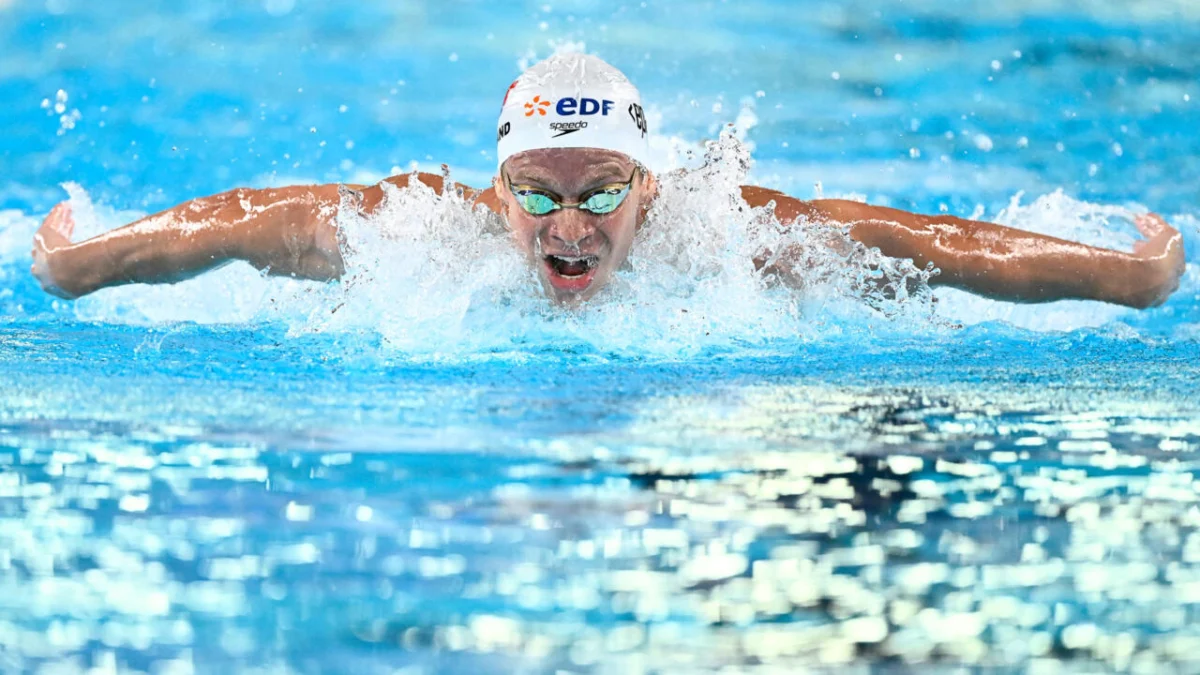
In the grand tapestry of French sporting history, few names resonate with the same magnetic intensity as Léon Marchand. Two years after his breathtaking performance at the 2024 Paris Olympics—where he emulated the legendary Michael Phelps by capturing four gold medals—the Toulouse native returned to the French capital to solidify his status as the premier swimmer of his generation. On Saturday, amidst the roaring fervor of a partisan home crowd, Marchand claimed his first continental title, winning the 200m butterfly final at the European Championships with a time that sent ripples through the swimming world.
Clocking in at 1 minute 51.72 seconds, Marchand did more than just secure a gold medal; he set the fastest time globally for the calendar year. This victory, a testament to his tactical brilliance and mental fortitude, serves as a triumphant bookend to a challenging period defined by physical setbacks. As the French national anthem echoed through the arena, it became clear that the 24-year-old had not only returned to the pool but had reasserted his absolute dominance in the water.
The Chronology of a Championship Performance
The Road to the Podium
The journey to this European gold was far from linear. Earlier this summer, at the French national championships in June, Marchand suffered a significant thigh injury. The setback forced him to recalibrate his training and adopt a more strategic, limited program for the European Championships. Concerns swirled among pundits and fans alike as to whether the "Marchand magic" could withstand the pressures of a major continental meet while he was still nursing his recovery.
His campaign began earlier this week with a display of team spirit, as he anchored the French 4x200m freestyle relay team to a silver medal. It was a crucial warm-up, allowing him to test his speed and endurance against international competition. However, all eyes remained fixed on Saturday’s 200m butterfly—the event where his technical efficiency and stamina would be pushed to their absolute limits.
A Dominant Final
As the starting signal echoed, the atmosphere in the Paris venue was electric, bordering on deafening. Marchand entered the water with a focused, methodical intensity. While he admitted later that his start was perhaps not as explosive as he might have liked, his closing speed was nothing short of extraordinary.
By the halfway mark, it was evident that the race was effectively for second place. Marchand surged ahead of the field, stretching his lead with every stroke. He touched the wall in 1:51.72, a commanding 2.34 seconds ahead of Hungary’s Richard Marton, who took the silver. Greece’s Apostolos Siskos rounded out the podium, trailing the Frenchman by an additional 0.04 seconds. The gap between Marchand and his competitors was not merely a result of physical exertion; it was a testament to his unmatched efficiency in the water.
Supporting Data: By the Numbers
To understand the magnitude of Marchand’s performance, one must look at the clock. A time of 1:51.72 is not merely a winning time; it is a world-leading benchmark for 2026.
- Winning Time: 1:51.72 (World-leading 2026 mark)
- Margin of Victory: 2.34 seconds (An overwhelming gap in elite 200m butterfly competition)
- Continental Status: First individual European Championship gold medal of his career.
- The "Final 50" Split: Marchand identified the final 50 meters as his best in recent years, highlighting his ability to maintain high-velocity output even as fatigue sets in.
These statistics confirm that despite a reduced program due to his thigh injury, Marchand’s anaerobic threshold and tactical pacing remain superior to his peers. The 2.34-second margin is particularly striking, suggesting that he is currently in a league of his own on the European stage.
Official Responses and Reflections
A Moment of Reflection
Following the medal ceremony, a visibly moved Marchand spoke to the press about the sensory experience of the night. "It was a brilliant moment," he remarked, his voice reflecting the gravity of the occasion. "There was an absolutely mad atmosphere in the pool; I’ll remember it for a long time."
His analytical nature was on full display as he dissected the race. While satisfied with the result, he remained critical of his own technical execution. "The last 50 metres were really good. I think it’s the best 50 metres I’ve swum in a long time, but that also means I might have been able to get off to a faster start." This constant pursuit of perfection—a trait he shares with the greats of the sport—is precisely what keeps him at the pinnacle of international swimming.
The Team Effort
The French Swimming Federation expressed immense pride in the result, noting that this was the country’s first individual gold medal at these championships. The victory serves as a morale booster for the French squad, who have been looking to Marchand not just as a competitor, but as the de facto leader of their swimming program.
Implications: The Path Forward
A Strategic Approach to Longevity
The decision to adopt a "reduced programme" for these championships was a calculated move by Marchand and his coaching staff. By prioritizing health and targeting specific events—the 4x200m relay, the 200m butterfly, and the upcoming 400m freestyle—Marchand is demonstrating a level of maturity that is essential for a long career.
The injury in June served as a warning shot, reminding the swimming world that even a talent as generational as Marchand is susceptible to the physical toll of elite sport. By carefully managing his load, he is ensuring that he remains competitive not just for this season, but for the next Olympic cycle.
The 400m Freestyle Challenge
Looking ahead, the focus shifts immediately to Sunday’s 400m freestyle. With the momentum of the 200m butterfly gold behind him, Marchand is widely considered the favorite to add another title to his collection. The 400m distance will test whether his thigh remains fully resilient under the pressure of a longer, more taxing race. If he succeeds on Sunday, he will leave Paris with a multi-medal haul, proving that his post-Olympic "comeback" is effectively a sustained reign.
Impact on Global Swimming
Marchand’s presence at the top of the podium influences the entire landscape of professional swimming. His dominance forces rival nations, particularly the United States and Australia, to rethink their tactical approaches to the butterfly and individual medley disciplines. As he consistently pushes the boundaries of what is possible in the 200m fly, he is effectively raising the bar for the entire sport, compelling younger swimmers to adapt to his speed and technical precision.
Conclusion: The Legacy Continues
Léon Marchand’s victory in Paris is more than just a headline; it is a narrative of redemption and sustained excellence. By overcoming the physical trauma of his thigh injury and performing under the immense weight of home-crowd expectations, he has reinforced the notion that he is the most resilient force in the water today.
As he prepares for the 400m freestyle, the sports world watches with bated breath. Whether he secures another gold or simply continues his journey of recovery and performance, one thing remains certain: Léon Marchand has solidified his place as a titan of the sport. His performance in Paris was a reminder that while records are made to be broken, the spirit of a champion is what defines the legacy of the sport itself.
The party that started in Paris two years ago has, in many ways, never stopped. With this European gold, Marchand has ensured that the music will continue to play for years to come.