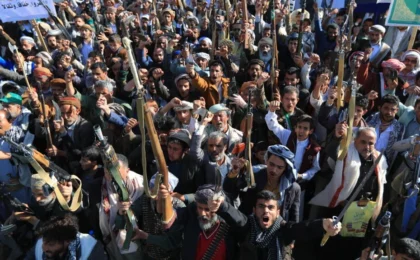
The fragile stability of the Middle East has been thrust into a precarious state as Iranian-backed Houthi rebels seized control of the strategic Red Sea port city of Mocha on Thursday. This significant territorial gain, coupled with a renewed surge in violence, marks a dramatic escalation in a conflict that has already claimed over 500 lives in the past week alone. As Houthi fighters marched through the streets chanting slogans against the United States and Israel, the global community watched with increasing alarm, fearing that the Yemeni theater may once again become the epicenter of a catastrophic, large-scale regional war.
The Strategic Fall of Mocha: A New Front
The capture of Mocha is not merely a tactical victory for the Houthi movement; it is a profound shift in the regional maritime power balance. For years, the port had been held by the Yemeni National Resistance Forces under the command of Tarek Saleh, a vital buffer against the Houthis’ southward expansion. By seizing the city, the Houthis have effectively gained a staging ground for potential operations against the Bab al-Mandab strait—the narrow, critical waterway that facilitates the passage of a significant portion of the world’s oil and consumer goods between Asia and Europe via the Suez Canal.
Witnesses on the ground reported an "apocalyptic" atmosphere as the rebels moved into the city, forcing a chaotic exodus of residents. Tarek Saleh, in a statement released Thursday, confirmed that he had relocated his command center to an undisclosed "safe location" to regroup his forces. The loss of Mocha, along with the seizure of Zuqar Island in the southern Red Sea—facilitated by rocket fire and amphibious boat assaults—demonstrates a newfound sophistication in Houthi tactical operations, likely bolstered by external support.
Chronology of a Relapsed Conflict
The current cycle of violence did not emerge in a vacuum; it is the culmination of months of simmering tensions that finally erupted in July.
- Mid-July 2026: The ceasefire—which had provided a veneer of stability since 2022—effectively collapsed when the Houthis permitted an Iranian aircraft to land in Sanaa, bypassing Saudi-controlled airspace. The Yemeni government retaliated with airstrikes on the capital’s airport, triggering a cycle of tit-for-tat violence.
- Late February 2026: The broader Middle East landscape darkened following US-Israeli strikes on Iran. This regional volatility emboldened the Houthis, who began launching direct, large-scale attacks on Saudi territory, causing dozens of casualties and signaling their intent to align their domestic offensive with the regional anti-Western axis.
- Last Week: The Houthis launched a massive, coordinated offensive against Riyadh-backed government forces, aiming to push south toward the coast.
- Thursday, September 10, 2026: Houthi forces officially captured the port of Mocha and the nearby island of Zuqar, prompting an emergency session of the UN Security Council.
Supporting Data: The Human and Economic Cost
The human toll of this renewed offensive is staggering. According to data compiled by the International Organization for Migration (IOM), nearly 20,000 civilians have been displaced from their homes in the last seven days. The conflict has triggered a humanitarian crisis that threatens to eclipse the years of relative calm that preceded it.

The economic shockwaves, however, are being felt far beyond the borders of Yemen. The threat to maritime traffic has caused global energy markets to jitter. On Wednesday, Brent North Sea crude crossed the $100-per-barrel threshold, a psychological and economic barrier that reflects the market’s anxiety over potential closures of the Bab al-Mandab strait. By Thursday, US WTI crude contracts followed suit, surpassing the $100 mark. Analysts warn that should the Houthis successfully establish a permanent presence along the strait, they would possess the power to effectively hold the global economy hostage, using "maritime coercion" to disrupt energy supplies at will.
Official Responses and Diplomatic Impasse
The international community has responded with urgent appeals for restraint, though with little evidence of immediate impact.
Rashad al-Alimi, leader of the internationally recognized Presidential Leadership Council, issued a stern warning following the fall of Mocha. He stated that the defense of Yemen’s coastline is not merely a national imperative but an "Arab and international interest," calling for a unified response to curb the encroachment of Iranian influence.
The United Nations Security Council held an emergency meeting on Thursday to address the crisis. Hans Grundberg, the UN envoy for Yemen, delivered a somber assessment, urging member states to invest their full diplomatic capital into preventing a total collapse of the region into a "far more dangerous conflict." The United Kingdom, which spearheaded the call for the emergency meeting, issued a clear directive: the Houthis must immediately de-escalate, cease their aggressive expansion, and return to the negotiating table.
Despite these calls, Houthi military spokesman Yahya Saree showed little sign of backing down. On Thursday, he claimed that Saudi Arabia had launched 64 airstrikes on Yemeni territory within the previous 24 hours, characterizing the coalition’s actions as an act of desperation. Al-Masirah, the Houthi-affiliated television network, reported significant strikes in the Taiz province, underscoring the intensity of the current aerial campaign.

Regional Implications: A "Precipice for Conflict"
Security experts are closely monitoring the role of Tehran in this resurgence. Andreas Krieg, a senior security researcher at King’s College London, noted that the Houthi advancement is not merely a local rebellion but a calculated expansion of the Iranian "Axis of Resistance."
"Control of the coast gives the Houthis a level of leverage that the international community has not yet had to contend with in this specific geography," Krieg stated. "Combined with their existing capabilities—drones, missiles, and now, strategic ports—the Houthis are evolving from a localized insurgency into a regional maritime threat."
The implications for global trade are profound. If the Strait of Hormuz remains effectively blocked by Iran, and the Houthis successfully threaten the Bab al-Mandab strait, the global supply chain faces a "pincer movement" that could drive energy prices to record highs and force a long-term reconfiguration of global shipping routes.
For the people of Yemen, the return to war is a devastating blow. After years of navigating one of the world’s worst humanitarian disasters, the hope for a permanent peace, which seemed attainable through the 2022 ceasefire, has been replaced by the grim reality of renewed artillery fire, forced displacement, and the resurgence of regional power struggles.
As the UN Security Council continues its deliberations, the consensus among observers is that the window to prevent a full-scale regional conflagration is closing rapidly. Without a major diplomatic breakthrough or a decisive shift in the military balance, the conflict in Yemen is poised to move from a regional humanitarian crisis to a global security challenge that will define the geopolitical landscape for years to come. The coming days will be critical; the world waits to see if the rhetoric of the UN can outpace the reality of the missiles currently being fired across the Red Sea.