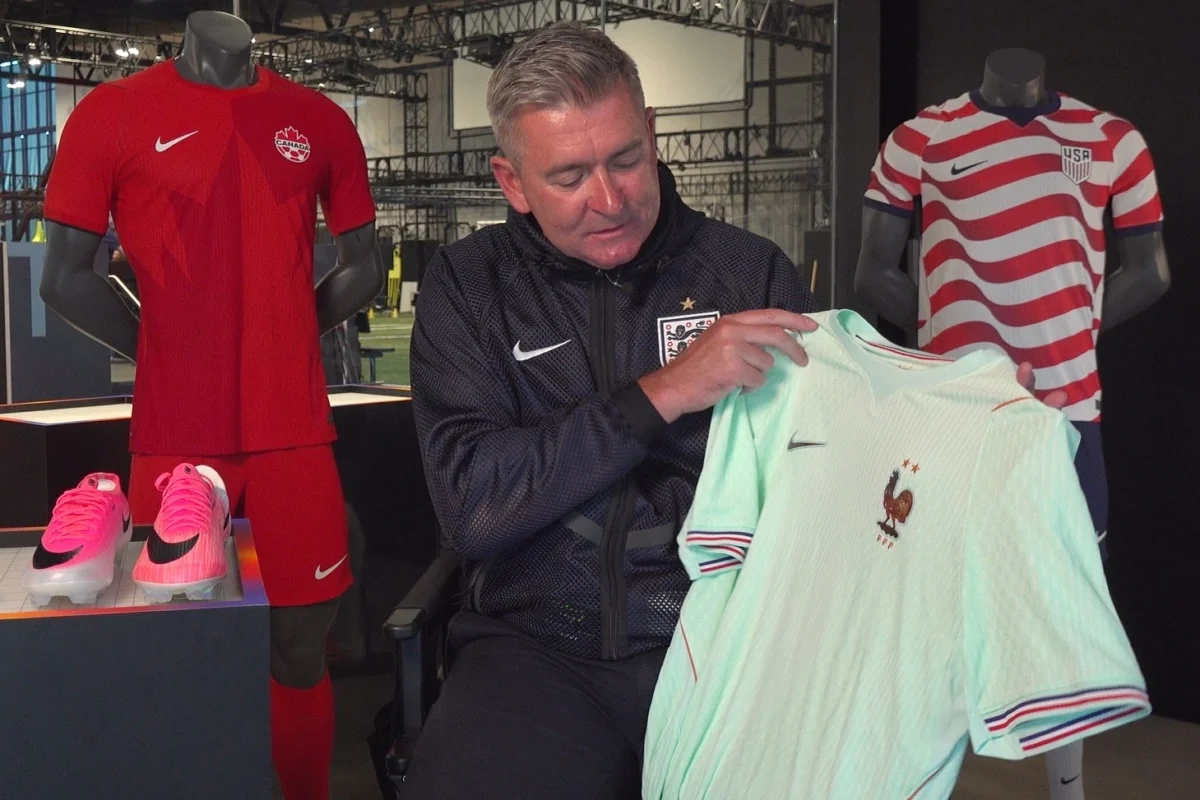
In the world of elite international football, the margin between victory and defeat is often measured in millimeters and milliseconds. While the focus remains squarely on the tactical prowess of coaches and the physical brilliance of players, a silent, high-tech revolution is unfolding on the skin of the athletes themselves. For the current World Cup cycle, the narrative of the tournament has been defined by three relentless forces: extreme heat, oppressive moisture, and the unyielding weight of national pride.
As the official outfitter for many of the world’s most storied footballing nations—including powerhouse programs like France and Brazil, as well as host nations the United States and Canada—Nike has transformed the humble jersey into a sophisticated piece of performance hardware. This year’s tournament has already been punctuated by climate-driven challenges, including severe storm delays and temperatures consistently hovering around 90 degrees Fahrenheit (32 degrees Celsius). In this environment, a uniform that fails to breathe or manage moisture is not just a fashion faux pas; it is a competitive liability.
Main Facts: The Intersection of Performance and Identity
The 2024-2026 World Cup kit cycle represents the most technologically advanced era in sportswear history. Nike, alongside competitors Adidas and Puma, has moved beyond simple aesthetic design into the realm of "biophysical engineering."
The primary objective for this year’s kits was to solve the "thermal regulation" puzzle. When a player’s body temperature rises, their cognitive function and physical stamina begin to degrade. By utilizing a new generation of recycled fabrics and precision-engineered knitting patterns, manufacturers are attempting to create a micro-climate between the fabric and the skin.
While Nike manages the apparel for the U.S., Canada, France, and Brazil, the competitive landscape is diverse. Adidas has provided the kits for the defending champions, Argentina, alongside host nation Mexico and a rising Colombia squad. Puma, meanwhile, has solidified its influence in the African and European markets, designing kits for Portugal, Morocco, and Senegal.
Phil McCartney, Nike’s Chief Innovation, Design, and Product Officer, emphasizes that the design process is a three-way conversation between science, the athlete, and the fan. "We talk to athletes, coaches, and football federations to understand how uniforms affect the game," McCartney stated. "But we also talk to fans—what does it mean to wear a Uruguay jersey, what does it mean to represent France? We merge that cultural soul with science to create beautiful, functional designs."
Chronology: From the Lab to the Pitch
The lifecycle of a World Cup kit begins years before the opening whistle. The process is a chronological journey from abstract data to physical prototype, and finally, to the global stage.
- The Consultative Phase (3-4 Years Out): Designers and engineers meet with national federations. They discuss historical preferences—such as the preference for collars in France and Uruguay—and gather feedback from players regarding the fit and feel of previous iterations.
- The Laboratory Phase (2 Years Out): At the Nike Sports Research Lab (NSRL) in Oregon, the "Aura" fabric and kit structures are born. This involves rigorous testing in thermal chambers and the use of motion-capture technology.
- The Prototype and Field Testing Phase (1 Year Out): Players wear "blackout" versions of the kits during training sessions. Sensors measure skin temperature and sweat rates to ensure the "wicking" properties are performing as expected.
- The Rollout and Troubleshooting (6 Months Out): Kits are officially unveiled to the public. During this phase in early 2024, some issues emerged, such as the "shoulder bulge" reported during friendly matches involving France and Uruguay.
- Tournament Implementation (Present): The kits are put to the ultimate test under the scrutiny of billions of viewers and the harsh reality of 90-degree heat.
Supporting Data: The Science of the Oregon Research Lab
To understand the complexity of a modern jersey, one must look at the Nike Sports Research Lab, located just outside Portland, Oregon. This facility is a cathedral of sports science, featuring a 200-meter track, a miniature football pitch, and a basketball court, all ringed by hundreds of high-speed motion-capture cameras.
Thermal Chambers and Robotic Mannequins
The most critical assets in designing for a "Hot World Cup" are the facility’s thermal chambers. These rooms can replicate any climate on Earth, from the humid jungles of Brazil to the arid heat of North American summers. Inside these chambers, Nike utilizes robot mannequins that are capable of "sweating" and generating body heat.
By dressing these robots in prototype kits, engineers can measure exactly how much moisture a fabric retains and how much air it allows to pass through to the skin. "We use the thermal chambers to test the kit’s breathability, to test wicking and moisture management," McCartney explained.
The Engineering of "Dri-FIT ADV"
The data gathered in these chambers led to the development of the latest "Dri-FIT ADV" technology. Rather than using a uniform weave, the jerseys are knit with varying densities. In high-heat zones—such as the center of the back and under the arms—the mesh stitching is more open, allowing for maximum airflow.
Furthermore, the kits are a testament to modern sustainability. The 2024-2026 kits are made from 100% recycled polyester, derived from recycled plastic bottles. This move aligns with broader corporate shifts toward "circularity" in manufacturing, proving that high-performance gear does not have to come at a high environmental cost.
Official Responses: Addressing the "Bumpy" Rollout
Despite the thousands of hours of testing, the transition from the lab to the pitch is not always seamless. Earlier this year, sports journalists and fans noticed a peculiar aesthetic flaw: prominent bulges at the shoulder seams of the Nike kits worn by France, Uruguay, and several other nations.
The Guardian reported that these bulges were distracting and appeared to compromise the sleek silhouette intended for the "authentic" player-version kits. When the issue was raised, it sparked a debate about whether the move toward tighter, more aerodynamic "player-fit" jerseys had finally hit a structural limit.
In a formal response to the Associated Press, Nike addressed the controversy, stating that the company had identified the "fit issue" before the World Cup commenced. The company worked closely with individual federations to adjust the tailoring and "ensure kits show up as intended" for the tournament. This proactive troubleshooting highlights the agility required by apparel giants when dealing with global audiences and high-profile athletes.
Cultural Significance: The Symbols of National Pride
While the players care about moisture-wicking, the fans care about the story. For a jersey to be successful, it must function as a piece of national iconography.
France: The "Liberty" Connection
France’s away kit is perhaps the most artistic entry in this year’s lineup. It features a subtle light green hue, specifically chosen to evoke the patina of the Statue of Liberty—a gift from France to the United States in the 19th century. This design serves as a bridge between the host nation and the French team. The interior tag features the word “Liberté” nestled within a silhouette of the monument’s crown, while the chest bears the traditional rooster and two stars, commemorating France’s 1998 and 2018 World Cup titles.
Uruguay and the Classic Collar
The return of the collar has been a major talking point in kit design this year. Both France and Uruguay opted for collars, though for different reasons. For France, the collar represents the nation’s status as the global capital of haute couture. For Uruguay, it is a nostalgic nod to the "golden age" of football, aiming to evoke the classic aesthetic of the mid-20th century.
North American Identity
For the host nations, the designs are more literal. The U.S. home kit utilizes horizontal red and white stripes, designed to mimic the appearance of a waving American flag in motion. Canada’s kit prominently features the maple leaf, utilizing a bold, modern graphic style that reflects the country’s growing prominence on the global football stage.
Implications: The Future of Sportswear and Climate
The innovations seen in this World Cup have implications that reach far beyond the football pitch.
1. The Climate Change Adaptation: As global temperatures continue to rise, the technology developed for World Cup athletes will inevitably trickle down to everyday consumer apparel. "Thermal regulation" is no longer just for elite strikers; it is becoming a necessity for outdoor workers and recreational athletes in a warming world.
2. The "Replica vs. Authentic" Market: The gap between what the players wear (Authentic) and what the fans buy (Replica) is widening in terms of technology. The "Authentic" kits are now so specialized—featuring 4D-mapped cooling zones—that they are effectively medical-grade performance wear. This allows brands to command premium prices (often exceeding $150 USD) for the high-tech versions.
3. Sustainability as a Standard: Nike’s commitment to 100% recycled materials sets a new industry benchmark. If the world’s most famous athletes can win a World Cup in jerseys made from recycled plastic, it removes the "performance stigma" once associated with sustainable fabrics.
In conclusion, the World Cup kit is no longer just a uniform; it is a synthesis of national identity and cutting-edge laboratory science. As Phil McCartney noted, the goal is to harness anything that connects the player to their country—past, art, music, or culture—and reinforce it with the best science available. As the tournament progresses, the success of these kits will be measured not just by how they look on the podium, but by how they helped the world’s best athletes survive the heat of the game.