By Carter Bahns | August 20, 2026
The high-stakes environment of NFL training camp is designed to replicate the intensity of the regular season, but on Thursday, the New York Giants and Miami Dolphins pushed the boundaries of professional conduct. What began as a routine opportunity for cross-roster evaluation quickly devolved into a series of heated skirmishes, culminating in a sprawling, all-out brawl that forced coaching staffs to intervene and resulted in the immediate removal of several key players from live drills.
As the NFL continues its crackdown on the culture of “practice violence,” this latest incident serves as a stark reminder of the thin line between competitive fire and uncontrolled aggression. With the league office already monitoring joint sessions with a hawk’s eye, the events in Miami have placed both organizations in the crosshairs of potential disciplinary action.
A Chronology of the Escalation
Joint practices are inherently volatile. For players who have spent the better part of three weeks hitting their own teammates, the chance to face an unfamiliar opponent acts as a pressure cooker for pent-up frustration. Thursday’s session in Miami started with the standard tactical drills, but the atmosphere grew noticeably brittle by mid-morning.
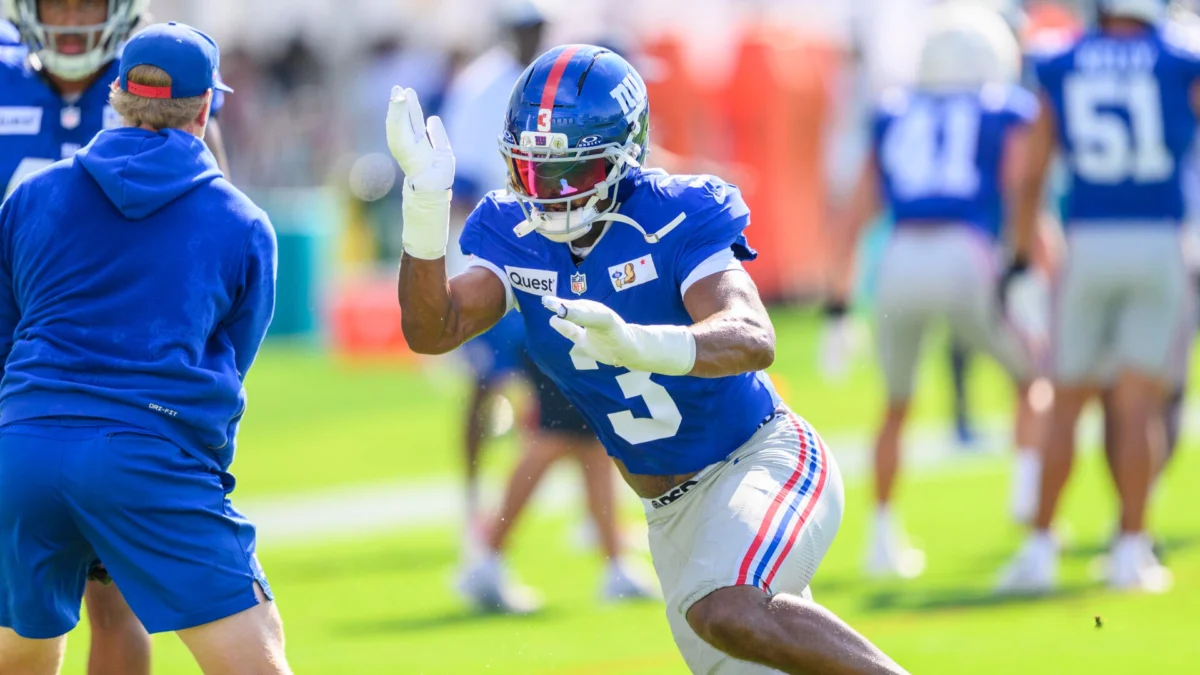
The initial flashpoint occurred during a standard team drill when second-year Giants edge rusher Abdul Carter initiated a physical confrontation with Dolphins offensive lineman Patrick Paul. While such exchanges are frequently dismissed as “competitive spirit” in the early days of camp, this specific altercation set a tone of volatility that permeated the remainder of the session.
The tension spiked again shortly thereafter in a separate incident involving the trenches. Miami offensive lineman Austin Jackson, visibly agitated after a play, threw a punch in the direction of Giants rookie Arvell Reese. The retaliation was immediate; Giants edge rusher Kayvon Thibodeaux sprinted into the fray, forcibly tackling Jackson to the ground. This triggered a chain reaction, with players from both sides rushing to the center of the field, resulting in a chaotic melee that required intervention from both John Harbaugh and the Miami coaching staff.
By the time the dust settled, the integrity of the practice had been compromised. Per the pre-arranged "rules of engagement" established by both teams, any player throwing a punch is subject to immediate ejection from the field. Consequently, several high-profile names, including Giants quarterback Jameis Winston and offensive lineman Jermaine Eluemunor, were escorted from the practice area. Harbaugh later confirmed that Eluemunor’s removal was mandatory after he was observed striking an opponent in the face.
The Psychology of the "Joint Practice" Brawl
To understand why these brawls occur with such frequency, one must look at the unique mechanics of the modern NFL training camp. For the majority of the offseason, players are siloed within their own organizations. They learn the tendencies, the weaknesses, and the temperaments of their own teammates. When two teams finally meet, that familiarity is replaced by the unknown.
“It’s just football,” Giants head coach John Harbaugh remarked during his post-practice media availability. “It’s not a game, so you don’t have quite the same guardrails on it. It’s a violent game. In this sort of an environment, you have these rules of engagement that aren’t really rules of the game. And then somebody perceives somebody else goes over the line—or they do go over the line—and then somebody needs to protect somebody, and that’s where it goes.”
Harbaugh’s perspective highlights a fundamental reality of the sport: the inherent violence of football requires a high level of self-regulation. When that regulation fails, the result is the kind of unchecked hostility witnessed on Thursday. While Harbaugh attempted to downplay the severity, the visual of a mass brawl—players shoving, helmets popping, and staff members sprinting to restore order—is precisely the imagery the league has spent years trying to scrub from its promotional materials.
The League’s Stance: A New Era of Accountability
The NFL’s patience for these incidents has evaporated. Prior to the commencement of the 2026 training camp cycle, the league office issued a stringent memorandum to all 32 franchises. The memo was explicit: the NFL would no longer tolerate the "culture of escalation" that has historically defined joint practices.
The league’s directive stated: "The league will not promote an atmosphere for fighting or escalation of incidents; instances of player fighting will result in individual fines, club fines, and/or loss of practice."
This is not merely a warning; it is a policy that has already begun to manifest in real-time financial penalties. Only 48 hours prior to the Miami incident, the Dallas Cowboys and New Orleans Saints found themselves in the league’s crosshairs after a series of altercations at their joint practice resulted in a massive, bench-clearing brawl. The NFL moved with unprecedented speed, slapping both organizations with a $500,000 fine apiece.
The existence of such a precedent looms large over the Giants and Dolphins. The league is currently reviewing game film and internal footage from the Miami facility. If the league determines that the Giants-Dolphins brawl reached a level of violence comparable to the Dallas-New Orleans incident, both clubs should expect significant financial repercussions.
Implications for the Season Ahead
Beyond the immediate threat of fines, these incidents carry long-term implications for how the NFL manages its summer calendar. For decades, joint practices have been hailed as the gold standard for team preparation. They offer coaches the ability to evaluate depth in a controlled setting, simulate game-speed scenarios, and build camaraderie. However, if these sessions continue to devolve into spectacles of violence, the league may be forced to reconsider their viability.
Critics argue that the frequency of these fights suggests a lack of discipline at the coaching level. When veteran leaders like Jameis Winston are being pulled from the field for their involvement in altercations, it raises questions about the culture within the locker room. Are coaches doing enough to instill discipline, or is the pressure of making a 53-man roster creating an environment where aggression is seen as the only path to job security?
For the Giants, losing a veteran presence like Eluemunor—even for a single practice—disrupts the continuity of the offensive line, a unit that requires absolute cohesion to succeed. For the Dolphins, the distraction of the fight shifts the focus away from tactical development and toward damage control.
Conclusion: A Turning Point for Training Camp
The brawl in Miami is a microcosm of the tension that exists in the modern NFL. As the game becomes faster and more physical, the challenge of maintaining professional standards during the "dog days" of August becomes increasingly difficult.
The NFL is currently at a crossroads. It wants to keep the intensity of joint practices to provide high-quality content and preparation for the regular season, but it cannot afford the liability and negative PR associated with professional athletes engaging in street-style fighting.
As the Giants and Dolphins move forward, they must address the internal culture that allowed such an escalation to occur. Whether the league decides to impose a half-million-dollar penalty or opts for a stern warning, the message has been delivered: the days of "letting them play" during practice are effectively over. In the new NFL, the whistle doesn’t just end the play—it marks the boundary of acceptable behavior. Failure to adhere to that boundary will now come at a significant cost, both in terms of reputation and revenue.
For now, the focus shifts back to the field. But for the coaching staffs and the league office, the events of Thursday remain a sobering reminder that even in the most structured environments, the volatile nature of the sport is always just one snap away from boiling over.