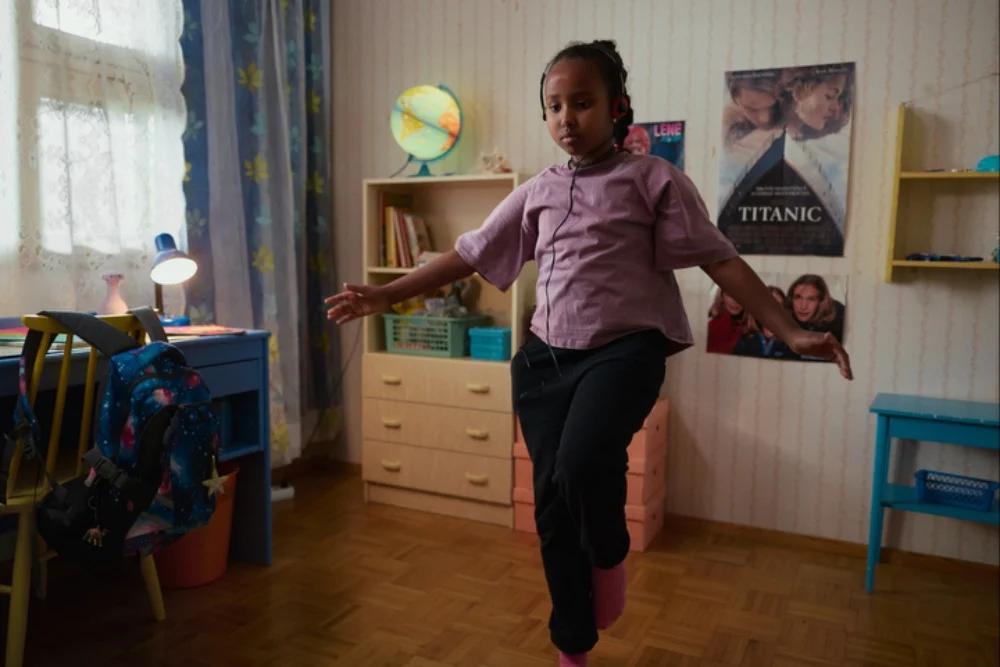
In a landmark moment for the Finnish film industry, director Naima Mohamud has secured the Best Fiction Project award at the prestigious Finnish Film Affair. Her debut feature, Halima, is not merely a testament to her emerging talent but a historic milestone: it marks the first time a Finnish feature film has been directed by a Black woman. As the film moves through post-production, it has already garnered international acclaim, signaling a shift in the landscape of Nordic storytelling.
Produced through a collaboration between It’s Alive Films, No-Office Films, and Vico Films, Halima is a vibrant, coming-of-age story set against the backdrop of 1998 Finland. At its center is the titular character, a 10-year-old Somali girl whose dreams are as expansive as her reality is confined. Obsessed with Leonardo DiCaprio and the Eurodance phenomenon Aqua, young Halima harbors a singular ambition: to become a global pop star. However, her life is defined by instability—a family constantly on the move, the absence of a father figure, and the crushing isolation of a childhood without roots.
The Chronology of a Visionary Project
The journey of Halima began in the mind of Naima Mohamud, who sought to fill a glaring void in the cultural representation of Finland’s diaspora. The Somali community has been a vital part of the Finnish social fabric for over 35 years, yet their domestic lives, internal cultural dynamics, and daily experiences remain largely invisible to the wider Finnish public.
"I really think that a film like Halima was a long time coming," Mohamud explains. "We Somalis have been living in Finland for over three decades, yet most Finns still don’t know anything about us, our culture, or how we interact at home. This film might help someone with a Somali neighbor finally get a glimpse. I hope that’s what this film does: opens up Finns to understanding Somalis."
Development on the project began in earnest years ago, with the script undergoing rigorous refinement to capture the specific essence of the late 90s. By choosing this era, Mohamud taps into a specific cultural zeitgeist—a time before the ubiquity of social media, where pop culture was consumed through magazines and MTV, and where the isolation of an immigrant child felt distinctively tactile.
The project’s momentum accelerated at the Finnish Film Affair, where the industry’s recognition validated not just the narrative, but the necessity of the voice behind it. With the project now in post-production, anticipation is mounting, as international festivals have already begun to take notice, recognizing the film’s potential to resonate far beyond the borders of Finland.
The Internal Conflict: An Outsider Within
At the heart of the narrative is the tension between Halima’s pop-star dreams and the pragmatic reality of her immigrant mother. The film explores this dynamic with a nuanced, often bittersweet lens.
"She has all these dreams of becoming a big star, which confuses her mom," says Mohamud. "She gets in trouble at school because of her imagination, and her mom just can’t understand the dancing and the obsession with music. But she has bigger fish to fry; she has to support the family and make sure everyone is okay, so she accepts it in her own way."

This friction is compounded by the harsh reality of being an outsider. Halima’s attempt to emulate the look of Lene, the lead singer of the band Aqua, leads to an act of self-expression that backfires. When she cuts her own hair to match her idol, the result is visibly "different," making her a target for playground bullying.
Mohamud describes this as a pivotal moment of lost innocence. "She’s still a child who’s not too self-conscious, but she’s slowly starting to understand that maybe this is embarrassing? Maybe I really look horrible?" It is a universal feeling of alienation, framed specifically through the lens of a young girl navigating the intersection of cultural expectations and personal identity.
Filmmaking Through a Child’s Eyes
One of the most remarkable aspects of Halima is its refusal to treat childhood as a purely nostalgic or tragic state. Instead, Mohamud embraces the boundless, sometimes chaotic logic of being ten years old.
"I’m still a kid!" Mohamud jokes when asked how she maintains such an authentic perspective. "I’ve always understood kids, so I had a great time working with them. I really enjoy this innocence of childhood. The older you get, the more you overthink. You start doubting yourself too much. Kids don’t have that. Halima thinks she can dance, and in her mind, she’s brilliant."
This philosophy extended to the director’s own life. Reflecting on her decision to enter the film industry at just 14 years old, she notes that she never considered the professional hurdles that would lie ahead. That same "childish" curiosity—the urge to jump out of a classroom window or test the limits of a school mailbox—is the engine of the film. Mohamud’s direction is aimed at preserving that sense of possibility, ensuring that the film’s triumph, while mischievous, remains deeply grounded in the character’s internal joy.
The Philosophy of "Joyful Cinema"
In a film market often saturated with grim, hyper-realistic, or somber portrayals of the immigrant experience, Mohamud is carving out a niche for herself: the purveyor of "joyful films."
Her approach is not about ignoring the hardships of life, but about choosing a different emotional destination for the audience. "I like happiness, and I like feeling happy," she explains. "I love watching deep, serious films the same way I love looking at beautiful pieces of art. But I don’t want to spend my time making them."
She illustrates this with a poignant example regarding another project she wrote, titled Camphor. The film, which follows a reclusive Muslim scholar performing a funeral ritual, is a meditation on grief and solitude. Despite the quality of the script, Mohamud recognized that her directorial voice was not the right fit for the material.

"That film needed a poetic soul, and that’s not me—at least not as a director," she says. "I’d probably make the characters tell a few jokes and it would be so inappropriate." By acknowledging her own strengths—and the influence of blockbuster, spectacle-driven filmmakers like James Cameron over the somber tones of the French New Wave—Mohamud has liberated herself from the pressure to create "socially serious" art.
Instead, she aims for an emotional arc that leaves the audience feeling invigorated. "I make films that I hope make you feel good when you leave the cinema. A tear here or there is great, but at the end, I want people to say: ‘You know what? Life is amazing.’"
Implications for the Finnish Film Industry
The success of Halima at the Finnish Film Affair is a signal of a broader structural change in the Nordic film industry. For too long, the stories told about minority groups in Finland have been filtered through a singular, often external perspective. By placing a Black woman in the director’s chair, the industry is not just diversifying its talent pool; it is diversifying the narrative language of its cinema.
The implications are twofold. First, there is the matter of authentic representation. By drawing on her own experiences and the collective history of the Somali diaspora, Mohamud is creating a cultural artifact that serves as a mirror for a community that has historically seen only distorted reflections of itself.
Second, the success of Halima challenges the gatekeepers of film financing and production. It proves that there is a hunger for stories that bridge cultural divides through the universal language of pop culture and childhood dreams. When Halima hits theaters, it will likely serve as a catalyst for future funding for minority filmmakers, demonstrating that "joyful" and "diverse" are not mutually exclusive—and that, in fact, they can be the foundation of a commercially and critically successful project.
As the industry looks toward the release of Halima, the focus remains on the film’s ability to change the conversation. It is a story about a girl who wants to be a pop star, but in the hands of Naima Mohamud, it becomes something much larger: a story about claiming space, defining one’s own identity, and the enduring, irrepressible power of a dream.
"I’m not going to change," Mohamud says firmly. "I’m just going to keep making films that feel like life." If Halima is any indication, that life is one filled with enough mischief, music, and heart to change the face of Finnish cinema forever.