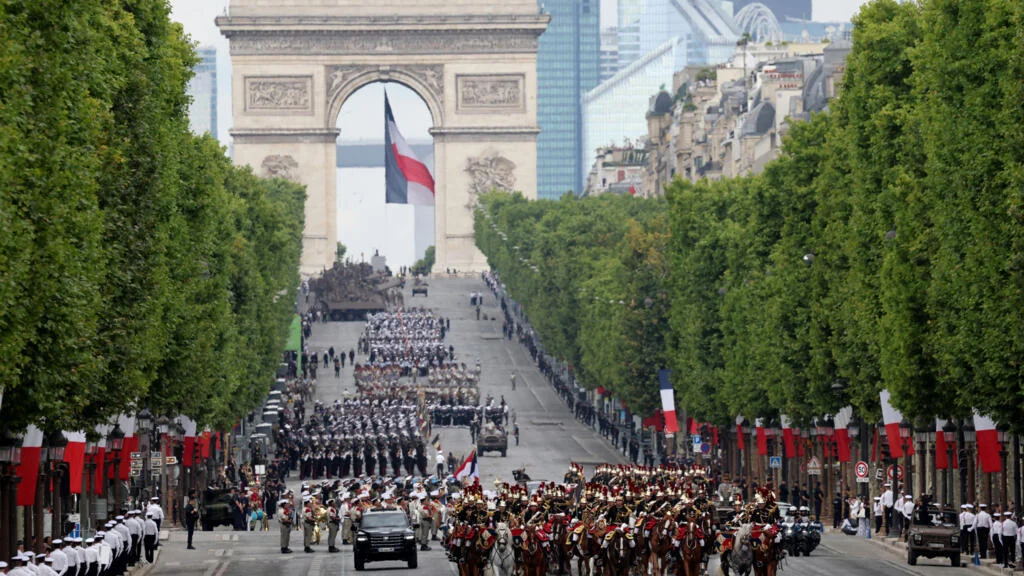
PARIS – The cobblestones of the Champs-Élysées are set to tremble under the weight of an unprecedented military display this Tuesday, as France marks its national holiday, Bastille Day. In what is being framed as the most significant geopolitical demonstration of the decade, Paris has become the stage for a "coalition of the willing," gathering nearly 30 heads of state and government to project a singular message: Europe is militarily awakened, strategically aligned, and unyielding in its support for Ukraine.
However, this year’s celebrations are characterized by a stark duality. While the military pageantry signifies a new era of European hard power, the festive atmosphere has been curtailed by a brutal, record-breaking heatwave and the ravages of uncontrolled forest fires, forcing the government to temper the celebratory spirit with a sobering reality check.
The Geopolitical Context: A Message to Moscow and Washington
For President Emmanuel Macron, this July 14 holds profound significance. It marks his final Bastille Day at the helm of the French Republic, serving as a legacy-defining moment that underscores his long-standing advocacy for "strategic autonomy" within Europe.
The parade is designed as a deliberate signal to the world’s power brokers. By inviting Ukrainian President Volodymyr Zelensky and leaders from across the continent to witness a massive mobilization of troops and air power, Macron is attempting to insulate European security from the volatility of external politics. Observers note that the spectacle is intended to be a visual manifesto for both Russian President Vladimir Putin and U.S. President Donald Trump.
The subtext is clear: Europe is no longer content to rely solely on the security umbrella of the United States. In an era where U.S. political isolationism has periodically cast doubt on the future of NATO commitments, the "coalition of the willing"—a group of nations committed to Ukraine’s post-war security—is signaling that it is prepared to shoulder the burden of its own defense and the reconstruction of European order.
Chronology of a Revolution: From 1789 to 2026
To understand the weight of this year’s events, one must look to the history that birthed them. Bastille Day commemorates the July 14, 1789, storming of the Bastille prison—a pivotal flashpoint in the French Revolution. The collapse of the fortress signaled the end of the Bourbon monarchy’s absolute power and the birth of modern democratic ideals: Liberté, Égalité, Fraternité.
- 1789: Parisians seize the Bastille, an act that catalyzes the end of the Ancien Régime.
- 1793: King Louis XVI and Marie-Antoinette face the guillotine, cementing the Republic’s radical break from the past.
- 1880: July 14 is officially declared a national holiday, serving as a tool for national reconciliation and pride.
- 2026: The parade returns to the Champs-Élysées, not merely as a celebration of the past, but as a military summit addressing the most existential threat to European stability since the end of the Cold War.
The Military Showcase: A "Strategic Reawakening"
The scale of this year’s military parade is unprecedented. Organizers have confirmed that 6,800 troops will march through the streets of Paris—a significant increase from the 5,810 who participated in 2025. This record-breaking mobilization is a physical manifestation of the continent’s shift toward increased defense spending and closer military integration.
The Ukrainian Presence
The emotional and strategic core of the parade is the integration of Ukrainian forces. In a poignant display of solidarity, Ukrainian troops will march alongside their European counterparts. Perhaps most symbolically, Ukrainian co-pilots—having completed rigorous training programs in France—will operate two Mirage 2000B fighter jets, flying in formation with the French Air and Space Force.
The Coalition of the Willing
The parade will open with a ceremonial march of 500 troops representing the "coalition of the willing." This group consists of nations that have pledged long-term security guarantees to Ukraine, ensuring that support for Kyiv remains robust regardless of shifts in global political winds.
The aerial display will be equally international, featuring aircraft from a wide coalition of partners:
- Western European powers: Germany, the United Kingdom, Spain, and Italy.
- Nordic and Baltic alignment: Sweden, Norway, and Denmark.
- Central and Eastern European allies: Poland, Croatia, and Greece.
This diverse participation underscores a unified front, effectively neutralizing the narrative of a fragmented Europe that has often been exploited by external adversaries.

The Climate Crisis: A Holiday Under Siege
While the military leaders discuss the future of security, the French public is grappling with the immediate, visceral threat of a climate-driven crisis. France is currently sweltering under its third major heatwave of the year, with temperatures in Paris and the southern regions hitting record highs.
The environmental impact has been catastrophic. Large-scale forest fires are currently raging in the Fontainebleau forest, located just south of the capital, and across the parched landscape of southern France. These fires have placed a massive strain on emergency services, forcing a pivot in the government’s priorities.
The Cost of Caution
The heatwave has necessitated the cancellation of many of the traditional festivities that usually bring the French public into the streets. Across various regions, local authorities have banned traditional fireworks displays, citing the extreme fire risk posed by dry vegetation and high temperatures. Additionally, the customary "firefighters’ balls"—a staple of the holiday—have been called off in many municipalities to avoid large gatherings in dangerous heat.
However, the government made an exception for the Eiffel Tower, where a drone light show proceeded as scheduled on Monday night, serving as a beacon of resilience in a country balancing traditional celebration with modern emergency management.
Official Responses and Diplomatic Implications
President Macron’s rhetoric on the eve of the parade was calculated to inspire. Addressing the armed forces at the Ministry of Defense, he remarked, "It is a great honour to welcome all the partners in the coalition of the willing and our Ukrainian friends who will march with us to illustrate our strategic reawakening and our unity."
Diplomatic analysts suggest that the presence of 30 heads of state is a quiet but powerful rebuke to the "America First" policies that have threatened to undermine the trans-Atlantic alliance. By fostering this coalition, Macron is positioning France as the natural leader of a sovereign Europe, capable of acting as an independent pole of power in a multipolar world.
The implications for the Kremlin are equally clear: the parade is a visual representation of a Europe that has moved past its internal squabbles to provide sustained, coordinated military support to Kyiv. For the United States, the event serves as a reminder that European allies are no longer passive recipients of security, but active contributors to a global defense framework.
Conclusion: A Turning Point for the Republic
As the parade concludes and the military hardware is stowed away, France finds itself at a crossroads. The 2026 Bastille Day will be remembered not for its pomp, but for the clarity of its intent.
The juxtaposition of a massive, multinational military display against the backdrop of a burning, overheated forest provides a powerful allegory for the challenges facing the 21st-century state. The government must simultaneously navigate the complexities of hard-power security and the immediate, existential threats posed by the changing climate.
On this final Bastille Day of his presidency, Macron has sought to leave behind a vision of a Europe that is armed, united, and cognizant of its duty to history. Whether this "coalition of the willing" can withstand the pressures of both the geopolitical arena and the environmental front remains the defining question for the years to come. For now, the message from the Champs-Élysées is one of endurance: through fire and tension, the alliance stands firm.