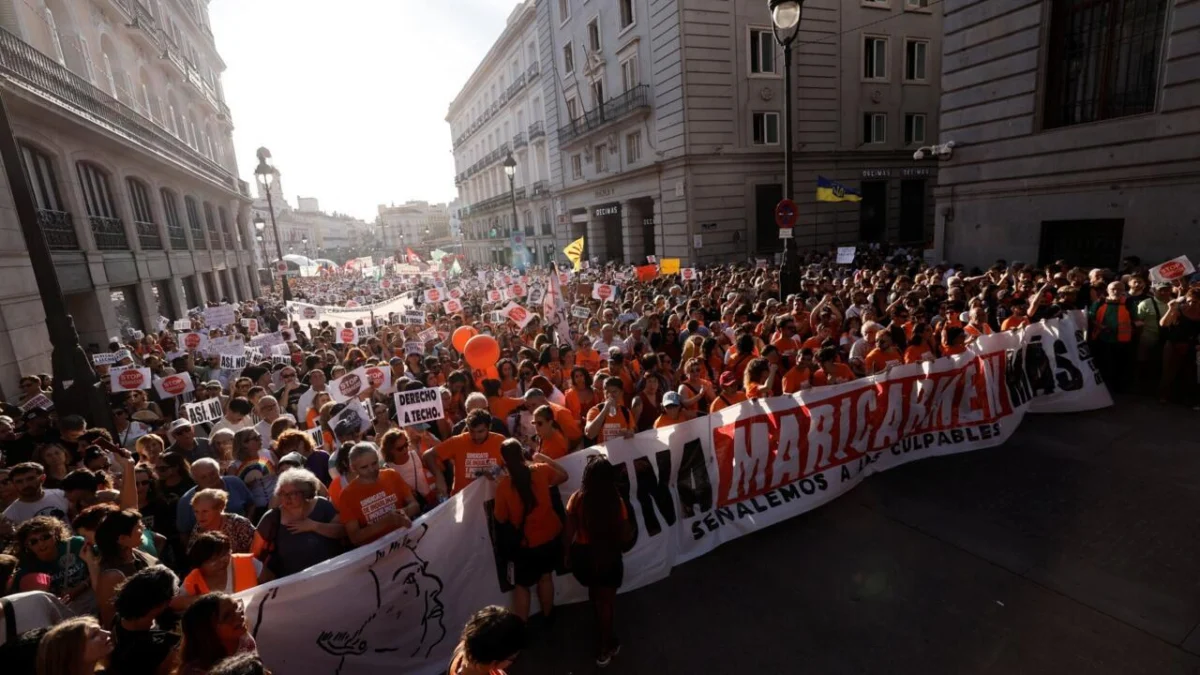
The streets surrounding Madrid’s iconic Retiro Park, usually a sanctuary of manicured gardens and elite tranquility, have transformed into a staging ground for a growing social movement. This week, the chic, tree-lined boulevards of the capital’s most prestigious district—the "Golden Triangle of Art"—have been punctuated not by the quiet hum of tourists visiting the Prado, but by the defiant chants of protesters. At the heart of this fervor is an unlikely catalyst: Maricarmen Abascal, an 87-year-old resident whose eviction has become a flashpoint for Spain’s escalating housing emergency.
Holding signs emblazoned with slogans like "Maricarmen vs. the Vultures," "Maricarmen, you are not alone," and the haunting rallying cry "Ni una Maricarmen más" (Not one more Maricarmen), demonstrators are demanding systemic change. Her forced departure from an apartment she occupied since the 1950s serves as a microcosm of the systemic displacement occurring across Europe’s most desirable cities.
The Case of Maricarmen Abascal: A Chronology of Displacement
The story of Maricarmen Abascal is not merely one of an expired lease; it is the story of a changing urban fabric.
- The 1950s: Maricarmen moved into her apartment in the Retiro district. For over seven decades, this unit was her home, a witness to the evolving history of post-Franco Spain.
- The Shift in Ownership: Over the decades, the ownership of the building shifted from private individuals to corporate entities—a common trend in Madrid’s hyper-financialized real estate market. These organizations, often disparagingly referred to by locals as "vulture funds," prioritize asset appreciation over residential stability.
- The Expiration: As a beneficiary of older, long-term rent-controlled agreements, Abascal remained in her home while the district around her gentrified rapidly. When the lease finally reached its legal expiration, the owners moved to reclaim the property to capitalize on the soaring market value of Retiro real estate.
- The Final Days: In the weeks leading up to Wednesday’s eviction, local activists organized around her door, creating a human shield. Despite these efforts, authorities carried out the court order on Wednesday, leaving the octogenarian homeless and igniting city-wide outrage.
Supporting Data: The Anatomy of a Housing Deficit
The eviction of Maricarmen is not an isolated incident but a statistical inevitability in a city struggling with a severe housing deficit.
Madrid is currently grappling with a "perfect storm" of economic pressures. According to recent reports from the Bank of Spain and various real estate indices, rental prices in the capital have surged by over 40% in the last five years. In districts like Retiro—situated in the heart of the city near the Prado Museum—the lack of affordable housing inventory is acute.
- Supply vs. Demand: Estimates suggest Madrid requires at least 20,000 new housing units annually to meet current demographic growth, yet construction has stalled significantly behind this pace.
- The "Golden Triangle" Effect: The prestige of the area surrounding the Prado, the Thyssen-Bornemisza, and the Reina Sofía museums has turned the Retiro quarter into a playground for international investment, where residential units are increasingly converted into short-term tourist rentals or high-end investment vehicles.
- Vulnerability of the Elderly: Data from the Spanish National Institute of Statistics (INE) indicates that the elderly population is increasingly at risk of "economic eviction." Those living on fixed pensions are unable to compete with the inflationary pressures of a market dominated by speculative capital.
The Blame Game: Official Responses
As the protests grow, the political fallout has been swift, characterized by a familiar cycle of finger-pointing between the national government and the Madrid city council.
The central government, led by the socialist-leaning coalition, has accused the Madrid city council of failing to implement adequate social housing protections. They argue that the regional administration has prioritized deregulation and tax incentives for developers over the welfare of long-term residents. "The city council has the tools to protect vulnerable citizens from predatory market forces," a government spokesperson stated, "but they choose to look the other way while our elders are cast onto the street."
Conversely, the Madrid city council, led by the conservative opposition, has pushed back, citing that the national government’s recent "Housing Law" is fundamentally flawed. They argue that national legislation restricts the market too aggressively, leading to a supply squeeze that inevitably hurts the most vulnerable. "The government is trying to solve a supply problem with price controls," a council representative remarked. "They are blaming us for their own failure to create a functional, free-market housing environment that encourages new construction."
Implications: A City at a Crossroads
The "Maricarmen movement" has moved beyond a singular case of eviction; it has become a symbolic challenge to the neoliberal urban planning policies that have defined Madrid for the past decade.
1. The Erosion of Social Cohesion
When long-term residents are displaced from their historic neighborhoods, the social fabric of the city is irrevocably altered. The Retiro district, once home to a diverse cross-section of Madrileños, risks becoming an exclusive enclave accessible only to the ultra-wealthy and transient tourists. This loss of community identity is a growing concern for urban sociologists who warn that "hollowed-out" city centers lose the very cultural vitality that made them desirable in the first place.
2. Legal and Regulatory Re-evaluation
The protests are likely to force a legislative showdown. Activists are calling for stricter rent controls, a moratorium on evictions for residents over the age of 80, and the expansion of social housing quotas for luxury developments. The pressure is mounting on the regional government to prove that "market-friendly" policies do not equate to "resident-hostile" outcomes.
3. The European Context
Madrid is not alone. From Berlin to Lisbon and Dublin, European capitals are facing a crisis of affordability. The outcome of the Madrid protests will be closely watched by policy-makers across the continent. If the activists succeed in establishing a legal precedent—perhaps a "Maricarmen Law" that protects vulnerable long-term tenants from corporate eviction—it could provide a template for other European cities struggling with similar housing deficits.
4. The Future of the "Vulture" Model
The term "vulture funds" has gained significant traction in the public discourse, signaling a shift in how Spaniards view corporate real estate investment. There is a burgeoning demand for greater transparency in property ownership. The public is increasingly asking: Who owns our city? When a corporation can displace an 87-year-old woman to maximize a quarterly profit margin, the moral legitimacy of the housing market itself is called into question.
Conclusion: Beyond the Signs
As the sun sets on the Retiro Park, the placards bearing Maricarmen’s name remain. They are more than just protest materials; they are a manifesto for a different kind of city—one that values the continuity of human lives over the volatility of asset classes.
The eviction of Maricarmen Abascal has acted as a mirror, forcing Madrid to look at the consequences of its rapid modernization. Whether the government and the city council can transcend their partisan bickering to provide a sustainable solution remains to be seen. However, one thing is certain: the citizens of Madrid have declared that the "Golden Triangle" is not just for art; it is for people.
The struggle for housing rights in Madrid is entering a new, more confrontational phase. As the movement gains momentum, it serves as a stark reminder that in the shadow of world-class museums and historic landmarks, the most important element of a city is the people who have called it home for a lifetime. For Maricarmen, the fight may have come too late to save her own apartment, but for the thousands currently standing in the streets, the fight for their city has only just begun.