The Heart of Paris Transformed
The iconic Champs-Élysées, usually a bustling artery of Parisian commerce and traffic, was transformed into a vast, open-air cathedral this Saturday. In an unprecedented display of religious fervor and logistical coordination, an estimated 700,000 pilgrims gathered across the historic avenue and the sprawling Place de la Concorde to witness Pope Leo XIV celebrate a monumental Mass. The event served as the centerpiece of the 71-year-old Pontiff’s four-day apostolic journey to France—his first official state and pastoral visit to the nation since assuming the papacy.
The atmosphere was a tapestry of solemnity and celebration. As the sun struggled to pierce through the grey Parisian sky, the arrival of the "popemobile" ignited a wave of electricity through the throngs of onlookers. Thousands of smartphones were raised in unison, capturing the image of the leader of the world’s 1.4 billion Catholics as he navigated the sea of faithful. The Pope, visibly moved by the scale of the reception, paused frequently to bless infants passed forward by volunteers and to greet individuals with disabilities stationed in the front ranks, creating intimate moments of connection amidst the massive crowd.

A Chronology of the Day: From Procession to Prayer
The day’s proceedings began well before the liturgical service commenced. Security cordons, stretching from the Arc de Triomphe to the Place de la Concorde, were tested by the sheer volume of attendees arriving from across Europe.
- 08:00 AM: Pilgrims began occupying the designated sectors, with local parish groups and international visitors establishing a presence along the tree-lined avenue.
- 10:30 AM: Pope Leo XIV departed the Apostolic Nunciature, embarking on a ceremonial procession down the Champs-Élysées. The journey was marked by cheers and the waving of Vatican and French flags.
- 11:30 AM: The Papal motorcade reached the Place de la Concorde, where a giant white canopy had been erected to shelter the altar. The Pope ascended the stage as the liturgical choir began the opening hymns, accompanied by the grand swell of organ music.
- 12:00 PM: The Mass proper began. The Pope, vested in white garments embroidered with olive branches, addressed the assembly. His homily focused on the necessity of spiritual pursuit over the transient nature of material wealth.
- 01:30 PM: The service concluded with a final blessing, leaving the crowd in a state of quiet reflection before the slow, orderly dispersal of hundreds of thousands of people.
The Message: Faith in an Individualistic Age
In his homily, Pope Leo XIV touched upon the challenges facing the modern French public. "It is truly good and pleasant when brothers and sisters come together and glorify the greatness of God," the Pontiff remarked, his voice echoing from speakers positioned throughout the city center. His words were punctuated only by the rhythmic hum of security helicopters circling overhead. "I hope that my presence here today confirms your faith."

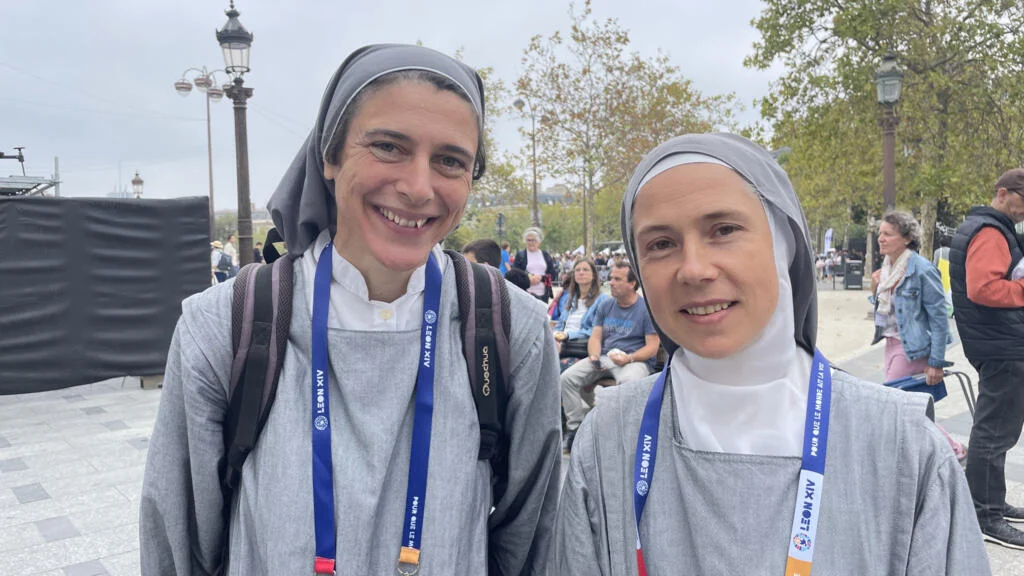
For many in the crowd, the message resonated deeply. Marie-Madeleine, a 45-year-old nun from Autun, expressed a sentiment shared by many participants. "France is a place where power and money reign supreme; there is not enough openness between people," she observed. She and her companion, Marie-Élisabeth, viewed the mass as a critical "public declaration" that Christianity remains a vibrant, albeit often hidden, force in French society. They lauded the Pope for his courage in challenging what they described as a "disconnected" and "individualistic" world.
Supporting Data: The Logistics of a Mega-Event
Managing a crowd of 700,000 in the center of one of the world’s most densely populated cities required a gargantuan effort from both the Vatican and French authorities. Thousands of volunteers, distinguished by their bright yellow T-shirts, were the backbone of the operation.

Angèle, a lifelong member of the French Scouts, traveled from Rouen specifically to assist with the event. Her duties ranged from distributing flags to navigating confused visitors through a maze of road closures. "Seeing the Pope in France is a once-in-a-lifetime event," she noted. "When I received the email asking for volunteers, I said yes straight away."
The volunteer corps represented a diverse cross-section of the Church. Frédéric, a 60-year-old volunteer, noted the stark contrast between this event and previous papal visits, such as the one in Marseille. "It is completely different from previous years," he observed. "Today feels more structured, more formal, yet equally powerful."

Official Responses and Public Sentiment
The presence of the Pope drew citizens from all walks of life—from the deeply devout to the curious observer. For some, like 36-year-old Emmanuelle, who moved to Paris from the United States, the event was an inheritance. Her grandmother had attended the Mass of John Paul II, an experience she described as "life-changing." Emmanuelle brought her two daughters, Olivia and Margaux, to ensure the next generation could witness a similar historical milestone.
The event was not without its moments of childlike spontaneity. When asked what she would say to the Pope, 8-year-old Olivia bypassed the theological and went straight to the contemporary: "Why isn’t the Pope ever a woman?" Her question highlighted the ongoing internal dialogues within the Catholic Church that persist even during grand public celebrations.

For others, the motivation was simpler. Justine and Thomas, a young couple who spent the day in Paris, came to witness the historic scale of the event. While they admitted to being casual churchgoers, they were drawn by the sheer weight of the occasion. Interestingly, their itinerary for the day included a search for another pop-culture icon—Céline Dion—highlighting the unique intersection of celebrity, faith, and public spectacle in modern Paris.
Societal Implications: The Resilience of Religion
The gathering serves as a barometer for the state of Catholicism in 21st-century France. Despite the country’s secular tradition (laïcité), the sheer volume of attendees suggests that religious identity remains a significant pillar for a vast portion of the population.

Jean-Albert, a 60-year-old mason from Normandy, captured the prevailing sentiment of the day perfectly. Having almost missed the bus organized by his parish due to work commitments, his presence at the mass felt like a personal victory. "It’s proof that faith moves people," he said. "I know there are atheists among us, people who aren’t necessarily convinced, but here we are. Religion resists!"
Looking Forward: A Lasting Impact?
The implications of Pope Leo XIV’s visit extend beyond the four-day itinerary. By choosing the Champs-Élysées—a site of national pride and historical significance—for his main Mass, the Pope effectively placed the Church back into the public square of French life.

For the Vatican, the success of the event is a testament to the enduring appeal of the papacy as a moral anchor in an increasingly fragmented world. For the French government, the peaceful conclusion of such a massive gathering is a logistical triumph. However, the true impact will be measured in the coming months: will this "moment of togetherness," as described by so many volunteers and pilgrims, translate into a sustained renewal of faith, or will it remain a cherished, singular memory of a weekend in September?
As the sun began to set on the Place de la Concorde and the crowds thinned, the prevailing feeling was one of quiet accomplishment. The "hidden" religion, as some participants called it, had been made visible. For one day, the heart of Paris beat in time with the prayers of 700,000 people, proving that even in a digital, individualistic age, the collective human need for spiritual connection remains as powerful as ever.