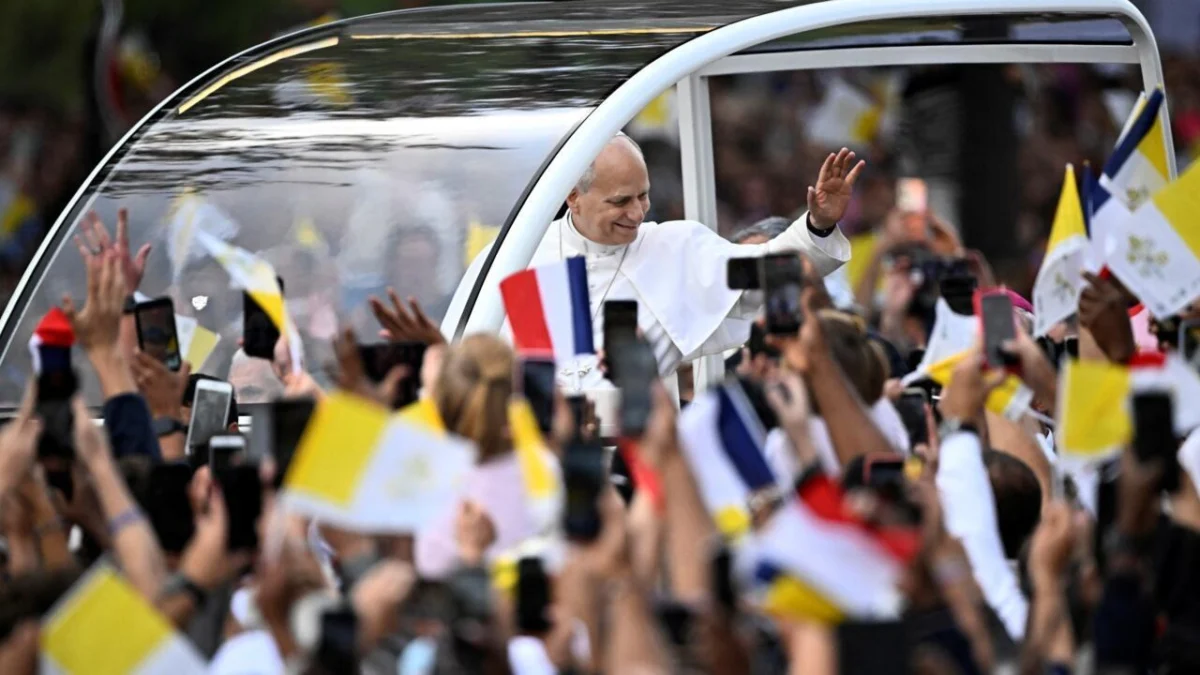
PARIS – In a display of religious fervor not witnessed in the French capital for decades, Pope Leo XIV, the first American-born pontiff, completed a monumental second day of his four-day apostolic journey to France. On Saturday, the leader of the world’s 1.4 billion Catholics commanded the attention of a nation that, while officially secular, maintains deep, inextricable Catholic roots. The visit, the first official papal trip to France in nearly twenty years, serves as a bridge between the Vatican’s global mission and the complex sociopolitical landscape of modern-day Europe.
The Grand Procession: Paris Under the Papal Gaze
The atmosphere in central Paris on Saturday morning was electric. Hundreds of thousands of the faithful, alongside the merely curious, lined the iconic Champs-Élysées, hoping for a glimpse of the pontiff. As the "popemobile" traversed the historic boulevard toward the Place de la Concorde, the city was transformed. The French capital, usually defined by the frantic pace of modern urban life, fell into a reverent hush, punctuated only by the cheers of the massive crowds.
The Vatican reported that over 800,000 people had gathered along the route, stretching well beyond the Arc de Triomphe. Security was unprecedented; the city center was effectively locked down, with military-grade surveillance helicopters circling the skyline and specialized security forces stationed on rooftops to ensure the safety of the 71-year-old leader.
For many attendees, the event transcended politics or even simple religious duty. "It is one time in history to see the pope," remarked Aline Riziki, a 41-year-old native of the Democratic Republic of Congo who has resided in France for over a decade. For Riziki, the moment was deeply personal. "I dropped everything to come here and see him, to pray for peace in the east of my homeland," she said, referring to the long-standing, brutal conflicts that have ravaged the region.

Chronology of the Apostolic Journey
The visit has been meticulously choreographed to balance high-level diplomacy, public ministry, and internal Church reform.
- Friday, September 25: The Pope arrived in France to a warm welcome. An estimated 300,000 citizens lined the streets as he traveled toward the historic Notre Dame Cathedral, a scene that commentators noted felt reminiscent of the historic visits of Pope John Paul II four decades ago.
- Saturday Morning, September 26: The pontiff visited the Maison Bakhita, an organization dedicated to supporting refugees and migrants. Here, he pivoted from the grand spectacle of the mass to the intimate realities of human displacement, calling for a society that prioritizes "dignity and peace."
- Saturday Midday, September 26: The centerpiece of the trip, an open-air Mass at the Place de la Concorde. A massive white canopy was erected to serve as a temporary altar, providing a visual focal point for the hundreds of thousands in attendance.
- Saturday Evening, September 26: Pope Leo XIV departed Paris for the southwestern pilgrimage town of Lourdes, where he began his visit by praying at the Grotto of Massabielle.
- Sunday, September 27 (Upcoming): The Pope is scheduled to hold a private meeting with seven victims of clerical sex abuse, a critical component of his mission to address the Church’s history of institutional failure.
The Place de la Concorde Mass: A Message of Unity
Under the shadow of the Obelisk, Pope Leo XIV, dressed in pristine white liturgical vestments, led the liturgy. "It is truly good and pleasant when brothers and sisters come together and glorify the greatness of God," he declared, his voice echoing across the plaza.
The scene was one of communal intimacy. Jeanne de Montagnac, 29, stood with her husband and their two-year-old daughter. "We’re happy that, even if she won’t remember it, we’re sharing this with her," she said, clutching a small golden cross. For the de Montagnac family, the presence of such a vast crowd provided a sense of solidarity. "It’s an important moment for us to be surrounded by other people who also have faith," she added.
Supporting Data and Societal Context
The success of this visit must be viewed through the lens of France’s evolving religious identity. Despite the state’s commitment to laïcité (secularism), the sheer turnout for Pope Leo XIV suggests that Catholicism remains a potent cultural force.

However, the Church in France carries the weight of a painful history. A landmark 2021 inquiry into clerical sex abuse shocked the nation, revealing that approximately 330,000 people had been abused by clergy or lay Church members over a seven-decade period. The Pope’s decision to meet with survivors on Sunday is seen by observers as a necessary, if difficult, step toward reconciliation. The Church is currently navigating a period of profound introspection, seeking to regain the trust of a public that has become increasingly disillusioned by systemic scandals.
Political Implications: A Nation at a Crossroads
The timing of the Pope’s visit is arguably as significant as the spiritual message. France is currently seven months away from a national election that will determine the successor to centrist President Emmanuel Macron. The political landscape is fraught with tension, particularly regarding immigration, national identity, and the rise of the far-right.
The presence of high-profile political figures at the Mass—including far-right leader Marine Le Pen and centrist politician Edouard Philippe—underscored the event’s political gravity. While President Macron did not attend, his wife, Brigitte, was present to represent the state, reflecting a delicate dance between the secular government and the Catholic hierarchy.
The Pope’s rhetoric during the visit has been carefully crafted to influence the national discourse without appearing to endorse specific candidates. At Maison Bakhita, he emphasized the "fundamental role of women in building a civilization of love" and the necessity of rejecting the "mentality of war." These themes are central to the current electoral debates in France, where nationalist sentiment has clashed with humanitarian concerns regarding migration.

Lourdes: A Sanctuary of Reflection
By Saturday evening, the tone of the visit shifted from the urban intensity of Paris to the spiritual tranquility of Lourdes. The Grotto of Massabielle, where Catholic tradition holds that the Virgin Mary appeared to Saint Bernadette in 1858, is one of the most sacred sites in Christendom.
In a prayer offered at the site, the Pope made a pointed appeal to the French political class: "May they make her (France’s) voice heard in promoting the defense of fundamental human rights and peace in the world, rejecting the mentality of war once and for all." He also prayed for "wise and generous leaders" who would be "eager to serve the common good."
As he touched the cool rock of the grotto, lit a candle, and drank the spring water, the Pope performed the same rituals as millions of pilgrims before him. This act of humility served as a reminder of his role not just as a global diplomat, but as the Bishop of Rome and a primary shepherd of the faithful.
Conclusion: A Legacy in the Making
Pope Leo XIV’s visit to France is far more than a ceremonial tour. It is an ambitious attempt to reaffirm the relevance of the Church in a secularized Western nation, to address the profound trauma of past abuses, and to offer moral guidance to a country standing on the precipice of a significant political shift.

As the Pope continues his journey, the eyes of both the faithful and the political establishment remain fixed on his every word. Whether his message of peace, dignity, and common good will resonate with a populace grappling with its own internal divisions remains to be seen. However, the scenes in Paris and Lourdes have made one thing clear: in the heart of Europe, the spiritual thirst of the people remains as profound as it is complex.