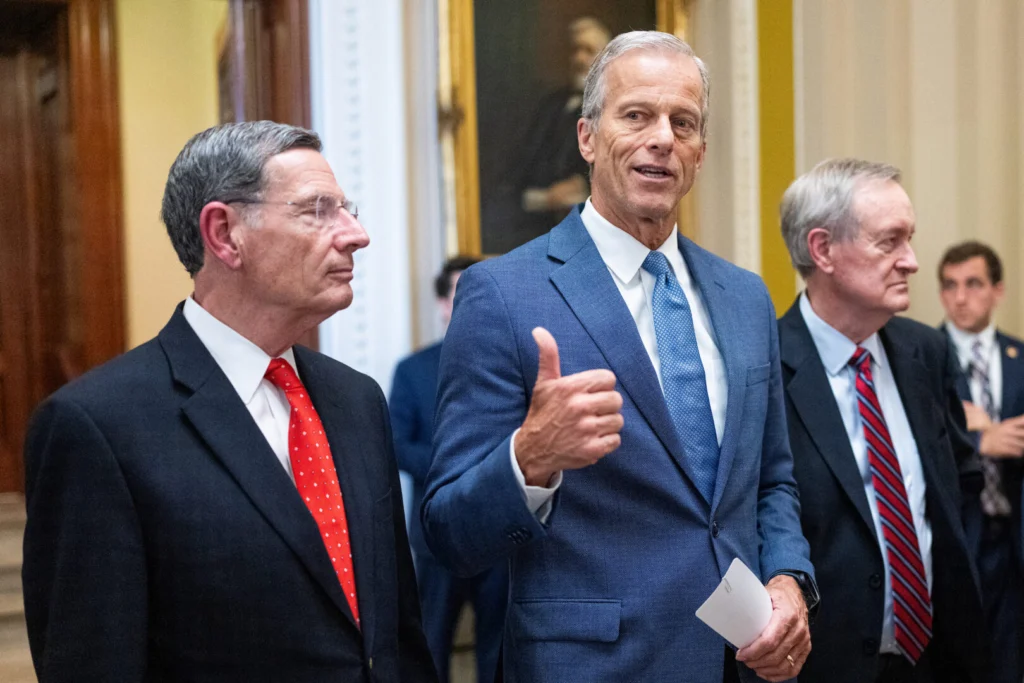
Capitol Hill, Washington D.C. – John Thune, the seasoned Republican Senate Majority Leader, rubbed his jaw, a telltale sign of the profound fatigue etched into his demeanor. What should have been a week of hard-won celebration, marking the successful passage of his party’s second budget reconciliation package – a significant legislative achievement barely a year and a half into his demanding tenure – instead devolved into an exhausting exercise in navigating the unpredictable currents emanating from the other end of Pennsylvania Avenue.
“There are a lot of things you just don’t control, and timing of White House announcements is one of them,” Thune, 65, observed on a recent Thursday afternoon, settling into a plush chair in the Republican leader’s Capitol suite. His words, delivered with a weary pragmatism, underscored a recurring pattern of presidential interventions that have consistently complicated his meticulous leadership calculus. The delicate dance between the Senate’s legislative machinery and the White House’s often-unconventional cadence has become the defining characteristic of Thune’s leadership, transforming his role into that of a chief architect attempting to build consensus on shifting sands.
This article delves into the multifaceted challenges and unexpected triumphs of Senator John Thune’s leadership, examining the external pressures from a demanding White House, the internal dynamics of a slim Republican majority, and the strategic maneuvers he employs to steer his party’s agenda through an increasingly volatile political landscape.
A Leader Under Pressure: White House Hurdles and Unpredictable Announcements
The immediate source of Thune’s recent exasperation was President Donald Trump’s seemingly ill-timed announcement of Jay Clayton as the nominee for Director of National Intelligence (DNI). The news broke just minutes before Thune was slated for an interview, and crucially, as the Senate was preparing to leave town for the week, hours after the House had concluded its votes. This timing was not merely inconvenient; it was strategically detrimental. An earlier announcement could have provided a critical window for congressional Republicans to extend a key spy powers authority, Section 702 of the Foreign Intelligence Surveillance Act (FISA), whose expiration loomed large. Instead, the moment was lost, highlighting a persistent disconnect between the executive and legislative branches.
The DNI Debacle: Timing and Trust
Thune confessed to reporters that he “hadn’t heard” about the DNI nomination before the President posted it on Truth Social, a revelation that speaks volumes about the communication breakdown. He later confirmed in his office that he hadn’t spoken with the President in several days, and conspicuously, had not attended the White House bill signing event for the reconciliation package – a ceremonial moment usually reserved for key legislative leaders. Instead, his week was consumed by the unfolding spy powers saga, a legislative priority now mired in uncertainty.
This wasn’t an isolated incident. The previous month, the White House had nominated the controversial Bill Pulte as acting DNI. Pulte’s appointment, criticized for his perceived lack of relevant experience and concerns about political independence, immediately alienated Democrats, who subsequently withdrew their support for a bipartisan reauthorization of FISA Section 702. This vital intelligence gathering tool, which allows the government to collect foreign intelligence from non-U.S. persons located outside the United States, became a political casualty of the White House’s actions.
“Some of the things that have happened the last few weeks have completely thrown a wrench into our ability to execute,” Thune acknowledged, his tone betraying a rare hint of frustration. “It has been particularly challenging.” This candid admission underscores the immense difficulty of his position, where carefully laid legislative plans can be instantly derailed by unexpected presidential pronouncements.
"Wrench in the Works": Presidential Interventions
Beyond the DNI issue, the White House’s penchant for injecting itself into legislative processes at critical junctures has become a recurring theme. Last month, the administration announced a Department of Justice “anti-weaponization fund” just as a crucial "vote-a-rama" – a marathon session of amendment votes – was approaching. This announcement, intended to address conservative concerns about government overreach, inadvertently irritated enough Republicans that Thune was forced to delay the vote-a-rama, disrupting an already tight legislative calendar.
Further complicating Thune’s efforts to maintain a cohesive party front, President Trump actively engaged in primary challenges against incumbent Republican senators. Senators John Cornyn of Texas and Bill Cassidy of Louisiana, both experienced lawmakers, were primaried out of their seats. These actions, driven by the President’s personal grievances or political calculations, directly undermined Thune’s efforts by alienating two crucial “yes” votes, further narrowing his already slim 53-47 majority.
The impact of these presidential interventions was palpable during a rescheduled vote-a-rama. Thune and his whip team found themselves in an unenviable balancing act, appeasing Cassidy on the Senate floor – the leader regularly rubbing his temples, another telltale sign of stress – while simultaneously fielding calls from the President more than once during the grueling 18-hour voting spree. Despite these considerable headwinds, Thune largely managed to hold his conference together, successfully passing the reconciliation bill. Only Alaska Sen. Lisa Murkowski opposed the final measure, and even Cassidy, after his amendment fell short, ultimately supported it.
“Now even more so with the primaries now behind us, we’ve got a few more free agents — and a 53-seat majority that’s now more like 46,” Thune mused, reflecting on the altered landscape of his conference.
Legislative Triumphs Amidst Turmoil: A Glimpse of Unity
Despite the constant challenges, Thune’s tenure has not been without significant legislative victories, showcasing his ability to marshal his caucus and leverage procedural tools to advance Republican priorities.
Budget Reconciliation: A Strategic Lever
Budget reconciliation has emerged as Thune’s most effective strategic lever, allowing him to bypass the Senate’s formidable 60-vote filibuster threshold. He successfully navigated two such packages through Congress. The first, widely dubbed the “One Big Beautiful Bill,” advanced a broad Republican agenda. The second, a “skinnier” 2.0 package, provided $70 billion to fund immigration enforcement agencies for the remainder of Trump’s term, strategically working around Democratic appropriations blockages. These two reconciliation bills stand as concrete examples of Thune’s legislative prowess and his capacity to deliver on key party promises, even under immense pressure.
Unprecedented Success in Vote-a-ramas
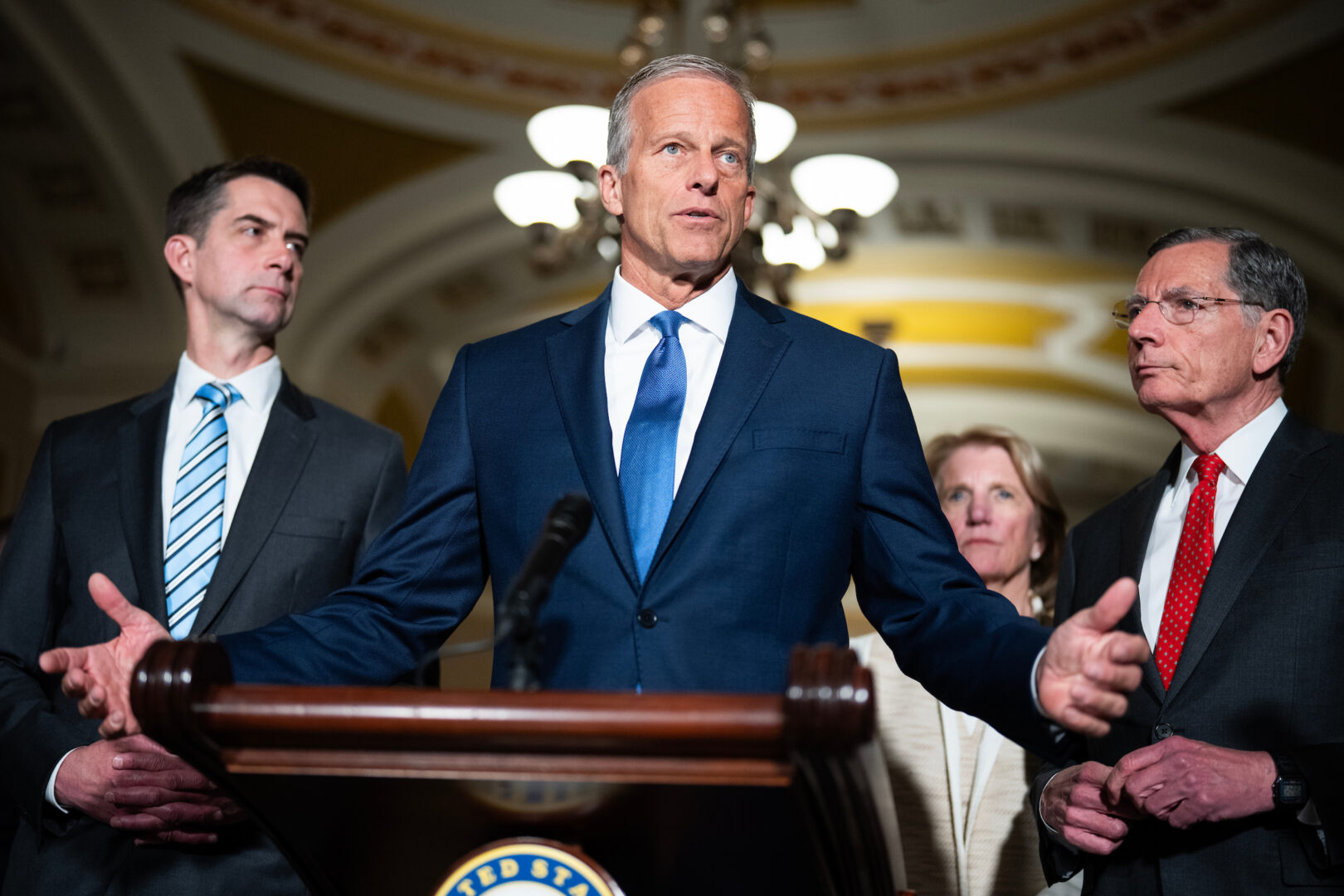
Thune has also successfully shepherded an unusually high number of "vote-a-ramas" this Congress, with six such marathon sessions resulting in no Democratic amendments triumphing. This remarkable record is a testament to his organizational skills and, crucially, his ability to largely keep his diverse conference united. In an era of intense partisan division, maintaining such a disciplined front, particularly with a slim majority, is no small feat.
“For the most part our members buy into the idea that we are a team,” Thune emphasized, highlighting his focus on cohesion. “If we’re going to succeed, we’ve got to succeed together, and that means sometimes holding hands and just doing hard things.” This sentiment was echoed by Sen. Shelley Moore Capito, a West Virginia Republican who serves in leadership as chair of the Republican Policy Committee. She described Thune as “a sports guy, and I think he knows you have to be patient and wait it out to look for your right opportunity.”
Other Notable Wins: The Rescissions Package
Beyond the high-profile reconciliation bills, Thune also successfully guided the first rescissions package of its kind into law in 30 years. This legislative tool, which allows Congress to cancel previously enacted appropriations, demonstrated a commitment to fiscal responsibility and a rare ability to claw back unspent federal funds, showcasing another facet of his legislative effectiveness.
The Unyielding Grip of "Arithmetic": Confronting White House Demands
For all his legislative successes, Thune remains grounded by an undeniable truth: “math is math.” His background as the Republican whip under former Leader Mitch McConnell taught him to “see the whole theater,” giving him an acute understanding that for many of Trump’s more radical demands, the necessary votes simply do not exist.
The SAVE America Act and the Filibuster Fight
This mathematical reality directly clashes with the White House’s insistent priorities. President Trump has vociferously advocated for the “SAVE America Act,” a marquee voter ID and election overhaul bill, and has called for the drastic measure of scrapping the legislative filibuster to push it through the Senate.
“His priorities are going to be to nuke the filibuster, pass the SAVE Act, fire the parliamentarian,” Thune stated plainly. “I’ve indicated to him in most cases — not all — that what he wants done, we just don’t have the votes for, and there’s nothing I can do to change that.” When asked if he feared Trump’s criticism for not acceding to his demands, Thune chuckled, replying, “That could happen.” This quiet acknowledgment belies the immense pressure he faces from the President and his fervent base.
Internal Party Discord: Cornyn vs. Lee
The voter ID bill, in particular, has become a lightning rod for Thune, drawing fire from the online MAGA world that presses him to deliver. “Obviously, I take fire from all sides,” he admitted. The internal party discord on this issue became publicly evident when Senator Cornyn, emboldened by his recent primary loss, publicly sparred with Senator Mike Lee of Utah. Cornyn admonished Lee to stop blaming Thune for the SAVE Act’s stalling, posting on X, “You don’t have the votes,” adding that Thune “can’t change that.”
During a recent vote-a-rama, Republicans pushing the SAVE Act couldn’t even muster a unified GOP front on a related amendment. An earlier extended debate on the bill was effectively abandoned due to lackluster support, further illustrating the “arithmetic” Thune consistently cites.
FISA and the "Full Version" SAVE America Act
The unpredictable nature of the White House’s demands continues to create hurdles. Recently, President Trump tossed up yet another challenge, posting on social media that he was “against FISA if it doesn’t come with The Save America Act (Full version!) firmly attached to it.” This linkage creates an impossible bind for Thune, forcing him to choose between a vital intelligence reauthorization and a bill that demonstrably lacks the votes, further complicating an already fraught legislative agenda.
The Future of Reconciliation and Midterm Anxieties
With the legislative calendar tightening ahead of the crucial midterm elections, the prospect of a third budget reconciliation bill, and the broader political environment, weigh heavily on Thune.
Reconciliation 3.0? A Tightrope Walk
Budget reconciliation, while a powerful tool, is not without its limitations. President Trump recently called for Republicans to “IMMEDIATELY advance and pass” a $350 billion defense reconciliation bill that “will include THE SAVE AMERICA ACT as well.” However, key Republican leaders, including Senate Appropriations Chair Susan Collins of Maine and Defense subcommittee chairman Mitch McConnell, have expressed skepticism, stating they don’t believe a third reconciliation bill will materialize and that the administration shouldn’t rely on it for additional defense funding.
Thune himself keeps the door cracked, but points to a tight schedule and growing skepticism within his conference. He notes that the “appetite” of the conference depends heavily on the bill’s “ingredients.” A “recon 3.0,” he warns, “implicates more committees of jurisdiction” and risks giving Democrats another opportunity to lob amendments designed to “undo” the GOP’s legislative work thus far. While most Republicans “are willing to support a higher topline number for the military,” Thune concludes, “But whether or not reconciliation is the vehicle to achieve that? I don’t have an answer for that yet.”
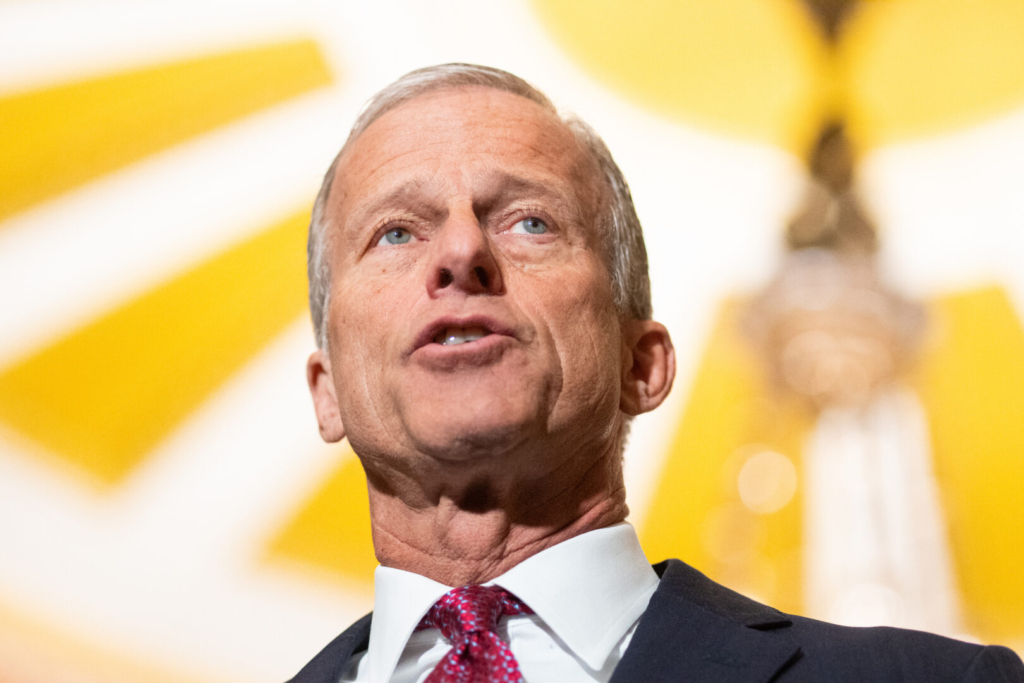
A Troubled Path to the Midterms
The political landscape leading into the midterms is fraught with challenges for Republicans. The ongoing war in Iran, which has surged well beyond the 100-day mark, has severely depleted the Pentagon’s munitions stockpile and contributed to high gas prices. These factors, coupled with President Trump’s hemorrhaging support from key independent voter groups, are setting off alarms for Senate Republicans.
Eight years prior, despite a tough national political environment marked by Trump’s job approval ratings, Republicans managed to gain two Senate seats while losing over 40 in the House. This time, even if the 2026 Senate map still appears to favor the GOP, Democrats are growing increasingly bullish. Senate Democratic Leader Charles E. Schumer confidently told Punchbowl News that his party had “multiple paths” back to power, citing Texas as an unexpected boon after Trump endorsed the scandal-plagued Ken Paxton over incumbent John Cornyn in the primary.
Thune and the National Republican Senatorial Committee had desperately hoped to avoid such intra-party drama, pleas that went largely ignored as the President continued to insert himself into state primaries. “This is not a normal political environment, and there’s a lot of anger out there,” Thune admitted. “I don’t think this is the kind of year, Democrat or Republican, where you’re going to be able to win an election by trying to get people to have a warm, fuzzy feeling about you.”
Still, as Republican candidates hit the campaign trail this summer, Thune hopes to refocus on legislative accomplishments, particularly the “One Big Beautiful” law, now branded as the Working Families Tax Cuts. “We have quality candidates. We have, I think, a record of accomplishment that we can run on that’s pretty compelling,” Thune asserted. However, he quickly tempered this optimism with the pervasive reality of his job: “There’s something coming out of the White House on a daily basis that keeps life interesting. When you’ve got a cycle where you’re facing not only political headwinds [but] some economic headwinds … you have to be adaptable.” This adaptability, he repeatedly emphasizes, is a lesson he keeps returning to: there are “things you can’t control.”
Leadership in a Cauldron: Thune’s Adaptive Style
Thune doesn’t necessarily relish being the target of blame from MAGA influencers, but he also accepts it as part of the job. “Sometimes they’re mad at the president, sometimes they’re mad at the Congress, and I obviously generate a lot of ire in my direction these days,” he acknowledged with a wry smile.
The "Coach or Point Guard" Mentality
A former high school and college basketball star, Thune often invokes a sportsman-like mentality in his leadership role, viewing himself as “the coach or the point guard.” “You distribute the ball to the people that can score it,” he explained, illustrating his collaborative approach. During a 30-minute conversation, the black smartwatch on his wrist lit up repeatedly with calls from members, a constant reminder of his active role in guiding his team. Colleagues consistently describe him as possessing a remarkably consistent personality, whether behind closed doors, in weekly policy luncheons, twisting arms on the Senate floor, or sounding off during “Squawk Box” appearances.
Navigating Obstruction and Innovation
Senate Majority Whip John Barrasso, a Wyoming Republican, praised Thune for doing well in a “demanding position,” adding that “in the face of unprecedented Democrat obstruction, a united front matters more than ever.” When Thune campaigned for the leadership role, part of his pitch was to get the Senate “working again” and protect its traditions. Yet, he concedes that “Democrats have tested that proposition a lot this year,” forcing him into creative workarounds.
He “seized” on the opposing party’s earlier idea to pass executive nominees in tranches to avoid procedural delays, a pragmatic adaptation. Similarly, using “reconciliation to fund the government,” as with the bill the President signed last week, became another necessary workaround after Democrats balked at Department of Homeland Security funding amid outrage over the agency’s tactics. “We’re doing things I never thought we’d have to do, but you’ve got to be creative,” he asserted, highlighting the necessity of innovation in an era of deep partisan trenches.
Glimmers of Bipartisan Hope
Despite the pervasive partisanship, Thune still holds out hope for bipartisan cooperation on several fronts in the remaining weeks of the legislative year. He pointed to a crypto package that recently advanced out of committee, a transformative college sports bill backed by the President, and a farm bill recently passed by the House.
“The question is to what level are Democrats going to participate. What’s the appetite in an even-numbered year, where the political overtones tend to take hold?” he pondered, acknowledging the inherent challenges of legislating in an election year. He concluded with a reflection on the Senate’s foundational purpose: “The Senate is designed to be a non-majoritarian body to give voice to the minority in the country.”
Conclusion: Steadfast in the Storm
For John Thune, the task now is to maintain a steady hand and a clear head even as one surprise after another lands on his desk. As he braces for the final, intense stretch before the midterms, the massive windows in his office overlook construction on the National Mall. The humid June sun illuminates preparations for the upcoming Great American State Fair, a celebration marking the country’s 250th birthday – a poignant backdrop to the current political disunity.
Despite his trying week, Thune still managed to crack a joke about country singer Martina McBride and other artists reportedly dropping out of the 250th concert, and the ironic meaning of her song “Independence Day.” “Got to find joy when you can,” the Republican leader said of his “dad-humor.” His words, delivered with a faint smile, carried the weight of the moment: “There’s not much joy in the job these days.” Yet, even amidst the weariness and the relentless political storms, John Thune’s commitment to navigating the complex currents of Washington, D.C. remains unwavering, a testament to his resilience in a deeply divided era.