Core Overview and Main Developments
Under the soft autumn light filtering through the soaring glass skylights of the Hart Senate Office Building, one of the American Capitol complex’s most prominent—and long-absent—artistic installations is finally regaining its complete form.
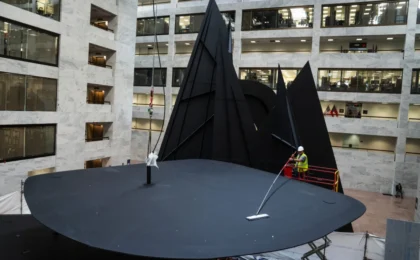
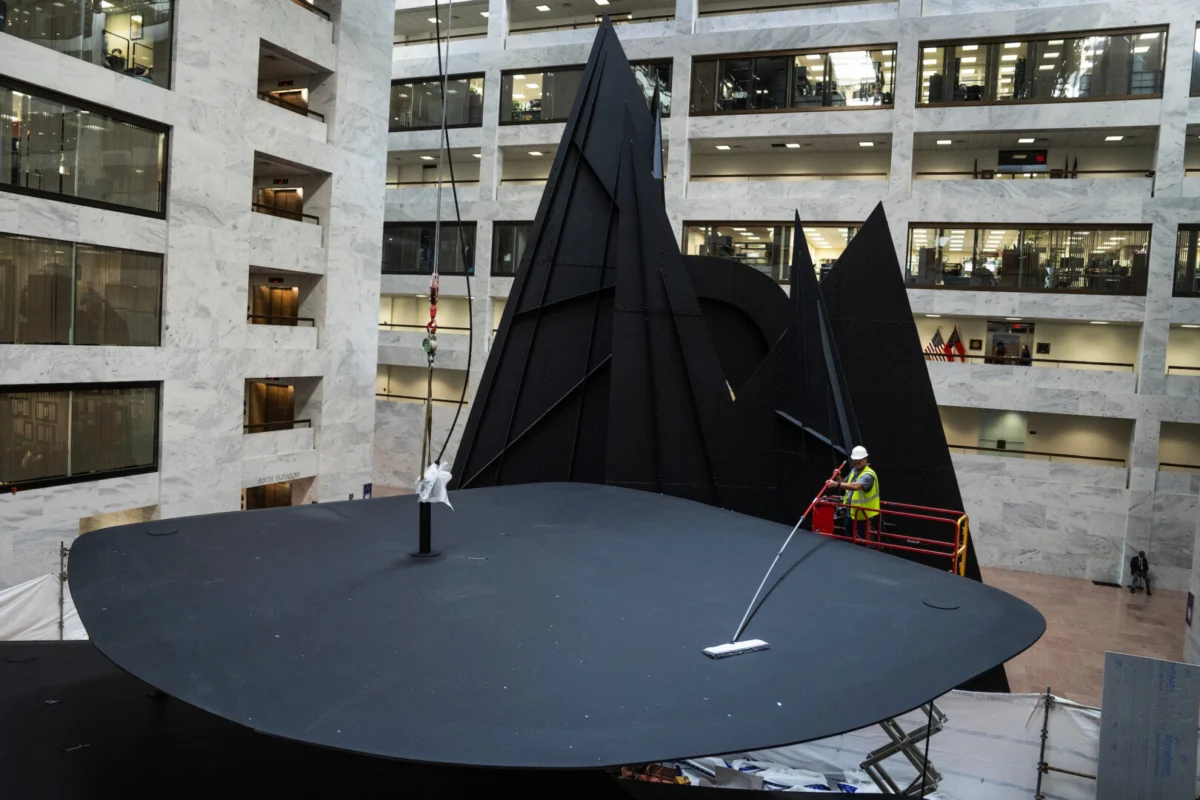
For the first time in over twelve years, specialized rigging crews have begun the delicate process of hoisting and re-anchoring the black aluminum "clouds" of Alexander Calder’s monumental sculpture, Mountains and Clouds, into the vast 90-foot-tall atrium of the Hart Building. The installation marks a pivotal milestone in a multi-year restoration initiative driven by bipartisan congressional advocacy, private funding partnerships, and technical conservation expertise.
       +-------------------------------------------------------+
       |             HART SENATE BUILDING ATRIUM               |
       |                                                       |
       |   +-----------------------------------------------+   |
       |   |             CEILING RIGGING SYSTEM            |   |
       |   +-----------------------------------------------+   |
       |                           |                           |
       |                           v                           |
       |           [ MOTORIZED SUSPENSION CABLE ]              |
       |                           |                           |
       |              ~~~  THE CLOUDS ~~~                      |
       |          (Restored Kinetic Aluminum Mobile)           |
       |                           |                           |
       |                           |                           |
       |               /~~~~~~~~~~~~~~~~~                     |
       |              /   THE MOUNTAINS                       |
       |             / (35-Ton Steel Stabile)                   |
       +-------------------------------------------------------+
While the massive, 35-ton painted steel "mountains" have remained stationary on the atrium floor since the sculpture’s original installation in the mid-1980s, the upper, mobile element—the floating "clouds"—was dismantled in 2014 due to structural concerns, mechanical failure of its motorized rotation mechanism, and safety assessments. For over a decade, the atrium housed only half of Calder’s final masterwork, leaving a prominent spatial void in the primary public thoroughfare of the Senate’s largest office complex.
Rigging teams equipped with industrial scaffolding, hydraulic lifts, and specialized balancing gear prepared the suspended elements for mounting. The physical hanging of the massive sheet-metal cloud shapes represents the culmination of a campaign spearheaded by Sen. Chris Murphy (D-Conn.) and Sen. Angus King (I-Maine), alongside the Calder Foundation and the Office of the Architect of the Capitol.
"I think the clouds are being hung this weekend," Sen. Murphy confirmed in an interview regarding the progress. "It’s going to take a little while to get them motorized, and they’ve got to get them balanced."
Although the structural suspended components are now taking physical shape above the atrium floor, full mechanical functionality—including the dynamic rotation originally intended by Calder—remains scheduled for completion in the weeks following the upcoming legislative recess.
Historical Chronology: From Commission to Long Absence
The trajectory of Mountains and Clouds spans half a century of American art history, legislative building projects, and complex engineering challenges. Understanding its restoration requires tracing its history from its inception in the mid-1970s to its removal and long recovery.
+-------------------------------------------------------------------------+
|                         CHRONOLOGY OF EVENTS                            |
+-------------------------------------------------------------------------+
| 1975-1976 | Alexander Calder commissioned; completes 1:16 scale model    |
| Nov 1976  | Calder passes away shortly after approving the design        |
| 1985-1986 | Sculpture fabricated and installed in the Hart Atrium        |
| 2000s     | Motor drive mechanism fails; mobile becomes static           |
| 2014      | Clouds removed for structural safety study; project stalls   |
| Feb 2024  | Calder Foundation secures private funding for restoration    |
| Aug 2026  | Scaffolding constructed in Hart Atrium                       |
| Sep 2026  | Physical reinstallation of cloud elements begins             |
+-------------------------------------------------------------------------+
Initial Conception and Calder’s Final Masterpiece (1975–1986)
In 1975, as construction was underway for the Hart Senate Office Building—designed by architect John Carl Warnecke—a federal fine arts panel selected Alexander Calder to design a site-specific installation for the central atrium. Calder, revered as the pioneer of the kinetic sculpture (or "mobile"), envisioned an artwork that would bridge the physical ground and the open vertical space above.
Calder created a 1:16 scale maquette (model) depicting a black steel "stabile" (the mountains) set beneath a dynamic, motor-driven aluminum "mobile" (the clouds). In November 1976, Calder traveled to Washington, D.C., to present the final model to the Architect of the Capitol. Just weeks later, Calder passed away at age 78.
Because Calder left behind precise models and specifications, Congress eventually appropriated funds for full-scale fabrication. The installation was completed
and formally dedicated in 1986, instantly becoming the visual anchor of the modernistic marble building.
Mechanical Failure and the 2014 Removal
Over the subsequent decades, the dynamic elements of Mountains and Clouds suffered from environmental wear and mechanical friction. Designed to rotate via a slow electric motor system mounted near the roof trusses, the clouds experienced repeated mechanical breakdowns:
- Drive System Malfunctions: The original electric motor and gear reducers faced continuous mechanical stress, resulting in frequent lockups.
- Structural Strain: The weight of the heavy aluminum sheet elements exerted uneven torque on the central support cables and suspension mounts.
- Operational Inaction: To prevent further mechanical failure, Capitol facility managers eventually turned off the motor, leaving the clouds suspended in a static orientation for years.
In 2014, citing the need for a comprehensive safety study and structural analysis of the ceiling anchor points, the Architect of the Capitol removed the upper "cloud" elements entirely. The clouds were placed in off-site storage, leaving the ground-level "mountains" isolated in the atrium and prompting ongoing critique from art historians, visitors, and lawmakers who viewed the incomplete installation as a disservice to Calder’s legacy.
Technical Specifications, Engineering, and Private Funding Data
The current reinstallation is not merely a re-hanging of the existing 1986 components, but a complete engineering overhaul designed to meet contemporary structural standards and ensure long-term mechanical reliability.
Architectural and Material Dimensions
| Component | Material | Physical Dimensions | Weight / Structural Load |
|---|---|---|---|
| The Mountains (Stabile) | Sheet Steel | 51 feet tall | ~35 tons |
| The Clouds (Mobile) | Sheet Aluminum & Steel | 85 feet wide span | ~4.5 tons (combined suspended load) |
| Atrium Clearances | White Marble / Glass Trusses | 90 feet ceiling height | Suspended ~60 feet above floor |
                [ SKYLIGHT TRUSS SYSTEM ]
                         |
           +-------------+-------------+
           | Modern Geared Drive Motor |
           +-------------+-------------+
                         |
                 [ STEEL CABLE ]
                         |
            /------------+------------
           /     THE CLOUD ASSEMBLY
          / (Precision Counterweighted)
         +-------------------------------+
The Engineering Challenge of Motorized Kinematics
Unlike classic outdoor or indoor mobiles that rely entirely on natural airflow, the scale and weight of Calder’s Clouds require controlled, motorized propulsion to achieve the subtle rotation the artist envisioned:
- Drive System Modernization: The original, high-maintenance 1980s drive assembly has been replaced with a modern, low-noise, high-torque industrial motor equipped with variable-frequency drives (VFD). This allows facility managers to precisely control rotational speed, minimizing mechanical fatigue.
- Load-Bearing Safety Interlocks: Modern computerized sensors monitor cable tension, rotational resistance, and weight distribution in real time. If gusting airflow from HVAC systems or mechanical binding creates asymmetrical loads, the drive system automatically halts to prevent structural stress on the atrium ceiling trusses.
- Precision Counterweighting: Because the aluminum clouds consist of asymmetrical, overlapping geometric forms, balancing the center of gravity relative to the single suspension axis requires millimeter-level adjustments before the motor drive can be engaged.
Public-Private Financial Model
A major hurdle in restoring the sculpture was navigating federal appropriations constraints. The project ultimately moved forward through a public-private framework designed to eliminate taxpayer burden for the art restoration itself:
- Private Philanthropy: In February 2024, the Calder Foundation confirmed that private funding had been secured to cover the conservation, engineering, and reinstallation costs.
- Federal Oversight: The Office of the Architect of the Capitol provided logistical support, building integration management, and structural safety sign-offs, maintaining compliance with federal facilities codes.
Official Responses and Congressional Advocacy
The restoration of Mountains and Clouds reflects years of persistent institutional lobbying within the Capitol complex. Congressional leadership and art preservation advocacy groups played central roles in bringing the project to fruition.
Senate Champions: Murphy and King Lead the Push
Senator Chris Murphy (D-Conn.) has been among the most vocal advocates for completing the work. Calder spent much of his adult life living and working in Roxbury, Connecticut, giving the state a strong cultural connection to the artist’s oeuvre.
"One of our nation’s most significant works of public art has stood incomplete for decades, right here in the U.S. Senate," Senator Angus King (I-Maine) noted in a statement celebrating the structural work. "I’m thrilled that the restoration of Alexander Calder’s Mountains and Clouds is moving forward."
Addressing the timeline for functional completion, Murphy noted that while the physical presence of the clouds is being re-established, the final kinetic activation will take time:
"I think the clouds are being hung this weekend. It’s going to take a little while to get them motorized, and they’ve got to get them balanced… I don’t think they’ll be moving until potentially after the election."
— Sen. Chris Murphy (D-Conn.)
Statements from the Calder Foundation and Capitol Authorities
The Calder Foundation, which oversees the preservation of Alexander Calder’s legacy worldwide, expressed satisfaction with the progress after years of technical planning and coordination with government agencies.
"We’re excited about the progress that has been made so far in this historic restoration and look forward to sharing more soon."
— Spokesperson, The Calder Foundation
The Office of the Architect of the Capitol (AOC), which manages the maintenance and preservation of the historic Capitol grounds, declined formal comment during the active rigging phase on Friday, but field crews worked systematically in the atrium to secure the rigging rigs and position safety barriers.
Institutional Implications and Long-Term Outlook
The return of Mountains and Clouds carries broader significance for the presence of modern public art within civic institutions and the long-term stewardship of national cultural assets.
Civic Identity and Public Art in Federal Spaces
The Hart Building atrium was explicitly designed around Calder’s work. The stark, geometric white marble walls designed by Warnecke were intended as a muted canvas for Calder’s sweeping black steel and aluminum forms.
+-------------------------------------------------------------------+
|                  ARTISTIC IMPACT ON HART ATRIUM                   |
+-------------------------------------------------------------------+
| WITHOUT CLOUDS (2014-2026)     | WITH CLOUDS RESTORED (Present)   |
|--------------------------------|----------------------------------|
| * Monolithic ground-level steel| * Integrated vertical composition|
| * Severe spatial imbalance     | * Dynamic play of shadow/motion  |
| * Visual truncation of ceiling | * Fulfillment of site design     |
+-------------------------------------------------------------------+
Art historians have long argued that removing the suspended mobile component mutilated the spatial balance of the atrium. By restoring the dynamic relation between ground (the mountains) and sky (the clouds), the space recovers its intended architectural proportion and artistic cohesion.
Furthermore, the project highlights a growing reliance on public-private partnerships to maintain and restore major artworks housed in federal facilities, offering a template for addressing backlogged maintenance on public art across the country without relying solely on congressional budget lines.
The Path to Final Completion and Motorization
With the heavy structural rigging underway, the coming weeks will involve methodical calibration steps before the public formal dedication:
- Static Suspension and Rigging Checks: Ensuring the multi-ton aluminum elements are securely anchored to the building’s primary steel trusses.
- Precision Weight Balancing: Fine-tuning the balance points of the mobile arms so that the forms hang naturally without unaligned tilting.
- Electrical Drive Integration: Connecting the replacement electric motor assembly and integrating safety shutoff controls.
- Kinetic Testing: Running slow-speed rotational tests during non-legislative hours to assess air current resistance and mechanical stability.
- Formal Unveiling: A planned dedication ceremony involving Senate leadership, the Calder Foundation, and preservation advocates, expected following the post-election legislative session.
Once fully motorized, Alexander Calder’s final vision will once again move fluidly above the floor of the United States Senate—restoring a kinetic landmark to its rightful place at the heart of American democracy.