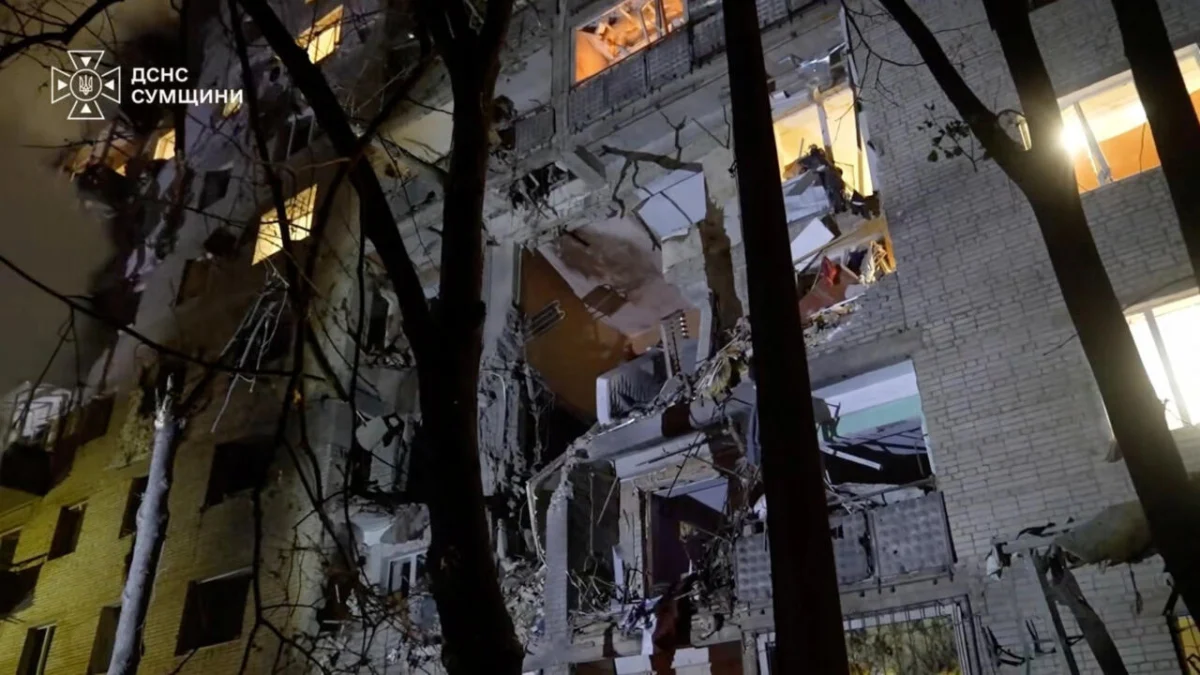
SUMY, UKRAINE – A devastating Russian aerial strike on a residential apartment complex in the northeastern city of Sumy has claimed the lives of at least two civilians, marking another grim escalation in the ongoing conflict between Moscow and Kyiv. The attack, which occurred late Friday, September 18, 2026, utilized a high-impact glide bomb, a weapon system that has become a hallmark of Russia’s recent aerial campaign to undermine Ukrainian urban infrastructure.
Ukrainian President Volodymyr Zelensky confirmed the fatalities early Saturday morning, condemning the strike as a deliberate act of terror against non-combatants. As rescue teams continue to sift through the smoldering ruins of the apartment block, the incident serves as a stark reminder of the extreme vulnerability of Ukraine’s northern and eastern border regions.
The Anatomy of the Strike
The impact occurred late Friday, catching residents off guard in their homes. According to initial reports from the State Emergency Service of Ukraine, the glide bomb—a precision-guided munition capable of being launched from aircraft at a distance outside the range of many Ukrainian air defense systems—struck the upper floors of the building with devastating force.
Images released by emergency responders depict a harrowing scene: a vertical section of the apartment building has been hollowed out, with a massive, jagged breach spanning three floors. Debris, twisted metal, and shattered concrete have buried what were, hours earlier, living rooms and bedrooms. The structural integrity of the remaining building remains in doubt, complicating search and rescue efforts as responders balance the need for speed against the risk of further collapse.
Chronology of the Escalation: September 2026
The attack on Sumy is not an isolated event but rather the latest in a rapid sequence of hostilities that have defined the autumn of 2026.
- September 16: Military analysts noted an uptick in Russian tactical aviation activity along the Sumy-Kharkiv axis, suggesting a pivot toward targeting rear-guard logistics and residential centers.
- September 17: Explosions were reported in the capital, Kyiv, as international pressure mounted on the U.S. Congress to expedite new sanction packages against Moscow’s military-industrial complex.
- September 18 (Evening): The strike on Sumy occurred, with sirens sounding only moments before the impact, leaving little time for residents to seek shelter in basements or designated bunkers.
- September 19 (Early Morning): President Zelensky issued a formal statement confirming the deaths and directing regional authorities to prioritize medical care for the injured and temporary housing for those displaced by the blast.
The Strategic Shift: Glide Bombs as a Tool of Attrition
The use of glide bombs—specifically the FAB-series munitions retrofitted with guidance kits—represents a significant evolution in Russian military strategy. Unlike traditional ballistic missiles, which can be intercepted by high-end systems like the Patriot, glide bombs are released from Russian fighter-bombers flying at high altitudes, often dozens of kilometers from the Ukrainian border.
Why Glide Bombs are Lethal
- Standoff Capability: Because the aircraft remain outside the range of most medium-range air defense systems, they operate with relative impunity.
- Destructive Payload: These bombs carry massive quantities of high explosives designed to penetrate fortified positions, making them excessively destructive when dropped on civilian housing.
- Low Warning Time: Their flight profile is different from cruise missiles, often resulting in shorter warning times for the general population.
Military experts point out that by deploying these weapons, Moscow is attempting to replicate the attrition tactics used in the early stages of the war in Donbas, aiming to make frontline cities uninhabitable and drain the morale of the Ukrainian populace.
Official Responses and International Condemnation
Kyiv’s Perspective
President Zelensky’s office has utilized the attack to reiterate calls for Western allies to lift restrictions on the use of long-range weapons against military airfields located inside Russian territory. "We are losing lives every day because we are prevented from striking the source of these attacks," a presidential advisor noted in a press briefing following the strike. The Ukrainian government maintains that as long as Russian aircraft can launch these bombs from their own airspace without fear of retaliation, the civilian population in border regions like Sumy will remain at mortal risk.
The Russian Stance
As is standard practice, the Russian Ministry of Defense has remained silent regarding the specific strike on the Sumy apartment block. However, state-aligned media outlets frequently characterize such hits as "high-precision strikes on military infrastructure," a claim that local authorities and international observers repeatedly refute by providing evidence of civilian casualties and the absence of military targets in residential districts.

The Humanitarian Toll
The State Emergency Service of Ukraine (SES) remains the primary point of contact for the victims. Volunteers and emergency responders are working in shifts, utilizing specialized equipment to lift slabs of reinforced concrete. The local regional administration has set up mobile heating and aid stations, as power and water lines in the vicinity of the blast have been severed.
Broader Implications: A War of Attrition
The situation in Sumy illustrates the broader strategic stalemate of the 2026 campaign. With both sides struggling to achieve decisive breakthroughs on the front lines, the conflict has increasingly shifted toward a "war of infrastructure."
Impact on Domestic Resilience
The sustained bombardment of Ukrainian cities is designed to erode the "home front." By targeting apartment complexes, the Kremlin aims to create a continuous stream of internally displaced persons (IDPs), placing immense pressure on the Ukrainian economy and social services.
The Geopolitical Context
The timing of the strike is significant. It follows a week of intense debate in Washington and Brussels regarding the sustainability of current aid levels. The attack serves as a grim bargaining chip, with Ukraine using the imagery of destroyed homes to pressure Western leaders into providing more advanced radar systems and interceptor missiles.
Looking Ahead: The Path Forward
As the sun rises over the ruins in Sumy, the immediate concern remains the rescue of those still trapped under the rubble. However, the long-term question for Ukraine is how to effectively counter the threat from the skies.
Military analysts suggest that the solution is threefold:
- Suppression of Enemy Air Defenses (SEAD): Ukraine needs more offensive capability to target the bombers at their source.
- Increased Air Defense Density: Deploying more NASAMS and Patriot batteries around major population centers near the border.
- Diplomatic Leverage: Continued pressure on the international community to isolate the Russian military-industrial supply chain, which provides the guidance components for these glide bombs.
For the people of Sumy, the war is not a series of map updates or geopolitical theories; it is a daily struggle for survival. The tragedy of September 19 is a stark reminder that while the world watches the macro-level shifts of the conflict, the human cost remains the most volatile and tragic variable in the war.
As the international community reflects on these events, the focus will likely turn back to the upcoming diplomatic summits in the West. Whether these discussions will result in the military hardware necessary to stop the glide bomb threat remains to be seen. Until then, the residents of Sumy and other border cities must continue to live under the constant shadow of an unpredictable and lethal sky.
This article is based on ongoing reports from the State Emergency Service of Ukraine, international news wires including AFP and Reuters, and statements issued by the Office of the President of Ukraine. As the situation is live, further updates regarding casualty numbers and the status of the rescue operation are expected throughout the day.