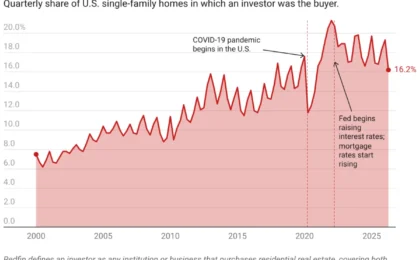
As autumn 2026 approaches, the traditional "busy season" for the U.S. housing market is drawing to a close. However, for millions of prospective homebuyers and industry analysts alike, it feels as though the market never truly awoke from its 2025 slumber. The housing landscape remains defined by a paradoxical mix of persistent sluggishness, record-high monthly costs, and a complex web of global economic pressures. For those asking the perennial question—"Should I buy now or wait?"—the answer has never been more deeply tied to individual financial health than it is today.
Main Facts: A Market in Stasis
The current state of the U.S. housing market can be summarized by three primary stressors: limited inventory, tepid transaction volume, and near-record monthly payment costs. Despite a slight uptick in the total number of homes for sale—now exceeding 1.5 million—the market is far from a state of equilibrium.
The median U.S. sale price currently hovers at $398,596, marking a 2.2% increase over the previous year. While this rate of growth has decelerated compared to the aggressive surges seen between 2012 and 2020, it nonetheless compounds an already strained affordability crisis. Prices today are roughly 20% higher than they were just five years ago. This creates a "stagnation trap" where sellers, unwilling to relinquish lower interest rates from years prior, keep supply tight, while buyers remain sidelined by the prohibitive cost of entry.
Chronology: The Road to the 2026 Slump
To understand the current impasse, one must look at the timeline of events that dismantled the post-pandemic housing momentum.
- 2025 – The "Very Slow" Year: Following the hyper-growth years of 2020–2022, 2025 began a correction phase characterized by high interest rates and a "wait-and-see" approach from both buyers and sellers.
- March 2026 – The Turning Point: Prior to March 2026, mortgage rates had shown signs of stabilization, trading in the 6.1% to 6.3% range. This tentative optimism was shattered as geopolitical tensions in the Middle East escalated, triggering a chain reaction in global oil prices and bond yields.
- Summer 2026 – Economic Whiplash: As summer progressed, the confluence of AI-driven labor market fears, ongoing tariff negotiations, and uncertainty surrounding Federal Reserve policy created a "perfect storm" for the mortgage market.
- September 2026 – Present: By mid-September, the 30-year fixed mortgage rate reached 7.17%, an 18-month high. This surge has effectively neutralized the cooling effect that price stagnation might have otherwise provided for affordability.
Supporting Data: The Mechanics of Affordability
The primary driver of the current housing freeze is the direct correlation between geopolitical instability and household debt service. As Chen Zhao, Head of Economics Research at Redfin, notes, the surge in energy prices has acted as an inflationary catalyst. When the Fed signals a potential rate hike to combat this inflation, mortgage rates—which are tied to the 10-year Treasury yield—inevitably climb.
The Inventory Paradox
While inventory is at its highest level since the pandemic—with roughly 1.5 million active listings—this data point requires nuance. In the Sun Belt, particularly in Texas and Florida, inventory has surged due to a combination of new construction and a reactionary cooling of demand. Conversely, the Northeast and Midwest continue to experience acute supply shortages. This regional disparity means that while some buyers have significant leverage to demand concessions, others are trapped in bidding wars for a dwindling supply of entry-level homes.
The Cost of Waiting
The financial implications of a 7%+ mortgage rate are profound. A one-percentage-point increase in rates translates to hundreds of dollars in additional monthly payments, potentially totaling tens of thousands of dollars over the life of a loan. Buyers who are currently waiting for a "market crash" are finding that the cost of inaction is, in many cases, higher than the cost of entering the market now, especially if they possess the financial stability to weather short-term volatility.
Official Responses and Expert Outlook
Daryl Fairweather, Chief Economist at Redfin, maintains a nuanced stance: "Now is a good time to buy a home, if you can afford it." According to Fairweather, while the macroeconomic picture is grim, the microeconomic reality for the buyer who remains in the market is surprisingly favorable.
Because many casual buyers have been pushed to the sidelines by high interest rates, those who are still in the market—particularly the ultra-wealthy or those with significant cash reserves—are finding less competition. This creates a rare window where sellers are more willing to offer concessions, such as covering closing costs or funding interest-rate buydowns, to close a deal.

However, the consensus among experts is clear: the era of "easy money" is over. Future affordability will likely be driven by wage growth rather than significant interest rate cuts. Consequently, the "reset" of the housing market is expected to be a long, uneven process rather than a sharp correction.
Implications for the Modern Homebuyer
For the individual, the decision to purchase a home in 2026 must be decoupled from the noise of national headlines. Success in this market requires a return to fundamental financial prudence.
The Financial Health Audit
Before engaging with the market, potential buyers must perform a rigorous self-assessment.
- Liquidity: In an era of unpredictable repairs and fluctuating taxes, an emergency fund covering 3 to 6 months of expenses is no longer a luxury—it is a requirement.
- Debt-to-Income Ratio: With mortgage rates elevated, the margin for error in your monthly budget is razor-thin. Ensure that your debt obligations do not leave you "house-poor."
- The "Stay-Put" Factor: Given the transaction costs associated with buying and selling, only those planning to stay in a home for at least five to seven years should consider purchasing.
Geographic and Climate Considerations
A critical, often overlooked factor in 2026 is climate risk. As insurance companies increasingly pull out of regions prone to wildfires, flooding, or hurricanes, the "cost" of a home now includes the volatility of the insurance market. Buyers must investigate the insurability of any property before making an offer. In many parts of the country, the mortgage payment is only the beginning; property taxes and insurance premiums are now becoming the primary drivers of monthly housing costs.
The Strategy for Success
If you decide that now is the time to buy, the following strategies are essential:
- Get Pre-Approved, Not Just Pre-Qualified: In a market where deals are falling through due to financing issues, a solid pre-approval from a reputable lender is your strongest bargaining chip.
- Work with a Local Specialist: Because the market is hyper-localized—with some cities experiencing a buyer’s market and others a seller’s market—a local agent is essential to navigating the specific inventory dynamics of your target area.
- Focus on Total Cost, Not Just Price: Negotiate based on your monthly budget. If you can secure seller concessions, such as points to buy down your interest rate, you may be able to lower your effective rate significantly.
Conclusion: The Path Forward
Is it a good time to buy? For the vast majority of Americans, the answer remains complicated. The market is not "fixed" in the traditional sense, and waiting for a perfect convergence of low prices and low interest rates is a strategy that has kept many on the sidelines for years.
The reality of 2026 is that the market favors those who are prepared, informed, and financially resilient. If your life circumstances—such as a growing family, a stable job, or the desire for long-term equity—align with homeownership, then the current climate provides an opportunity to negotiate terms that would have been impossible during the frenzy of the early 2020s.
However, do not let the fear of missing out (FOMO) dictate your decision. The housing market is currently a test of discipline. For those who can navigate the high-rate environment with a clear budget and a long-term horizon, the path to homeownership remains open—albeit narrow and demanding. The key is to stop viewing the housing market as a speculative investment and start viewing it as the foundation of your personal financial stability.