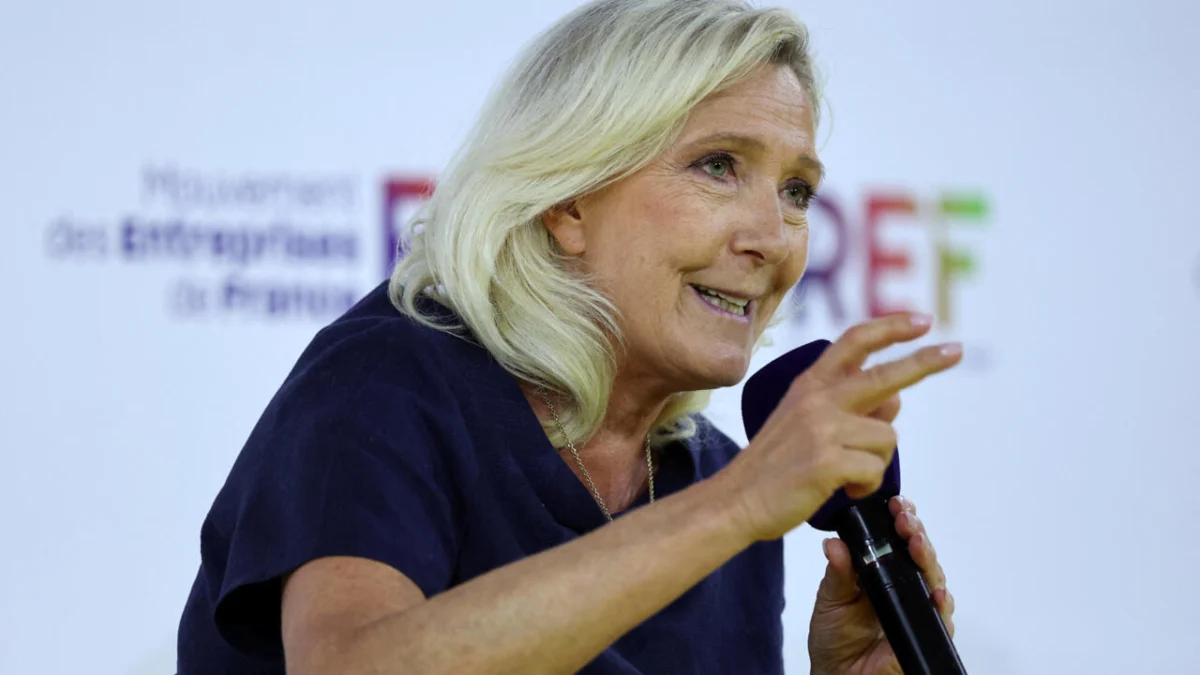
PARIS – As the summer of 2026 fades into a politically charged autumn, the landscape of the 2027 French presidential election has crystallized around a series of pivotal confrontations. Among the most significant was the high-profile debate held before the Mouvement des Entreprises de France (Medef), the nation’s largest employer federation. The event, which saw Marine Le Pen take the stage alongside other key contenders, served as a litmus test for the economic credibility of the populist right and signaled the intensity of the campaign to come.
With the French electorate grappling with post-inflationary economic shifts, industrial decline, and the complexities of European integration, the Medef stage became more than a forum for policy discussion; it was a battleground for the future of the French socio-economic model.
I. Main Facts: The Medef Confrontation
The late August gathering at the Medef Summer University in Paris brought together the leading figures of the political spectrum. For Marine Le Pen, the veteran leader of the Rassemblement National (RN), the appearance was a calculated move to broaden her base. Historically, the business elite and the corporate world have been the most resistant segments of society to her platform. By standing before the captains of industry, Le Pen aimed to transition from an anti-establishment firebrand to a credible, "presidential" candidate capable of managing the world’s seventh-largest economy.
The central tension of the debate revolved around three pillars: protectionism vs. globalization, the simplification of the tax code, and the future of France’s social safety net. Le Pen, leaning into her "economic patriotism" doctrine, argued for a redirection of state support toward domestic industries and a reduction in energy costs, which she claims are strangling French small and medium-sized enterprises (SMEs).
II. A Chronology of the 2027 Campaign Trail
To understand the significance of the August 27 debate, one must view it within the broader timeline of the 2027 election cycle, which began in earnest following the end of the current administration’s tenure.
- Early 2026: Informal alliances begin to form. The center-right struggles to find a unified voice, while the left-wing coalition, despite internal fractures, focuses on the cost-of-living crisis.
- May 2026: The official announcement of the 2027 electoral calendar. The urgency of the campaign causes a surge in political lobbying.
- August 27, 2026: The Medef Summer University debate. This event acts as the "unofficial" kickoff for the final year of campaigning. It forces candidates to move beyond slogans and address fiscal reality.
- September 2026: Immediate aftermath of the Medef event. Political analysts begin dissecting the "Le Pen pivot," questioning whether her overtures to the business community will alienate her core working-class constituency.
- Late 2026 – Early 2027: Anticipated period of televised primary debates and the solidification of party platforms.
III. Supporting Data: The Economic Context
France’s economic trajectory remains the primary engine of the 2027 election. According to data provided by the Institut national de la statistique et des études économiques (INSEE), the following metrics are shaping voter sentiment:
- Purchasing Power: Despite a stabilization of inflation, household confidence remains historically low. The cumulative effect of the 2023–2025 inflationary period has left a lasting impact on the "middle France" demographic.
- Corporate Tax Burden: France continues to struggle with one of the highest tax-to-GDP ratios in the OECD. Medef leaders have long argued that this inhibits innovation and competitiveness.
- Industrial Sovereignty: Post-pandemic shifts have prioritized the re-industrialization of the "Hexagon." Le Pen’s focus on "Made in France" policies aligns with a growing consensus that the country must reduce its reliance on external supply chains, particularly in energy and defense.
Critics, however, point to the potential for a massive capital flight if Le Pen’s policies—which include stringent immigration controls and a focus on national preference—are perceived as hostile to foreign investment.
IV. Official Responses and Political Reactions
The reaction to Le Pen’s performance at the Medef was predictably polarized.
The Rassemblement National (RN):
Supporters of Le Pen hailed her performance as a masterclass in diplomacy. Her aides noted that she successfully navigated tough questions regarding the Eurozone and public debt, presenting a "pragmatic nationalist" vision that comforted nervous CEOs. "She showed that the RN is no longer a protest party, but a party of government," said one senior party strategist.
The Centrist/Government Response:
Government officials and supporters of the current centrist establishment characterized her proposals as "economic populism" that would lead to isolation. They argued that her protectionist measures would violate EU trade laws and invite retaliation from partners in Germany and the United States. Finance Ministry officials warned that any deviation from fiscal discipline would result in a downgrade of France’s sovereign credit rating.

The Left-Wing Coalition:
The left-wing bloc, largely absent from the Medef’s inner circles, criticized the entire event as an exercise in "crony capitalism." They argued that Le Pen’s flirtation with the Medef was a betrayal of the working class and that her tax-cut proposals would only serve the wealthiest shareholders while slashing public services.
V. Implications: The Path to the Élysée
The 2027 election is shaping up to be a referendum on the nature of French identity and its role in a fractured global economy. The implications of the Medef debate are profound:
1. The Normalization of the Right
By standing on the same stage as traditional institutionalists, Le Pen has achieved a form of "normalization." Even if CEOs do not agree with her policies, they are now treating her as a potential future president. This shift in perception is a crucial victory for the RN, which has spent years attempting to shed its image as an extremist fringe.
2. The European Dilemma
The debate underscored the looming conflict between national sovereignty and EU mandates. Any candidate advocating for protectionist industrial policies will inevitably clash with Brussels. The Medef, traditionally pro-European, served as a reminder that French business success is inextricably linked to the European Single Market. Le Pen’s ability to balance her nationalist rhetoric with the realities of the EU will be the central question of the next six months.
3. Voter Volatility
The French electorate is currently characterized by high volatility. The traditional divide between the left and the right has been supplanted by a divide between the "globalists" and the "localists." Le Pen’s challenge is to ensure that her new business-friendly face does not cost her the support of the voters who feel left behind by globalization. If she pivots too far toward the corporate center, she risks losing her base to more radical challengers on the far right.
4. The Future of French Industry
The Medef debate highlighted a consensus on at least one front: the need for industrial renewal. Regardless of who wins in 2027, the next administration will be pressured to invest heavily in the green energy transition, AI-driven manufacturing, and the decarbonization of the French industrial base. The debate provided a preview of how each candidate intends to fund these massive transitions.
Conclusion
As the 2027 presidential election approaches, the image of Marine Le Pen at the Medef podium serves as a powerful symbol of a changing political order. The barrier between "fringe" politics and "establishment" power has become increasingly porous.
For the business community, the task remains to determine which candidate offers the best balance of stability and growth in an era of geopolitical uncertainty. For the French public, the choice in 2027 will be even more foundational: whether to double down on the European project and its associated economic policies, or to experiment with a form of sovereign protectionism that has not been tested in the Fifth Republic for decades.
With the campaign season moving into its final, most critical phase, all eyes remain on Paris. The events of August 27 were merely the opening salvo in a struggle that will define the direction of France—and by extension, the European Union—for the next decade. As the rhetoric sharpens and the stakes rise, the electorate will be forced to choose between the comfort of the status quo and the siren song of a radical, nationalist shift.