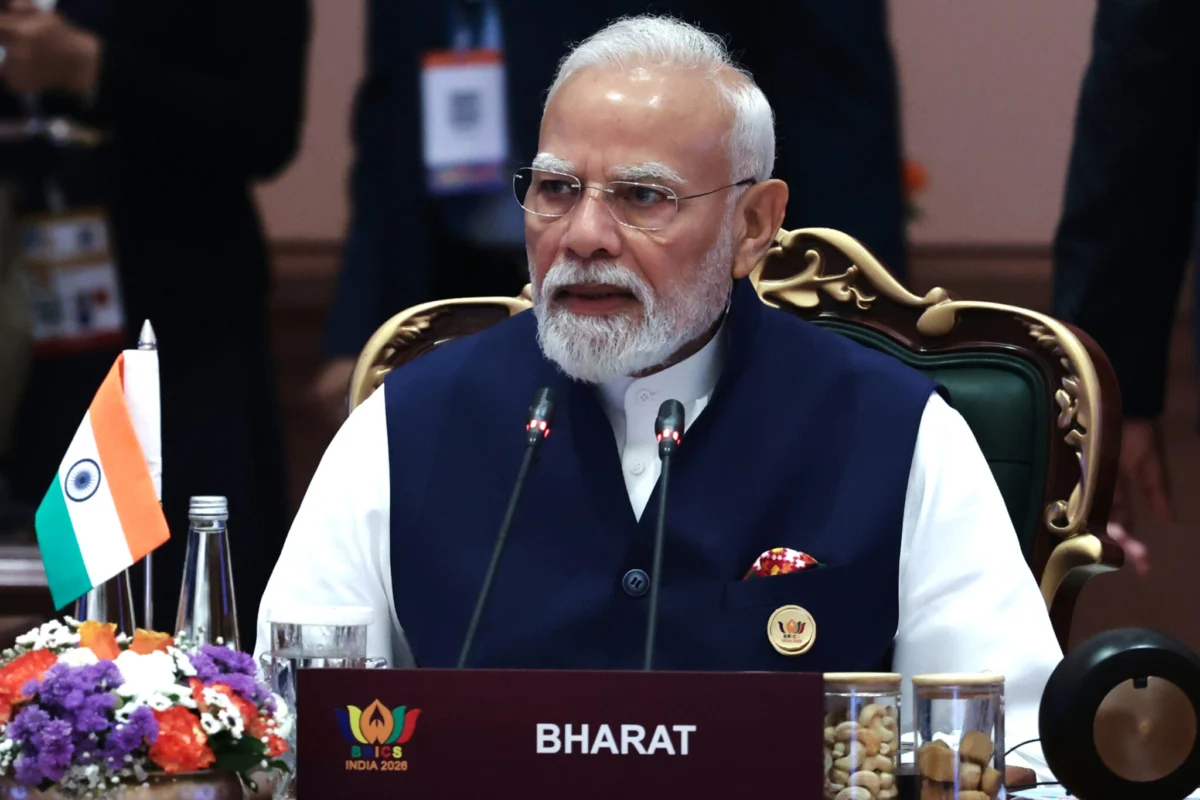
NEW DELHI – In a landmark address that underscored the shifting tectonic plates of global diplomacy, Indian Prime Minister Narendra Modi issued a stern warning against the "weaponization" of technology and critical minerals, calling for a more resilient and cooperative framework among the nations of the Global South. Speaking on the concluding day of the BRICS summit in New Delhi, Modi framed the 11-member bloc not merely as a political alliance, but as an "ecosystem of solutions" capable of navigating a world increasingly fractured by geopolitical strife, climate catastrophes, and economic volatility.
The summit, which brought together the leaders of the world’s most significant emerging economies, concluded with a call for a fundamental overhaul of the post-World War II international order. As the bloc expands its footprint, representing nearly half of the human population, its collective voice is increasingly focused on challenging Western hegemony in finance and technology while proposing a "multipolar" alternative.
Main Facts: A Unified Vision for a Fragmented World
The New Delhi summit served as a critical platform for the expanded BRICS—now including heavyweights like Iran, Saudi Arabia, and the United Arab Emirates—to harmonize their often-competing interests. The primary outcomes of the summit centered on three pillars: security, economic sovereignty, and global health.
The Weaponization of Resources
Prime Minister Modi’s warning regarding the "weaponization of technology and critical minerals" hit a resonant chord. This refers to the growing trend of advanced economies using export controls, sanctions, and patent monopolies to maintain dominance. For the Global South, which holds the lion’s share of the world’s raw materials—such as lithium, cobalt, and rare earth elements—the message was clear: these resources must be used for shared prosperity rather than as leverage in geopolitical games.
Concrete Health Initiatives
A tangible breakthrough of the summit was the agreement to establish an integrated early warning system for infectious diseases. Citing the lessons learned from the COVID-19 pandemic, Modi emphasized that in an interconnected world, a health crisis in one region is a threat to all. This system aims to decentralize vaccine production and diagnostic capabilities, ensuring the Global South is not "at the back of the queue" during the next global outbreak.
The New Delhi Declaration
On Saturday, the bloc issued a comprehensive joint declaration. Key highlights included:
- Conflict Resolution: Urgent calls for dialogue in the Middle East and Sudan.
- Financial Autonomy: A commitment to increasing the use of local currencies in cross-border trade, reducing reliance on the U.S. dollar.
- Institutional Reform: A demand for permanent representation for developing nations on the UN Security Council and reforms to the IMF and World Bank.
Chronology: From an Acronym to a Global Powerhouse
The trajectory of BRICS reflects the changing nature of global influence over the last two decades.
- 2006–2009: The Formative Years. Originally conceived by Goldman Sachs economist Jim O’Neill as "BRIC" (Brazil, Russia, India, and China), the group held its first formal summit in Yekaterinburg, Russia, in 2009. The focus was initially on economic cooperation and reforming global financial institutions following the 2008 financial crisis.
- 2010: The Addition of South Africa. With the inclusion of South Africa, the group became "BRICS," providing it with a crucial foothold on the African continent and a more diverse "Global South" identity.
- 2014: The New Development Bank (NDB). The establishment of the NDB (headquartered in Shanghai) marked the bloc’s first major institutional challenge to the World Bank, providing infrastructure funding without the stringent political conditions often imposed by Western lenders.
- 2023–2024: The Great Expansion. The summit in Johannesburg (2023) paved the way for the historic expansion that saw Iran, Egypt, Ethiopia, Saudi Arabia, and the UAE join the fold. The New Delhi summit (2024) represents the first major gathering of this expanded "BRICS+," focusing on integrating these diverse economies.
- The New Delhi Sessions: Over two days, leaders held bilateral and multilateral talks. Day one focused on the joint declaration and regional conflicts, while day two—headlined by Modi’s speech—focused on future-proofing the bloc against technological and environmental risks.
Supporting Data: The Economic Weight of the Bloc
The significance of BRICS is best understood through the lens of its sheer scale. The expansion has transformed the group from a secondary economic club into a primary driver of global growth.
Demographic and Economic Scale
- Population: The 11 members of BRICS now account for approximately 45% of the world’s population, totaling over 3.6 billion people.
- GDP (PPP): In terms of Purchasing Power Parity (PPP), the BRICS bloc has already overtaken the G7. It currently represents roughly 37% of global GDP, a figure projected to rise as India and Southeast Asian partners continue to grow at high rates.
- Energy Reserves: With the inclusion of Saudi Arabia, the UAE, and Iran, BRICS now controls more than 40% of global crude oil production and a significant portion of natural gas reserves.
The Critical Mineral Factor
The "weaponization" of minerals mentioned by Modi is backed by stark data. China currently processes about 60% of the world’s lithium and 80% of rare earth elements. Meanwhile, Brazil and India hold massive reserves of iron ore and bauxite. By cooperating within BRICS, these nations aim to move up the value chain from raw material exporters to high-tech manufacturers.
Official Responses: Voices from the Summit
The summit featured a rare gathering of leaders who are often at odds with Western capitals, providing a window into the "multipolar" worldview they advocate.
Narendra Modi (Prime Minister of India):
"The number of conflicts and tensions in the world is continuously increasing, and this is having an increasingly negative and far-reaching impact on the lives of ordinary people. Pandemics, climate disasters, and supply-chain disruptions have shown that in today’s interconnected world, no crisis remains confined to a single region. BRICS is not merely a group of countries, but an ecosystem of solutions."
Vladimir Putin (President of Russia):
Putin, attending via high-level diplomatic channels and video link in previous sessions due to international complexities, emphasized the "irreversible process" of de-dollarization. He praised the bloc for resisting "unilateral sanctions" which he characterized as tools of economic warfare.
Xi Jinping (President of China):
As China prepares to take over the BRICS chair for the next term, Xi emphasized "high-quality partnership." He called for the bloc to lead the way in reforming global governance, stating that "the traditional global governance system has become dysfunctional, and the international community looks to BRICS to provide a new blueprint."
Masoud Pezeshkian (President of Iran):
In one of his first major international appearances, the Iranian leader hailed the bloc as a shield against "Western bullying." He emphasized that the integration of Middle Eastern energy powers into BRICS would create a new "energy security architecture" that does not depend on the Atlantic alliance.
Implications: A New Era of "Strategic Autonomy"
The New Delhi summit signals several profound shifts in the global landscape that will resonate for years to come.
1. The End of Unipolarity
The collective demand for UN Security Council reform is no longer a polite request; it is a central pillar of BRICS policy. By aligning the interests of India, Brazil, and South Africa (all of whom seek permanent seats), the bloc is putting unprecedented pressure on the current "P5" members to adapt to modern realities.
2. Financial Decoupling
While a single "BRICS currency" remains a distant and complex goal, the move toward local currency settlements is accelerating. This has significant implications for the efficacy of Western sanctions. If nations can trade oil, tech, and food in Rupees, Yuan, or Dirhams, the "financial nuclear option" of disconnecting a country from SWIFT loses its potency.
3. Managing Internal Friction
Perhaps the most significant implication of the summit was the successful mediation of internal differences. The New Delhi Declaration managed to find common ground between Iran and Saudi Arabia, and between India and China. If BRICS can continue to function as a "conflict-neutral" zone where rivals cooperate on economic goals, it will become the world’s most effective diplomatic clearinghouse.
4. The Tech Divide
Modi’s focus on the "weaponization of technology" suggests that the next frontier of global competition will not be over land, but over silicon and code. BRICS nations are likely to increase investments in "sovereign AI" and independent satellite navigation systems to ensure that their developmental trajectories cannot be throttled by a "kill switch" held in Silicon Valley or Brussels.
5. Transition to China’s Chairmanship
As the gavel passes to Beijing, the world will watch to see if the "ecosystem of solutions" remains a collaborative effort or if it leans more heavily toward China’s strategic "Belt and Road" objectives. Modi’s closing remarks, urging the transition from "files to real-life impact," set a high bar for the next year of the bloc’s evolution.
In conclusion, the New Delhi summit was a testament to the growing confidence of the Global South. By addressing the "weaponization" of resources and calling for "tangible, time-bound action," Prime Minister Modi has positioned India at the heart of a movement that seeks to redefine what global leadership looks like in the 21st century. The message to the West was clear: the era of unilateral decision-making is over, and the "ecosystem of solutions" is now open for business.