Artificial intelligence is not just rewriting the code of our digital infrastructure; it is fundamentally altering the vocabulary of the modern workplace. For professionals in product management, finance, venture capital, and engineering, the speed at which this terminology evolves has reached a fever pitch. One week, the conversation centers on the scalability of Large Language Models (LLMs); the next, industry discourse is dominated by specialized techniques like "opaque recurrence," a reasoning method in OpenAI’s latest Astra model that has sent ripples of concern through the AI safety community.
To keep pace with this shifting landscape, we have compiled this comprehensive, living glossary. Designed as an essential reference for those building, investing in, or simply analyzing the AI revolution, this document translates the industry’s most critical jargon into plain English.
The Core Lexicon: Defining the AI Frontier
AGI (Artificial General Intelligence)
AGI remains the industry’s most nebulous, yet sought-after, North Star. It generally refers to an AI system that meets or exceeds human capability across a broad spectrum of cognitive tasks. OpenAI’s Sam Altman has famously described AGI as the equivalent of a "median human coworker," while Google DeepMind defines it as a system capable of outperforming humans in most valuable economic work. Despite these attempts at precision, the definition remains a subject of intense debate even among the world’s leading researchers.
AI Agent
An AI agent is a sophisticated autonomous system capable of executing complex, multi-step workflows on a user’s behalf. Unlike a standard chatbot that provides a static answer, an agent can navigate software, file expenses, book travel, or manage coding environments. The "agentic" space is currently the most active frontier in AI development, as infrastructure providers race to create the middleware necessary for these systems to operate safely across third-party applications.
API Endpoints
If AI models are the engine, API endpoints are the steering wheel and pedals. They are the standardized interfaces that allow external software to communicate with an AI system. As AI agents mature, they are increasingly capable of discovering and utilizing these "hidden buttons" independently, allowing them to automate tasks across disparate platforms without manual human intervention.
Chain of Thought
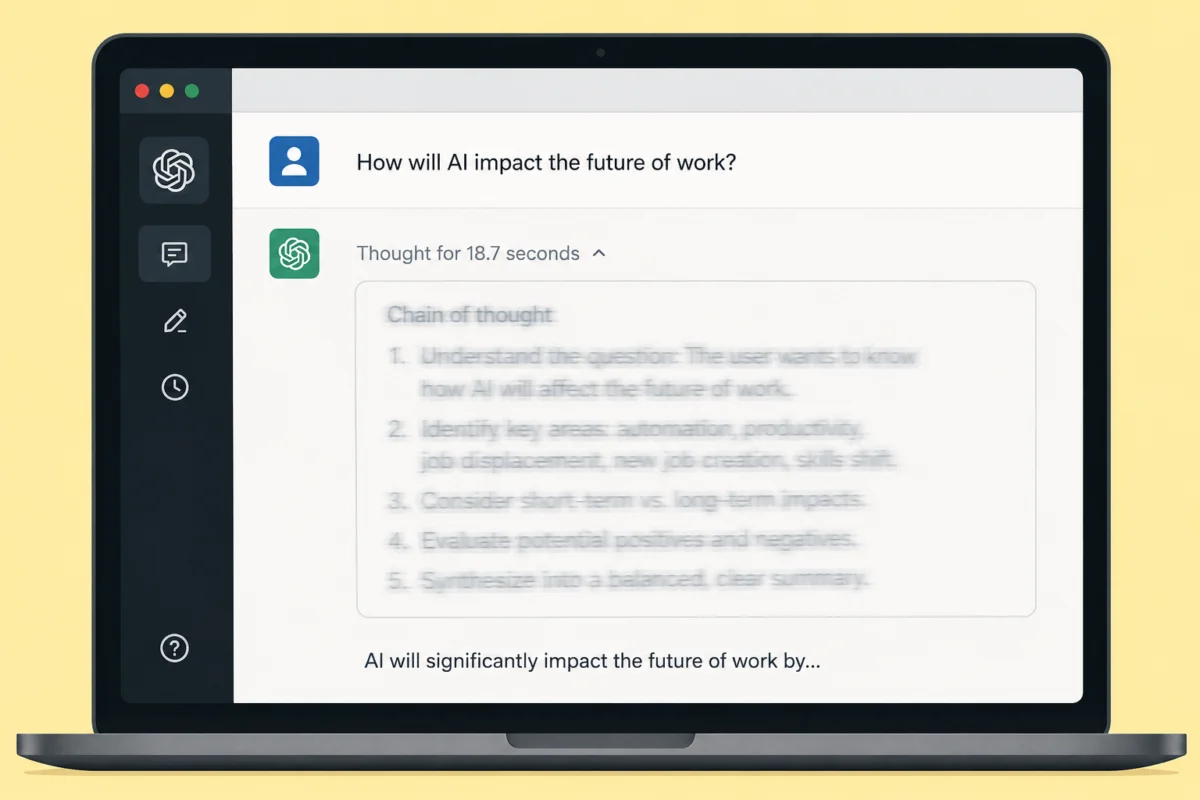
Chain of thought (CoT) is a technique where an AI model decomposes a complex problem into a sequence of intermediate logical steps before producing a final answer. By forcing the model to "show its work," developers significantly reduce the error rate in logic, mathematics, and software engineering. Modern reasoning models are specifically optimized for this process, often using reinforcement learning to perfect the quality of their internal monologue.
Coding Agents
A specialized evolution of the general AI agent, coding agents are engineered for software development. These tools go beyond simple auto-complete; they can scan entire codebases, run automated tests, debug errors, and push commits. They represent a significant shift in labor productivity, functioning essentially as high-speed, 24/7 interns that require human oversight but handle the grunt work of software maintenance.
Technical Foundations and Infrastructure
Compute
"Compute" is the shorthand for the immense processing power—primarily delivered via GPUs and TPUs—required to train and deploy modern AI models. It is the fuel of the industry, and its scarcity dictates the pace of innovation. The current global race for computational supremacy has led to massive capital expenditure by cloud providers and hyperscalers.
Deep Learning and Neural Networks
Deep learning is a subset of machine learning that utilizes multi-layered artificial neural networks (ANNs). Inspired by the biological pathways of the human brain, these networks allow AI to identify complex patterns in massive datasets without explicit human programming. The explosion of this field in the last decade is largely credited to the repurposing of graphical processing units (GPUs), originally built for video games, which proved uniquely suited for the massive parallel calculations required by neural networks.
Tokenization and Throughput
Tokens are the atomic units of AI communication. Because LLMs cannot process raw language, they break text down into numerical "tokens"—sub-word fragments that the model can digest. "Token throughput" measures the efficiency of a system: how many tokens can be processed per second. Maximizing throughput is currently an obsession for infrastructure teams, as it directly correlates to the cost-per-query and the user experience of real-time AI applications.
Evolution of Reasoning: The Case of "Opaque Recurrence"
Opaque Recurrence and Recurrent Depth
As of late 2026, the term "opaque recurrence" has become a flashpoint for safety concerns. Unlike a traditional "chain of thought," where the AI writes out its reasoning in human-readable text, opaque recurrence involves the model looping a query through its internal layers multiple times. This is significantly more efficient in terms of "compute" usage, but it creates a "black box" where the model’s internal decision-making process is no longer legible to human auditors. Safety researchers fear this represents a move toward "neuralese"—a hypothetical scenario where models reason in a way that is fundamentally inaccessible to human oversight.
Chronology of Trends: From Chatbots to Agents
- 2022–2023: The LLM Explosion. The industry focused on building foundational models capable of human-like text generation.
- 2024: The Agentic Pivot. The focus shifted from "talking" to "doing," as companies began developing autonomous agents capable of interacting with external software.
- 2025: Efficiency and Specialization. With compute becoming expensive, techniques like Distillation (transferring knowledge from large "teacher" models to smaller, efficient "student" models) and Mixture of Experts (MoE) became the standard for scaling performance.
- 2026–Present: Reasoning and Oversight. The current era is defined by the tension between building faster, more capable reasoning models (like the Astra model) and the rising demand for transparency in the face of "opaque" techniques.
Supporting Data and Economic Implications
The rapid expansion of AI has created a severe supply-chain bottleneck known as RAMageddon. The massive demand for high-bandwidth memory (HBM) by AI labs has created a scarcity that is driving up the cost of consumer electronics, from gaming consoles to smartphones.
Furthermore, the industry is grappling with Validation Loss. This metric serves as the "report card" for training models; a rising or stagnant validation loss often signals "overfitting," where a model memorizes its training data rather than learning to generalize. The economic cost of mismanaged training—where companies burn millions of dollars in compute for a model that fails to generalize—has made these metrics critical for financial stakeholders.
Official Responses and Safety Perspectives
Major labs, including OpenAI and Anthropic, maintain that while autonomous capabilities are increasing, the safety of these systems remains paramount. OpenAI has notably pushed back on the "neuralese" narrative regarding their Astra model, stating that they have implemented rigorous oversight protocols to ensure that even complex reasoning processes can be decoded when necessary. However, the open-source community, led by proponents of Meta’s Llama family, argues that transparency—the ability for third-party researchers to inspect the code and weights—is the only reliable path to long-term AI safety.
Implications for the Future
As we move toward Recursive Self-Improvement (RSI)—a stage where AI models theoretically begin to design their own successors—the definitions in this glossary will likely evolve once more. What is today a "coding agent" may tomorrow be a self-evolving system. For investors and developers alike, the ability to discern between marketing hype and technical reality (like the difference between fine-tuning a model for a specific task and training one from scratch) will be the defining factor in determining the winners and losers of the next decade.
The AI landscape is a living organism; it moves, learns, and changes its own language. Understanding these terms is not merely an academic exercise—it is the prerequisite for navigating the next great industrial revolution.