For more than a hundred years, it was a hidden protagonist in the lush, emerald tapestry of the Chocó forests—a creature so common that its distinct “click” served as the rhythmic soundtrack to the Andean night. Yet, for all its prevalence, the frog remained a phantom to science, masked by a century of mistaken identity.
In a landmark study published in the international journal ZooKeys, researchers from the Pontificia Universidad Católica del Ecuador (PUCE) have formally described Pristimantis milpe, the Milpe Robber Frog. This discovery is a rare anomaly in the world of taxonomy; while most new species descriptions involve rare, elusive creatures tucked away in remote, high-altitude pockets, Pristimantis milpe is both widespread and abundant. Its formal recognition marks the conclusion of a century-long taxonomic puzzle that required a bridge between 19th-century history and 21st-century genetic science.
The Chronology of a Taxonomic Error
The story of Pristimantis milpe began long before modern field biologists arrived in the Chocó. In the 19th century, European naturalists traversed the rugged terrain of Ecuador, collecting specimens that would eventually be shipped across the Atlantic to the hallowed halls of the Natural History Museum (NHM) in London. Among these collections were specimens that would eventually be categorized under the wrong names, creating a ripple effect of misidentification that persisted for over a century.
As biology shifted toward molecular phylogenetics in the modern era, inconsistencies in classification became increasingly apparent to researchers at PUCE. Santiago Ron, a leading researcher at the university and the study’s lead author, recognized that the taxonomic confusion surrounding several Ecuadorian amphibians could only be resolved at the source: the museum drawers of London.
Traveling to the UK, Ron undertook an exhaustive investigation of the "types"—the original specimens used by 19th-century scientists to define a species. By meticulously comparing the physical morphology of these preserved historical specimens with living populations currently thriving in the Ecuadorian Chocó, the research team identified a critical disconnect. The frogs collected in the 1800s had been incorrectly linked to an entirely different species. For decades, field biologists had been observing and documenting Pristimantis milpe, but because it lacked a distinct scientific name, it remained a taxonomic "ghost," trapped in the shadow of a misidentified relative.
The Clicking Sentinel of the Chocó
The Milpe Robber Frog, known locally as the Cutín de Milpe, is a master of the nocturnal landscape. Its habitat spans a massive 67,000-square-kilometer range, stretching from the sea-level lowlands of the Ecuadorian Chocó into the forests of southern Colombia, reaching elevations of up to 1,200 meters.
Distinctive Biology and Behavior
The frog is perhaps best known for its auditory presence. During the dark, humid hours of the night, male Pristimantis milpe take up positions on the leaves of shrubs and bromeliads, often several meters above the forest floor. Their call is a loud, sharp "click" that differentiates them from the diverse choir of other amphibians in the region.
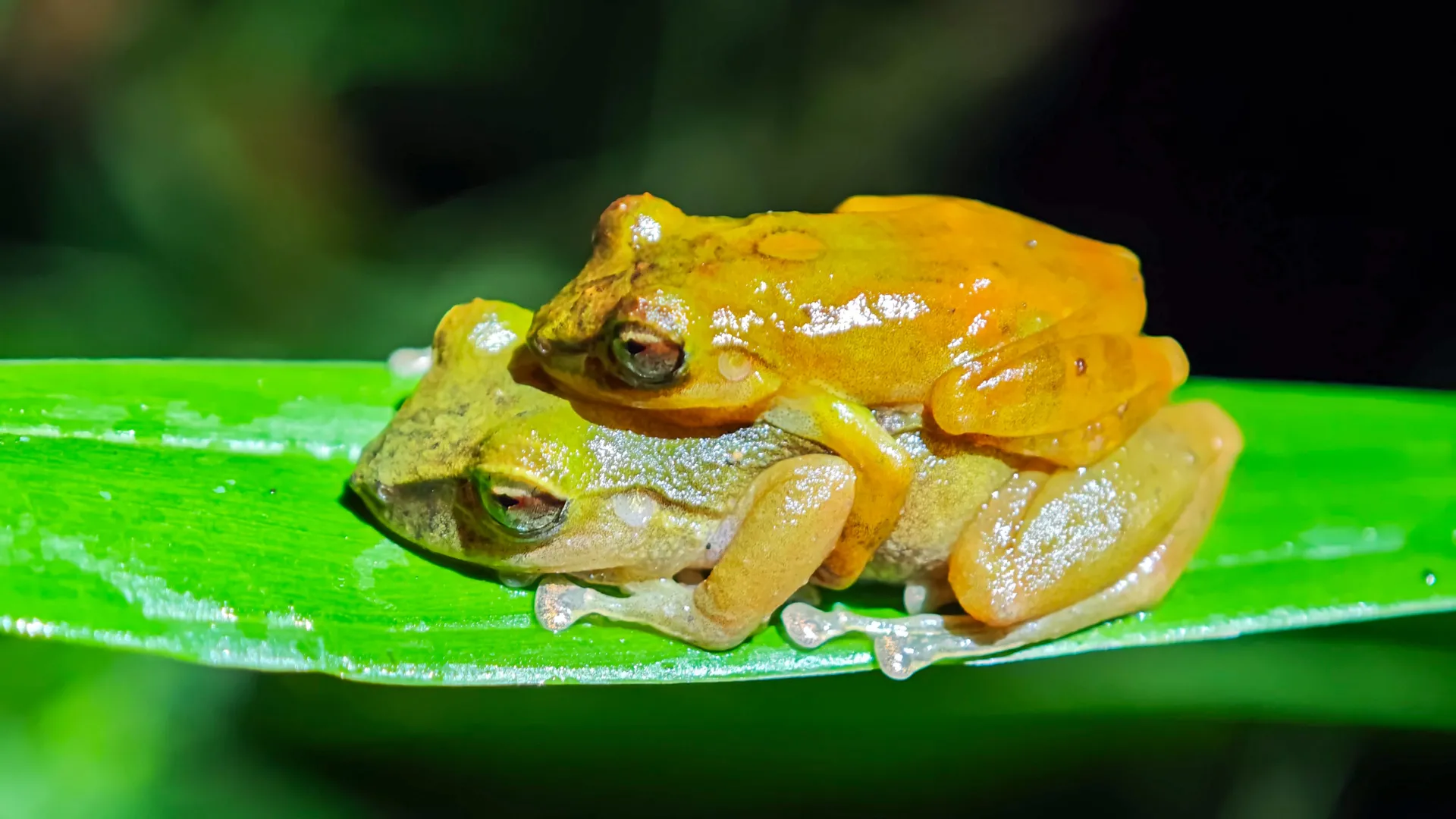
Sexual dimorphism in the species is striking, providing further evidence of its unique evolutionary path. Females possess vibrant, eye-catching coloration around the groin and thighs, featuring intricate patterns of orange or light blue tones punctuated by deep black spots. In contrast, males exhibit a more uniform, muted coloration, likely a strategic adaptation for camouflage while they sit exposed on leaves to call for mates.
The Significance of the Range
The fact that such a common animal remained undescribed is a testament to the immense, untapped biodiversity of the Chocó region. This area is recognized globally as a critical hotspot for conservation. The ability of Pristimantis milpe to occupy such a vast geographical range—without ever being formally recognized—suggests that our understanding of even the most "common" species is far from complete.
Supporting Data: The Importance of Natural History Collections
The resolution of the Pristimantis milpe case serves as a powerful argument for the continued funding and preservation of natural history museums. In an era where digital databases and molecular labs often take center stage, the physical specimens housed in institutions like the Natural History Museum in London remain the "gold standard" of biological proof.
"Specimens preserved for decades or even centuries provide us with a time machine," explains one of the study’s researchers. "They allow us to revisit the physical traits that early scientists documented, compare them against our modern genomic data, and rectify errors that were essentially ‘baked into’ the literature of the 19th century."
The study highlights that taxonomy is not a static endeavor but an iterative process. By combining 19th-century physical specimens with modern acoustic recordings, DNA analysis, and field surveys, the team was able to provide the evidence necessary to elevate Pristimantis milpe to its rightful place as a distinct species. This process is essential, as it ensures that conservation efforts are based on accurate data. If we do not know what species we are protecting, we cannot effectively manage their habitats or understand the threats they face.
Official Responses and Scientific Perspectives
The discovery has resonated throughout the academic community, particularly among those who focus on neotropical biodiversity. Jhael Ortega, a PhD student at Virginia Tech and a co-author of the study, emphasized the profound nature of the oversight.
"That such a common species has gone unnoticed under the wrong name for decades highlights the importance of correctly connecting scientific names with living populations in nature," Ortega noted. "It reminds us that biology is not just about finding new things in remote places; it is about questioning what we think we already know."
For the scientific community, the publication of the findings in ZooKeys acts as a formal correction to the historical record. It encourages other researchers to look back at museum archives with fresh eyes, suggesting that the "hidden" biodiversity of the world may be hiding in plain sight, mislabeled in dusty cabinets rather than concealed in unreachable jungles.
Broader Implications: Biodiversity in the Age of Discovery
The formal description of the Milpe Robber Frog carries several key implications for the future of conservation and biological research:
- Re-evaluating "Common" Species: The discovery challenges the assumption that common species are well-understood. It suggests that many widespread animals may actually represent complexes of cryptic species, each with its own unique conservation needs.
- The Role of Institutional Cooperation: The project required international cooperation between Ecuadorian universities and British institutions. Such partnerships are vital for global science, enabling the cross-pollination of historical data and modern analytical techniques.
- Conservation Advocacy: By giving the frog a formal name, researchers have provided a new tool for conservationists in Ecuador and Colombia. A named species is a recognized entity, making it easier to advocate for the protection of the specific habitats and forest corridors that the Milpe Robber Frog calls home.
- A Call for Taxonomic Literacy: The study highlights the need to support taxonomic research. As global biodiversity faces unprecedented threats from climate change and habitat loss, the ability to accurately identify and track species is the foundation upon which all environmental policy must be built.
Conclusion: A Lesson in Humility
The tale of Pristimantis milpe is a humbling reminder of the limits of human knowledge. It proves that even in the 21st century, the natural world is capable of concealing secrets right beneath our noses. The next time a researcher enters a forest in the Chocó, the night will no longer be filled with the call of a "mystery frog," but with the voice of a formally recognized member of the global biological community.
As we move forward, the scientific community must continue to champion the synergy between historical archives and modern technology. The mystery of the Milpe Robber Frog has been solved, but for every species that has been correctly identified, there are likely dozens more still waiting for their names to be rediscovered in the silent rows of a museum cabinet. The work of identifying the planet’s life forms is far from finished; in many ways, it is just beginning.