Washington D.C. – With the summer sun beating down and the August congressional recess looming large, a bipartisan Senate bill aiming to reshape the landscape of college athletics is making a frantic push towards President Donald Trump’s desk. Its authors, acutely aware of the ticking clock, are now urgently calling for House Republicans and Democrats to join the negotiating table, recognizing that bicameral support is the only viable path to codifying federal oversight into the complex world of collegiate sports.
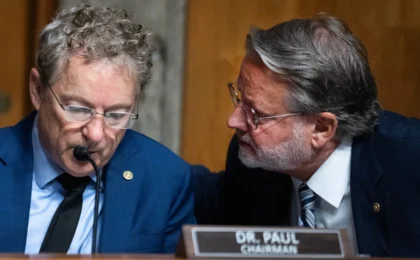
Senator Maria Cantwell (D-Wash.), the ranking member of the powerful Senate Commerce Committee, underscored the imperative of broadening the discussion. While the bill’s initial journey through the Senate panel involved what she termed "three corners" – senators, White House officials, and key college athletics stakeholders – the path to enactment now necessitates a "five-corner" dialogue. This expansion would include representatives from both sides of the aisle in the House of Representatives, a critical yet challenging next step in a highly contentious legislative environment.
"The issues we’re seeing are from both sides of the House," Cantwell told reporters following a June 18 markup of the legislation. "I think that’s probably what would make the most sense to get everybody’s viewpoint properly represented." Her comments highlight the recognition that the nuances of college sports governance are not confined to a single chamber, and that a truly comprehensive solution demands input from a wider array of perspectives and political considerations.
The Urgency of the Legislative Calendar
The call for broader engagement comes amid an election-year calendar that is already truncated and fraught with partisan clashes. Barely a week has passed since the Senate Commerce Committee successfully advanced the bill, yet that period was dominated by widespread legislative chaos in both chambers. This internal turmoil, marked by high-profile disputes and an inability to achieve consensus on other pressing matters, casts a long shadow over the prospects of any major bipartisan initiative, let alone one seeking to fundamentally alter the financial and regulatory framework of college sports.
Committee Chair Ted Cruz (R-Texas), a key architect of the Senate bill alongside Cantwell and Senators Eric Schmitt (R-Mo.) and Chris Coons (D-Del.), has openly welcomed the prospect of expanded talks with House members. He confirmed having already initiated preliminary exchanges regarding the legislation. Cruz’s message to his House counterparts is unequivocal: the Senate bill, forged through painstaking bipartisan compromise, represents the "only game in town." With a House version of similar legislation having stalled amidst significant controversy, the Senate measure stands as the singular bipartisan vehicle with a realistic chance of navigating both chambers and ultimately securing the President’s signature.
"I understand House leadership’s concerns. They have a lot invested in the SCORE Act. They worked hard in good faith on the SCORE Act," Cruz acknowledged, referencing the House bill, the Student Compensation and Opportunity through Rights and Endorsements Act. However, he was quick to point out the stark reality of its legislative viability.
The Shadow of the SCORE Act and Political Entanglements
The House’s effort, the SCORE Act, had a tumultuous journey. House GOP leaders introduced a revised version of the bill in April, only to be forced to pull it from consideration. The legislation became inextricably linked to highly sensitive political issues, with the Congressional Black Caucus and the NAACP drawing parallels between its provisions and recent redistricting efforts in Republican-led states that had diminished the representation of majority-Black House districts. This unexpected entanglement of college sports policy with racial justice and electoral maps proved to be a fatal blow, effectively sidelining the House’s initial attempt at federal college sports reform.
Cruz minced no words regarding the SCORE Act’s prospects in the Senate. "I agree with that bill. The challenge is there are precisely zero Senate Democrats who would vote for the SCORE Act," he stated bluntly. "And so, it is a bill that has no prospect of actually being signed into law. The only bill that has a realistic path to becoming law is this [Senate] bill."
The reason for the Senate bill’s perceived advantage, according to Cruz, lies squarely in its foundation of bipartisan compromise. This often-elusive quality in modern American politics has been central to its advancement thus far. "I had to make concessions that, frankly, I didn’t like. Sen. Cantwell made concessions that she didn’t like. And that’s how you get a compromise where not everybody gets everything they want," he explained. "But I think the final product is a good product, and so the next step is going to be to bring this bill to the floor and take a vote on the floor."
The chairman expressed optimism last week that Senate Majority Leader John Thune (R-S.D.) would agree to bring the bill to the floor for a vote in July. The overarching goal remains ambitious: to secure President Trump’s signature on the measure before the autumn academic semester and the collegiate sports season commence. This timeline underscores the perceived urgency of addressing the evolving landscape of college athletics, particularly concerning Name, Image, and Likeness (NIL) issues and the broader financial framework governing student-athletes. As of Thursday, committee aides indicated that Cruz had not shifted this legislative goalpost, and a lobbyist representing smaller collegiate conferences confirmed that July remains the target for floor consideration.
Supporting Data: The Shifting Sands of College Athletics
The push for federal legislation is not occurring in a vacuum; it’s a direct response to a rapidly changing collegiate sports environment. For years, the NCAA operated as the sole arbiter of amateurism, but landmark court decisions and state-level NIL laws have fragmented this authority, creating a patchwork of regulations that many stakeholders argue is unsustainable and inequitable. The current legislative efforts aim to establish a uniform federal standard, providing clarity and potentially pre-empting further state-by-state variations.
While the specific details of the Senate bill’s provisions are not fully outlined in the original report, the context of federal interest in college sports strongly suggests it addresses key areas such as:
- Name, Image, and Likeness (NIL) Framework: Establishing clear rules for how student-athletes can profit from their NIL, likely including guardrails against direct pay-for-play and perhaps collective bargaining.
- Athlete Welfare and Protections: Provisions related to health care, long-term injury management, and academic support.
- Transfer Rules: Potentially standardizing or streamlining the process for student-athletes transferring between institutions.
- Antitrust Exemptions: Granting the NCAA or conferences limited antitrust protections, a contentious issue that could shield them from certain legal challenges while imposing federal oversight.
- Enforcement Mechanisms: Defining who will enforce the new federal standards and how disputes will be resolved.
The urgency stems from the desire to bring stability and a level playing field to an industry that generates billions of dollars annually but faces increasing scrutiny over its treatment of athletes and its governance structure. The varying state laws have created an uneven recruiting environment, prompting calls from coaches, athletic directors, and even some athletes for a national standard.
The Senate bill’s ability to garner bipartisan support, in stark contrast to the House’s SCORE Act, highlights the importance of finding common ground on these issues. The SCORE Act’s failure due to its perceived link to redistricting and its lack of Democratic buy-in underscores the treacherous political terrain surrounding any federal intervention in college sports. The Senate sponsors’ emphasis on compromise—where "not everybody gets everything they want"—is a direct acknowledgment of these challenges and a strategic imperative for legislative success.
Official Responses and Lingering Questions
Despite the Senate bill’s momentum, key players remain silent or openly opposed. Spokespersons for Senate Majority Leader Thune and Senate Majority Whip John Barrasso (R-Wyo.) did not respond to inquiries regarding the bill’s potential July floor time. This silence is notable, especially considering Thune’s own athletic background as a college basketball player at California’s Biola University, suggesting a personal connection to the world of collegiate sports. Their non-committal stance adds an element of uncertainty to the bill’s immediate future on the Senate floor.
The powerful Southeastern Conference (SEC), a dominant force in college athletics, has openly stated its opposition to the Senate legislation. This resistance from one of the "Power Two" conferences—alongside the Big Ten—could pose a significant hurdle. However, both Cruz and Cantwell expressed confidence that the bill could still pass both chambers even without the explicit endorsement of these major conferences. Cruz even predicted "big vote margins" well beyond the Senate’s customary 60-vote threshold, arguing that a strong bipartisan vote would generate momentum for House passage.
"My objective from the beginning was not simply to squeak by with just 60 votes, but to have a bigger bipartisan vote than that," Cruz reiterated. "I think this committee vote argues well for a strong vote on the floor. And I believe when we pass this with a big, bipartisan vote, it will go to the House with momentum — and I believe the House will take it up and pass it." Senator Schmitt also confirmed his ongoing discussions with SEC officials, aiming to assuage their concerns before the measure reaches the Senate floor.
"Who’s the Puppet?": Power Dynamics and Political Manoeuvres
Both Cruz and Cantwell acknowledge that additional modifications might be necessary to secure the requisite votes in both chambers, though they deem major revisions unlikely. Cantwell, however, offered a revealing glimpse into the complex political dynamics at play, particularly concerning the internal machinations within university leadership and powerful athletic conferences.
She described her exchanges with colleagues, noting that many were "trying to understand the politics" as the November midterm elections drew nearer. More strikingly, Cantwell pointed to a potential reckoning for athletic directors and university presidents from their own governing boards. "I think what’s going to come up is that [athletic directors] and presidents are going to get their comeuppance from regents who were all of a sudden like, ‘What the hell are you doing?’" she quipped, suggesting a growing frustration among university trustees with the current state of college athletics governance.
Cantwell then recounted a particularly telling conference call she and Cruz had with presidents of the Southeastern Conference. The anecdote laid bare the intricate power structures that often dictate decision-making in collegiate sports. "The presidents had to have a meeting to decide whether they could get on a conference call with Sen. Cruz and I without the conference commissioners," she revealed. "One university president could talk. He read a statement, and then nobody else could talk, and they didn’t have any questions. So, who’s the puppet here? So, I think the jig is going to be up on schools in a broader discussion, like, ‘Hey, are you really letting the conference drive this discussion now?’"
This pointed remark from Cantwell, directly questioning the autonomy of university presidents in the face of conference power, speaks volumes about the underlying tensions within college athletics. It suggests a potential disconnect between the interests of individual institutions and the broader strategic objectives of powerful conferences. The SEC, unsurprisingly, did not respond to an email seeking comment on Cantwell’s "puppet" remark, further underscoring the sensitive nature of these internal power struggles.
Implications for the Future of College Sports
The successful passage of the Senate college sports bill, particularly before the August recess and the start of the fall sports season, would carry profound implications across the entire landscape of collegiate athletics.
For Student-Athletes: A federal framework could bring much-needed clarity and consistency to NIL opportunities, potentially standardizing rules that currently vary widely from state to state. It could also enshrine additional protections related to health, safety, and academic pursuits, ensuring a more uniform standard of care and support across all divisions and conferences. The bill’s success or failure will directly impact the economic agency and overall welfare of thousands of college athletes.
For Universities and Conferences: A federal law would impose a national standard, potentially alleviating the current regulatory chaos caused by differing state laws and court rulings. While some conferences, like the SEC, may resist federal intervention, a uniform framework could ultimately provide a more stable operating environment, albeit one with increased federal oversight. The "puppet" comment from Cantwell highlights the ongoing power struggle between individual universities and their conferences, and federal legislation could shift that dynamic, either empowering institutions or further centralizing authority.
For the NCAA: The NCAA, which has long been the primary governing body for college sports, has seen its authority erode significantly in recent years. Federal legislation could either empower the NCAA by granting it limited antitrust exemptions and a clearer mandate, or it could further diminish its role by establishing a new federal oversight body or shifting significant power to Congress. The nature of the bill’s provisions will determine whether it acts as a lifeline or another blow to the NCAA’s traditional model.
For the Political Landscape: The bipartisan nature of the Senate bill, particularly in an election year marked by intense partisanship, represents a rare legislative achievement. Its success could serve as a model for future cross-party cooperation on other complex issues. Conversely, its failure, especially after such a concerted bipartisan effort, could deepen cynicism about Washington’s ability to address critical national concerns, even those with broad public interest. The intertwining of college sports with issues of racial justice, as seen with the SCORE Act, also signals a new era where policy decisions in athletics cannot be divorced from broader societal debates.
As the clock ticks down, the fate of the Senate college sports bill hangs in the balance. Its journey from committee markup to potential floor vote, and then hopefully to the House and the President’s desk, will be a testament not only to the urgency of reforming college athletics but also to the enduring challenges and possibilities of bipartisan cooperation in a deeply divided Congress. The coming weeks will determine whether this legislative effort can bridge the divides and usher in a new era for college sports.