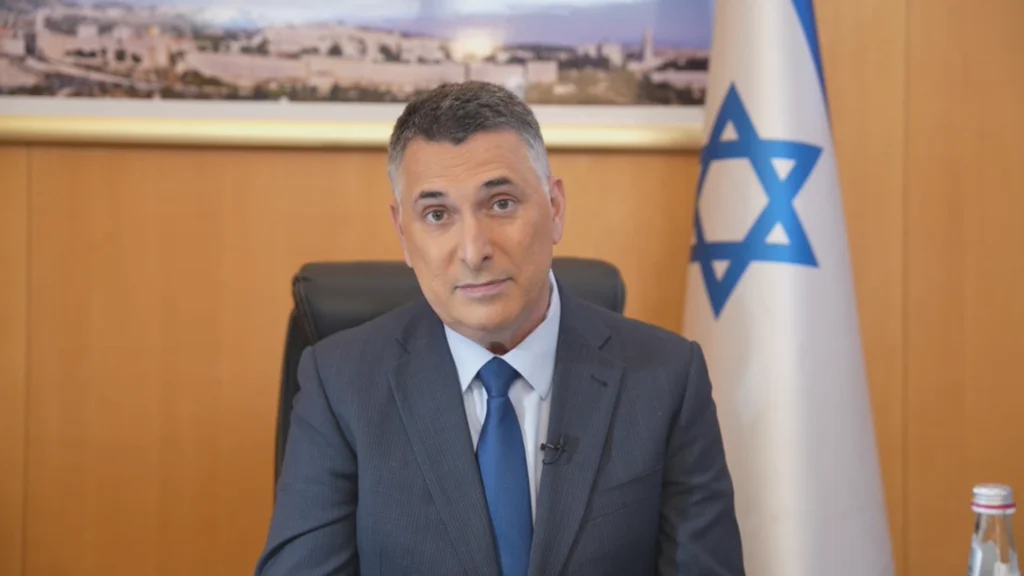
JERUSALEM – As the Middle East teeters on the edge of a broader conflagration, Israel’s Minister of Foreign Affairs, Gideon Sa’ar, has issued a stern warning to Tehran, signaling that any direct military provocation against Israel will be met with a “severe” and decisive response. In an exclusive interview with FRANCE 24, Sa’ar addressed the volatile intersection of resurgent U.S.-Iran hostilities and Israel’s ongoing security challenges in the West Bank.
The interview comes at a time of acute regional anxiety, as the United States military engages in targeted strikes against Iranian infrastructure following a series of attempted attacks on international shipping lanes. Amidst this climate of uncertainty, the Israeli government is attempting to strike a delicate balance: maintaining its red lines against Iranian nuclear ambitions while navigating intense diplomatic friction with European allies over its settlement policies.
Main Facts: The Red Lines of Israeli Security
Minister Sa’ar’s rhetoric centered on two primary pillars of Israeli national security: the containment of the Iranian nuclear program and the deterrence of direct state-on-state military confrontation.
"If we are attacked by Iran, we will surely respond heavily," Sa’ar stated during the broadcast. However, he expressed a measured hope that the regime in Tehran would exercise restraint, suggesting that a direct attack on Israeli soil would be a “mistake” for which the Islamic Republic is not prepared.
Furthermore, Sa’ar leveled a significant accusation against the Iranian leadership, claiming that Tehran continues to pursue nuclear weapons aspirations with clandestine persistence. He underscored that Israel’s position remains absolute: "We will not allow them to achieve such a capability." This reiteration of the “Begin Doctrine”—Israel’s policy of preventing regional enemies from acquiring nuclear weaponry—signals that Israel views the nuclear file as an existential threshold that transcends current regional skirmishes.
Chronology: A Cascade of Escalation
The current atmosphere of heightened alert is not an isolated event but the culmination of months of deteriorating security in the Middle East.
- Mid-2026: Tensions regarding shipping security in the Persian Gulf reach a breaking point. Repeated harassment of commercial vessels by Iranian-aligned forces prompts a robust U.S. naval response.
- August 2026: European powers—including France, Germany, the UK, and Italy—issue a joint condemnation of the Israeli government’s approval of the E1 settlement expansion project, labeling the move a significant obstacle to a two-state solution.
- Late August 2026: The U.S. military initiates targeted strikes against Iranian assets in retaliation for continued provocations in the Strait of Hormuz.
- September 2026: Amidst the U.S.-Iran military friction, Donald Trump makes headlines by suggesting the renaming of the Strait of Hormuz to the “Trump Strait,” highlighting the unpredictable nature of the current diplomatic environment.
- Current Date: Minister Sa’ar’s interview reaffirms Israel’s readiness to join the fray only if directly targeted, while simultaneously justifying the expansion of settlement activity in the West Bank.
Supporting Data and Strategic Context
The geopolitical landscape of the Levant is currently defined by three distinct but overlapping conflict zones.
The Nuclear Threshold
International monitoring agencies have reported a steady increase in Iran’s uranium enrichment levels, pushing closer to weapons-grade material. While Tehran maintains its program is for peaceful civilian purposes, intelligence assessments from the U.S. and Israel continue to contradict this narrative. The threat of an Israeli preemptive strike remains a central variable in global energy markets and security architecture.
The West Bank Friction
The E1 project, which has drawn the ire of the international community, involves the development of land that connects the Ma’ale Adumim settlement to Jerusalem. Critics argue that this expansion would effectively sever the northern West Bank from the southern portion, rendering a contiguous Palestinian state geographically impossible.
Settler Violence and Legal Recourse
The surge in localized violence between settlers and Palestinians has become a point of international scrutiny. According to human rights organizations, 2026 has seen a marked increase in incidents of vigilante activity. Minister Sa’ar, however, pushed back against the narrative that the state is complicit, asserting that law enforcement is working diligently to prosecute those who breach the law, regardless of their background.
Official Responses and Diplomatic Fallout
The international reaction to the Israeli government’s posture has been bifurcated. While Israel’s strategic alignment with the U.S. remains robust in the face of Iranian aggression, the diplomatic rift with Europe is widening.
The European Stance
European capitals view the E1 project as a "red line" that threatens the long-term viability of the peace process. The joint statement issued in August by the "E4" nations (France, Germany, UK, and Italy) was described by analysts as one of the most sternly worded rebukes in recent memory. By framing the project as illegal under international law, these nations are signaling a potential shift toward more concrete diplomatic or economic measures if the construction proceeds.
The Israeli Defense
In his defense of the settlement expansion, Sa’ar invoked a narrative of historical and moral right, stating, "It is our right to live anywhere in our land." This phrasing reflects the ideological core of the current coalition government, which prioritizes historical claims over the international consensus regarding the 1967 borders.
Regarding the criticism of settler violence, Sa’ar attempted to contextualize the instability. He stated, "Some of these cases begin with Palestinian attacks on Israelis," framing the settler movement’s actions as part of a cycle of violence rather than a policy-driven strategy of dispossession. This argument, while aimed at mitigating the impact of international condemnation, has faced significant pushback from NGOs who document a systemic failure in the Israeli justice system to hold settlers accountable for attacks on Palestinian agricultural property and residential areas.
Implications: A Region at a Crossroads
The implications of the current trajectory are profound for the stability of the Middle East and global security.
1. The Risk of Miscalculation
The primary danger currently identified by regional analysts is the risk of "accidental escalation." With U.S. forces actively striking Iranian assets, a single miscalculated drone strike or naval engagement could trigger a wider regional war. Israel’s insistence that it is not currently seeking to join the conflict, but is prepared to do so if attacked, highlights how quickly the regional chessboard could change.
2. The Erosion of the Two-State Framework
The E1 expansion, if fully realized, represents a structural shift in the West Bank. If the international community fails to halt the project, it may mark the permanent end of the two-state paradigm that has underpinned diplomatic efforts for decades. This would force the European Union and the United States to reconsider their long-term strategies for regional engagement.
3. The Future of the Iranian Nuclear Dossier
If Israel determines that Iran has reached a "breakout" point in its nuclear program, the possibility of a direct Israeli strike becomes a high-probability event rather than a hypothetical deterrent. Such an event would likely ignite a regional firestorm, involving not just Israel and Iran, but also Iranian-aligned proxies in Lebanon, Syria, and Yemen.
4. Domestic Stability and International Standing
For the Israeli government, the challenge is twofold: maintaining a unified front against external threats while managing the internal social and legal fractures caused by the settlement expansion. The perception of the state’s inability to curb settler violence creates a dual risk—it fuels international criticism and undermines the perceived legitimacy of the state’s law enforcement agencies.
Conclusion
Minister Gideon Sa’ar’s interview provides a clear window into the mindset of the current Israeli leadership. By prioritizing national security through deterrence against Iran and asserting a right to land expansion in the West Bank, Israel is charting a course that is increasingly at odds with its traditional Western allies.
As the U.S. and Iran continue their skirmishes, the world remains focused on the potential for a catastrophic expansion of hostilities. Whether the current strategy of "deterrence through strength" will succeed in keeping the peace, or whether it will inadvertently provoke the very conflict it seeks to prevent, remains the central question of the coming months. The coming autumn will be a critical period, not only for the stability of the Persian Gulf but for the future of the entire Middle Eastern political order.