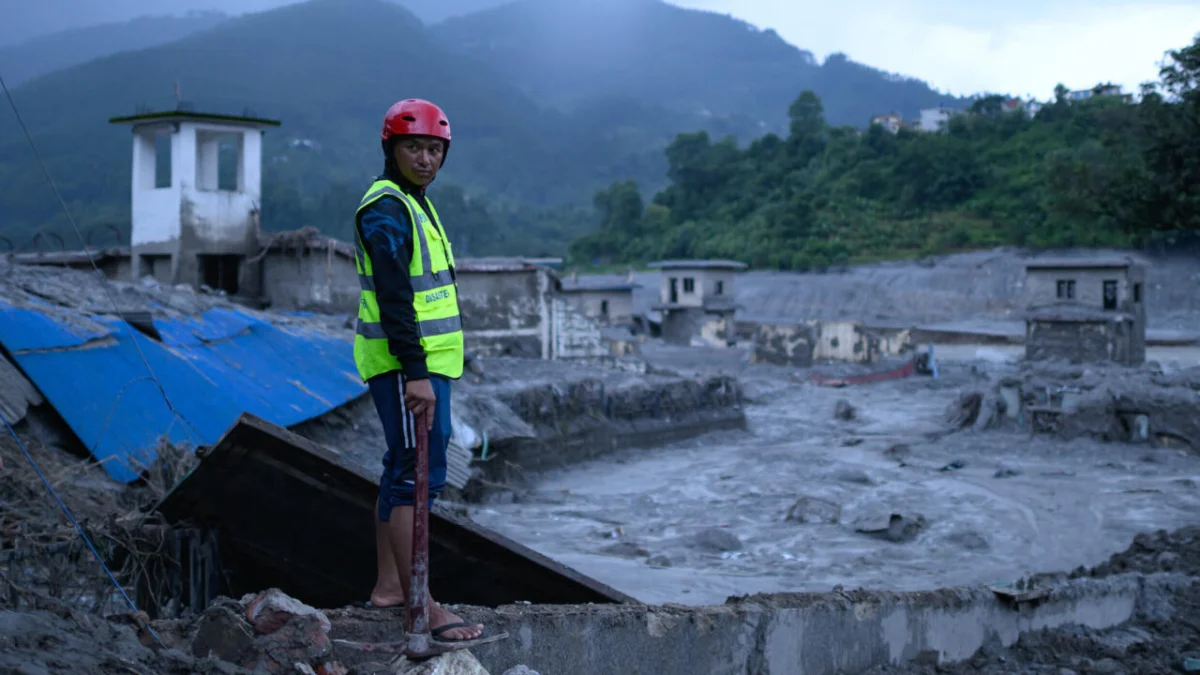
In an unfolding tragedy that has shattered the peace of the high Himalayas, rescue teams from Nepal and China are currently engaged in a desperate, high-stakes race against time. A massive, tsunami-like wall of water, ice, and debris, triggered by a catastrophic glacial collapse, has torn through the border region, obliterating entire villages and paralyzing vital energy infrastructure. As of Saturday, the combined death toll has climbed to 682, with nearly 3,000 individuals still listed as missing—a figure that officials fear will rise as search efforts push into the most remote, mud-choked corners of the mountain range.
The Anatomy of a Disaster: Chronology of the Collapse
The disaster originated on Wednesday, August 26, 2026, when a massive glacial breach occurred near the Nepal-Tibet border. The U.S. Geological Survey (USGS) has confirmed that the event was a sudden, violent glacial collapse, which released a torrent of water and sediment with enough kinetic energy to mimic a tsunami.
Within minutes, the floodwaters surged down the steep mountain valleys, acting as a battering ram that swept away everything in its path. By Thursday, the scale of the destruction began to emerge as communication lines were severed and entire settlements were wiped off the map.
On Friday, the focus of the rescue operation shifted toward the industrial sites along the Trishuli River. By Saturday, the Nepali army achieved a crucial breakthrough: engineers successfully inserted a specialized ventilation pipe into a tunnel at the Trishuli 3A hydroelectric site. Inside, over 100 workers are believed to be trapped, struggling for air and waiting for rescue. Home Minister Sudan Gurung confirmed the operation’s progress, stating, "We have already started sending air through the small opening, and we will now begin excavation work and send the rescue team inside."
The Human Toll: Families in Limbo
The emotional fallout of the disaster is perhaps best encapsulated at an army base in the Nuwakot district, which has become the epicenter for families seeking information. The air is heavy with grief as parents and spouses scan long, printed lists of the rescued and the deceased.
Kalka Sharda, a father who traveled to the Bidur army base, represents the agonizing uncertainty faced by thousands. His 18-year-old son, Vinod, was employed at a local hydropower facility when the water hit. "He was a labourer at the hydropower plant, but I can’t find his name, and the authorities are not saying anything," Sharda said, his voice trembling. "I don’t think there is any hope left. If he was alive, he would have found a way to get in touch."

The disaster has not only claimed local residents but has also impacted a diverse array of international travelers. Among the 517 foreign nationals reported missing are trekkers and Hindu pilgrims traveling to the sacred Mount Kailash in Tibet. The Isha Foundation, led by the prominent spiritual teacher Sadhguru, reported that 80 of its members were in the area when the flood hit the Gyirong border port. According to the foundation, the port was "completely washed away," and there are currently "no encouraging indications of survivors" in that sector.
Supporting Data and Scale of Impact
The geographic scope of the destruction spans the high-altitude border zones of two nations, presenting a logistical nightmare for emergency responders.
- Casualty Figures: As of the latest official counts, Nepal has reported 675 deaths, while Tibet has confirmed seven. The search for the remaining 3,000 missing continues, with seven additional bodies recovered downstream in India, suggesting the debris field has extended across international borders.
- Infrastructure Crisis: Nepal’s disaster management authority has identified 933 hydropower workers among the missing. The energy sector, which is the backbone of the region’s modernization efforts, has been crippled.
- Resource Mobilization: China has mobilized a massive response, with 2,141 rescuers deployed near the Gyirong site alone. Meanwhile, in Nepal, the government has requested international aid, specifically asking for heavy-lift drones, advanced detection technology, and specialized forensic kits to handle the identification of bodies that have been submerged in sediment-heavy floodwaters.
Official Responses and Diplomatic Cooperation
The severity of the disaster has necessitated an unprecedented level of coordination between Kathmandu and Beijing. On Saturday, the foreign ministers of both nations held an emergency call to discuss the sharing of hydrological and satellite data. This collaboration is deemed essential, particularly after reports emerged that the disaster had created a series of new, unstable lakes in the mountains—one of which posed a significant threat of secondary flooding.
While authorities in Tibet temporarily suspended rescue operations due to the danger posed by a newly formed lake, the threat was mitigated late Saturday. China’s Ministry of Water Resources reported that the lake had begun "discharging naturally" and was "essentially drained," allowing rescue teams to resume their push into the most devastated sectors.
However, the path forward remains fraught with financial and logistical hurdles. Nepal’s Foreign Minister, Shisir Khanal, warned that the reconstruction bill could easily reach into the billions of dollars. "The urgency is on rescue and saving lives as much as we can," Khanal stated, emphasizing that the focus must remain on the humanitarian crisis before the nation can even begin to contemplate the massive infrastructure overhaul required to recover from the disaster.
The Climate Change Connection
While the immediate cause was a geological event—a glacial collapse—the broader context is one of global environmental transformation. Climate change, driven by the sustained burning of fossil fuels, is rapidly warming the Himalayan region. This warming is causing glaciers to recede and melt at an alarming rate, leading to the formation of unstable "glacial lakes" that are prone to sudden, violent bursts.

Simon Steill, the UN climate chief, issued a stark warning following the catastrophe. "The sudden glacial collapse and flash flood is a devastating reminder of how fragile these mountain environments can be," he said. Steill highlighted that the tragedy is not an isolated incident but a symptom of a systemic crisis. "We also know a warming climate… is making tragedies like this one, and so many others around the world, much more likely, frequent, and severe, with vulnerable communities often hardest hit."
Implications: A Fragile Future
The implications of this disaster extend far beyond the immediate recovery efforts. For Nepal, a nation heavily dependent on hydropower for its economic development, the destruction of these facilities is a major setback. For the local communities in Nuwakot and beyond, the destruction is total. As Buddhi Ram Dangol, a local resident, lamented, "All the settlements near the river were swept away. There is nothing left."
The disaster has laid bare the extreme vulnerability of mountain communities to the secondary effects of global warming. As glaciers continue to thin and retreat, the topography of the Himalayas is shifting, making traditional risk assessment models obsolete.
Looking ahead, the international community faces the daunting task of assisting Nepal and China not only in the current search-and-rescue phase but in developing long-term strategies for climate adaptation. This will likely involve the creation of better early-warning systems, more robust infrastructure engineering capable of withstanding extreme water surges, and a significant increase in international funding for disaster-prone developing nations.
For now, the focus remains on the darkness of the tunnels and the silence of the riverbanks. As the sun sets on another day of searching, the thousands of families waiting for news continue to cling to the slimmest of hopes, while the international community watches, aware that the tragedy in the Himalayas may be a grim harbinger of the challenges to come in an era of rapid climate instability.