Main Facts: A Historic Victory in the East Bay
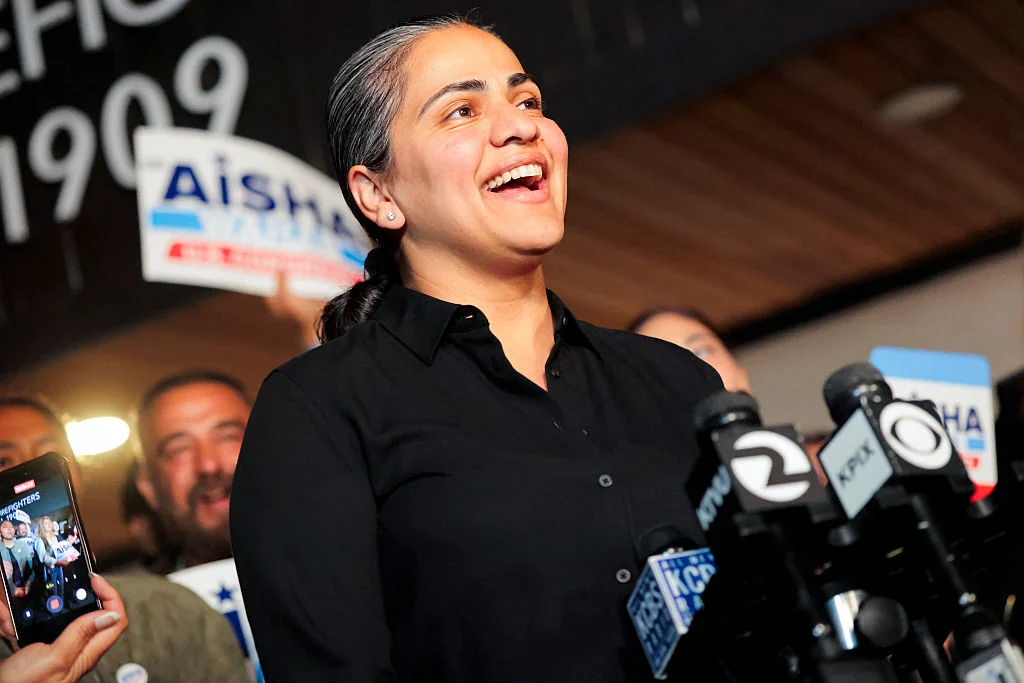
California State Senator Aisha Wahab has secured victory in the special election for California’s 14th Congressional District, claiming the East Bay seat previously held by former Representative Eric Swalwell. The race was officially called by The Associated Press on Thursday afternoon—two days after Election Day—after updated vote tallies showed Wahab holding an insurmountable lead over her fellow Democrat, Melissa Hernandez, the president of the Bay Area Rapid Transit (BART) Board of Directors.
With more than 95 percent of the ballots counted across the district, Wahab led Hernandez by a margin of 53 percent to 47 percent. The victory concludes a high-stakes, fast-tracked campaign triggered by Swalwell’s abrupt resignation from the House of Representatives in April 2026 amid multiple allegations of severe sexual misconduct.
CA-14 Special Election Results (95%+ Counted)
------------------------------------------------
Aisha Wahab (D-Progressive)    : 53% [WINNER]
Melissa Hernandez (D-Moderate) : 47%
------------------------------------------------
Wahab’s election carries both deep political significance and historic milestone status:
- Historic Representation: Wahab becomes the first Afghan American elected to the United States Congress.
- Overcoming Outside Capital: The victory marks another notable triumph for the progressive wing of the Democratic Party over an establishment-backed, heavily funded opponent.
- Immediate Swearing-In: Wahab will serve out the remainder of Swalwell’s unexpired term, which runs through January.
- November Rematch: She will immediately re-engage in campaign mode for the upcoming November general election, where she and Hernandez will square off once again for a full two-year term under newly redrawn district boundaries.
Chronology: The Road to the Special Election
The political sequence that culminated in Wahab’s election spans several years of shifting ambitions, ethics investigations, and strategic realignments within East Bay politics.
Timeline of Events Leading to the Special Election

2018      - Aisha Wahab elected to Hayward City Council.
2020      - Swalwell runs for U.S. President; Wahab briefly launches CA-15 bid before stepping down when Swalwell returns.
2022      - Wahab elected to the California State Senate.
Nov 2025  - Swalwell announces campaign for Governor of California; California voters approve Prop 50 redistricting.
Jan 2026  - Wahab officially enters the congressional race for CA-14.
Early 2026- Allegations of sexual misconduct, including rape, surface against Swalwell, prompting House ethics scrutiny.
Apr 2026  - Swalwell ends gubernatorial bid and resigns from Congress (denying allegations); special election called.
Jun 2026  - Wahab places first in the primary, advancing with Hernandez to the special election.
Aug 2026  - Wahab defeats Hernandez 53%-47% in the special election.
Early Career and the First Congressional Bid (2018–2020)
Aisha Wahab first entered public office in 2018 with her election to the Hayward City Council, where she built a platform focused on housing affordability, renters’ rights, and civic accessibility. In 2019, when incumbent Representative Eric Swalwell launched a campaign for the 2020 Democratic presidential nomination, Wahab briefly entered the race to succeed him in what was then California’s 15th District. However, when Swalwell withdrew from the presidential primary and sought re-election to his House seat, Wahab ended her campaign to avoid a primary clash with the incumbent.
Elevation to the State Senate and Swalwell’s Gubernatorial Launch (2022–2025)
In 2022, Wahab won election to the California State Senate, expanding her visibility across Alameda and Santa Clara counties. Political dynamics shifted again in November 2025, when Swalwell publicly announced his intention to forgo another House term in order to launch a campaign for Governor of California in the 2026 cycle. Recognizing an upcoming vacancy, Wahab formally launched her second congressional campaign in January 2026.
Ethics Probe, Resignation, and the Special Election Call (Spring 2026)
The campaign timeline was drastically accelerated in early 2026 when multiple women came forward with allegations of sexual misconduct, including allegations of rape, against Swalwell. As pressure mounted within the Democratic caucus and House leaders faced calls for formal ethics investigations, Swalwell suspended his gubernatorial campaign. On April 13, 2026, Swalwell formally resigned his seat in the House of Representatives while continuing to deny all allegations against him.
Swalwell’s sudden resignation left the 14th District vacant and prompted California Governor Gavin Newsom to issue a proclamation calling a special election to fill the remainder of the 119th Congress term.
The Summer Primary and General Special Election (June–August 2026)
The open primary in June 2026 produced a crowded field of candidates. Wahab finished comfortably in first place, leveraging her strong grassroots organization and progressive base across the East Bay. Hernandez, serving as BART Board President and backed by moderate political action committees, placed second to secure a spot in the August special election runoff.
Over the course of July and early August, the campaign intensified as national interest groups intervened heavily, setting up a sharp confrontation between progressive grassroots networks and moderate establishment funders.
Supporting Data and Campaign Dynamics
Campaign Spending and Outside Intervention
While Wahab emerged from the June primary with momentum, the campaign tightened significantly throughout July and August due to massive financial interventions from outside political groups.
The political action committee affiliated with the American Israel Public Affairs Committee (AIPAC), alongside independent expenditure organizations allied with moderate Democratic coalitions, funneled millions of dollars into the district during the final weeks of the campaign to support Hernandez. This influx paid for extensive digital advertising, targeted mailers, and broadcast television spots framing Hernandez as a pragmatic administrator suited for regional transit and economic governance.
Despite being heavily outspent on independent expenditure communications in the final sprint, Wahab relied on a coalition of local labor unions, community organizers, and small-dollar donors.
Key Campaign Dynamics & Financial Factors

Candidate          Ideological Alignment    Primary Support Base                   Outside Spending Support
-----------------------------------------------------------------------------------------------------------------
Aisha Wahab        Progressive              CA Dem Party, Labor, CPC Leadership     Grassroots / Small Donors
Melissa Hernandez  Moderate / Establishment NewDem PAC, Regional Reps, BART Allies   Super PACs (incl. AIPAC-affiliated)
The Broader Progressive Trend
Wahab’s ability to withstand massive outside spending mirrors a broader national trend in recent Democratic primaries, where progressive candidates have successfully blunted financial disadvantages through grassroots mobilization:
- Florida State Senate Primary: Earlier in the same week, Florida State Representative Angie Nixon secured the Democratic nomination for state Senate despite being outraised by her moderate primary opponent by a nearly 16-to-1 margin.
- District Grassroots Resistance: Wahab’s performance demonstrates the continued strength of established progressive networks in urban and suburban California districts, even when confronted with aggressive late-stage Super PAC advertising strategies.
Map Changes and November Context
Wahab’s 53-to-47 percent victory grants her immediate custody of the congressional seat under its current boundaries. However, her term will end in January 2027 unless she wins the November 2026 general election.
Under Proposition 50—a redistricting measure passed by California voters in late 2025—the 14th Congressional District will feature slightly adjusted geographical lines for the upcoming full term. Wahab and Hernandez will face each other once more on the November ballot under these modified boundaries.
House Vacancies Status (As of August 2026)
-------------------------------------------------------------------
District    Former Incumbent             Status
-------------------------------------------------------------------
CA-14       Eric Swalwell (D)            FILLED (Aisha Wahab won)
GA-13       David Scott (D)              Runoff scheduled next week
TX-23       Tony Gonzales (R)            Vacant (No election set)
FL-20       Sheila Cherfilus-McCormick(D)Vacant (No election set)
-------------------------------------------------------------------
Official Responses and Candidate Statements
Aisha Wahab’s Victory Remarks
Following the Associated Press’s official call on Thursday afternoon, Wahab released a statement addressing her supporters via social media, framing her victory as a rejection of heavy corporate and Super PAC spending in local politics.
"This victory belongs to the voters who made clear that our district cannot be bought," Wahab stated. "From foster care to Congress, this journey shows the possibility of the American Dream. Today this district made history by electing the first Afghan American to Congress."
Wahab’s personal narrative played a central role throughout her campaign. Born to Afghan refugees, Wahab lost her father to murder at an early age, and her mother passed away shortly thereafter. She and her sister navigated the California foster care system before being adopted by an Afghan couple living in the San Francisco Bay Area.
High-Profile Endorsements
The division within the Democratic Party was clearly reflected in the endorsements received by both candidates during the special election campaign:
Endorsement Profile

Aisha Wahab (Progressive Alignment)
* Official Endorsement of the California Democratic Party
* Rep. Greg Casar (D-TX), Chair of the Congressional Progressive Caucus
* Rep. Pramila Jayapal (D-WA), Former Chair of the Congressional Progressive Caucus
* Regional Labor Coalitions and Progressive Advocacy Groups

Melissa Hernandez (Moderate Alignment)
* Campaign Arm of the New Democrat Coalition
* Rep. Zoe Lofgren (D-CA), Senior Bay Area Delegate
* Rep. Sam Liccardo (D-CA), Former Mayor of San Jose
* Regional Business and Transportation Associations
Swalwell’s Departure Context
Former Representative Eric Swalwell, whose resignation prompted the special election, has maintained a low profile since vacating his seat in April. In his formal resignation announcement, Swalwell denied all allegations of sexual misconduct and rape, maintaining that his departure was intended to spare his constituents and family the distraction of an extended House Ethics Committee investigation.
Political Implications and Future Outlook
Ideological Balance in the Democratic Caucus
Wahab’s arrival in Washington, D.C., reinforces the progressive bloc within the House Democratic Caucus. As a state senator, Wahab championed legislative efforts focused on consumer protections, criminal justice reform, and affordable housing. Her entry into Congress adds another committed progressive voice to national debates on economic inequality, foreign policy, and federal safety-net funding.
Furthermore, her victory demonstrates that moderate coalitions and outside Super PACs face significant headwind when attempting to flip progressive-leaning seats in core Bay Area districts, even when deploying substantial capital late in an election cycle.
The November General Election Strategy
While Wahab will be sworn into office shortly to complete the 119th Congress term through January, both the Wahab and Hernandez campaigns are immediately shifting focus to the November general election rematch.
Key factors framing the November contest include:
- Incumbency Advantage: Wahab will now run as an active member of Congress, affording her national visibility, official constituent service capabilities, and increased platform reach.
- Redistricted Boundaries: The implementation of the voter-approved Proposition 50 map introduces subtle shifts in voter demographics that both campaigns will need to navigate over the autumn strategy period.
- Voter Turnout Dynamics: Turnout for the special election in August was subject to summer voting patterns. The November general election will feature a significantly larger electorate driven by statewide and national contests, which could alter the margin between the two candidates.
National House Composition
Wahab’s victory reduces the total number of current House vacancies to three. The seating of Wahab brings the Democratic caucus closer to full strength as both parties maneuver for advantage ahead of the general election. With special elections pending in Georgia’s 13th District and unscheduled vacancies in Texas and Florida, Wahab’s immediate swearing-in provides Democrats with a fully represented vote in the East Bay as Congress prepares for crucial autumn legislative sessions.