For decades, the supercar industry operated under a rigid, unwritten contract: vehicles with low ground clearance, aggressive aerodynamic spoilers, and high-strung, mid-mounted engines belonged exclusively to the smooth, controlled surfaces of a racetrack or a freshly paved mountain pass. To take a supercar off-road was considered an act of automotive sacrilege—a recipe for cracked carbon fiber and shattered suspension components.
However, the industry’s perception of "performance" is undergoing a seismic shift. As the market for luxury SUVs becomes increasingly saturated, manufacturers and boutique customizers are pivoting toward a new, paradoxical segment: the high-performance, all-terrain supercar. Leading the charge into this rugged frontier is the newly unveiled Rezvani Dune, a vehicle that pushes the boundaries of the genre so far that it makes factory-built off-road specials look like commuter cars.
The Genesis of the Off-Road Supercar
The concept of a dirt-ready supercar is not entirely new, though it has long been relegated to the realm of "what-if" design studies. In 2013, Italdesign Giugiaro stunned the automotive world at the Geneva Motor Show with the Parcour concept. A high-riding, V10-powered machine based on the Lamborghini Gallardo platform, the Parcour was a provocative vision of a future where sports cars could conquer sand dunes and gravel trails with equal poise.
While the Parcour remained a design exercise, it planted the seed for a niche that would eventually reach production. It took nearly a decade for the mainstream market to catch up. In 2022, Lamborghini finally embraced the idea with the Huracán Sterrato, a limited-run production vehicle that proved consumers were hungry for a car that offered supercar thrills without the anxiety of a steep driveway or a gravel road. Porsche followed suit shortly after with the 911 Dakar, a rally-inspired titan that leaned into the German manufacturer’s storied history in off-road endurance racing.
The Rezvani Dune: Redefining the Threshold
Fast-forward to 2026, and the mantle has been picked up by California-based Rezvani Motors. While Lamborghini and Porsche approached the off-road supercar with the constraints of large-scale manufacturing and global emissions regulations, Rezvani has taken a "no-holds-barred" approach.
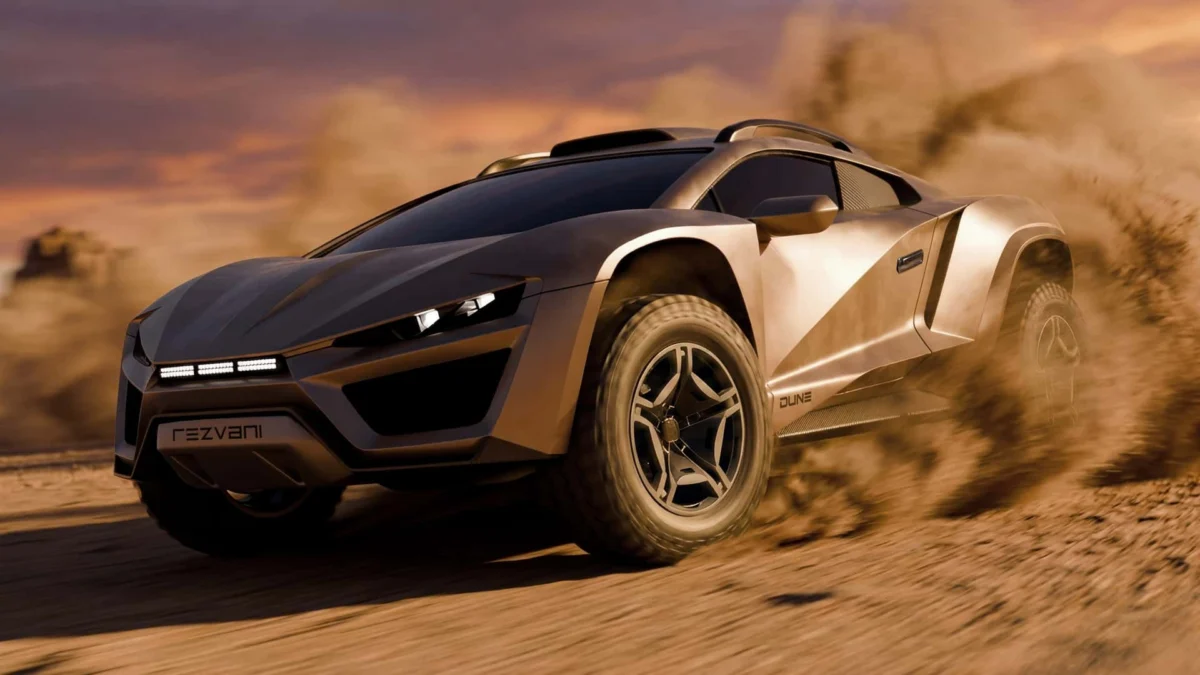
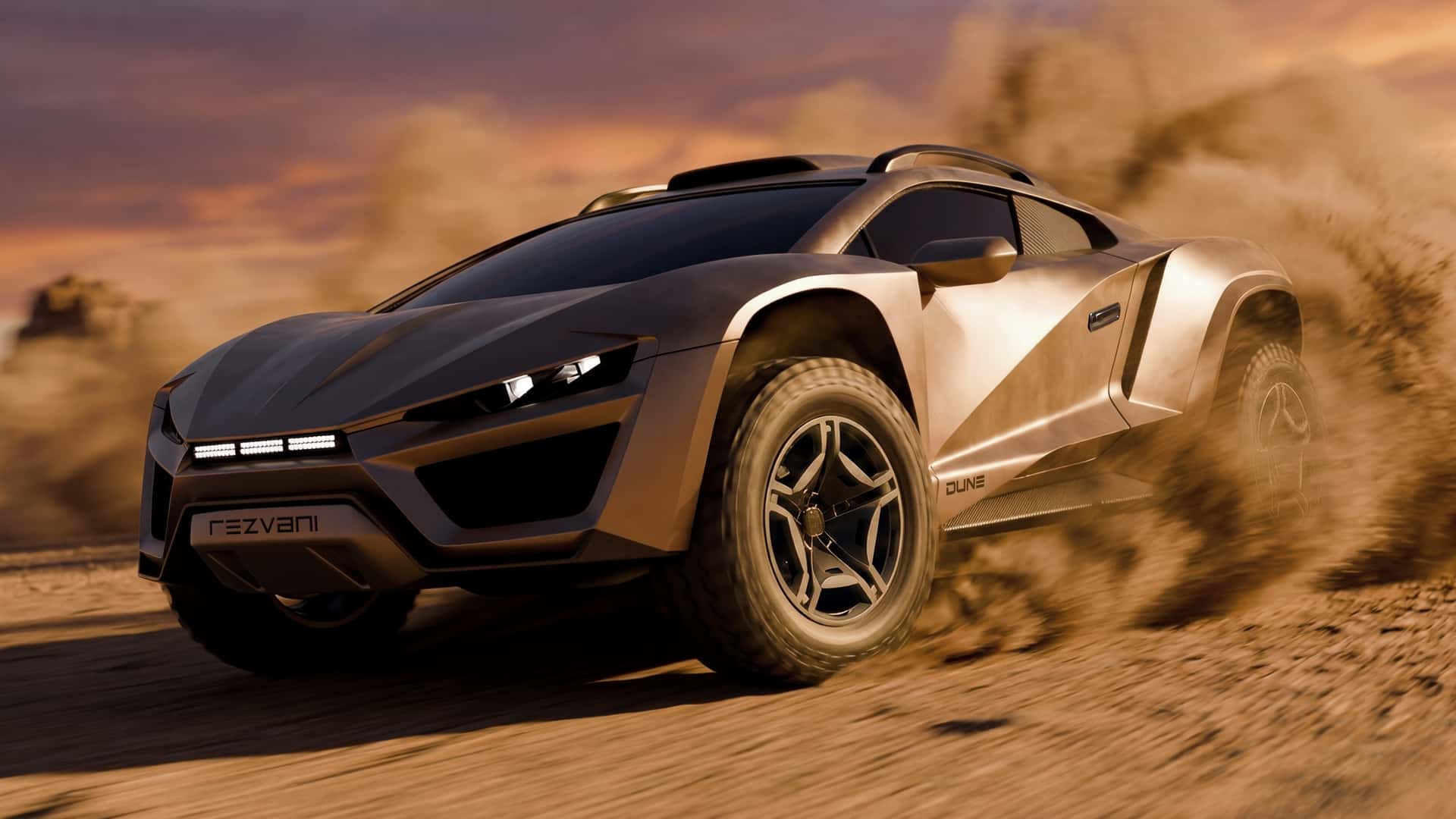
The Rezvani Dune, based on the Lamborghini Huracán, is not merely a lifted sports car; it is a comprehensive, radical transformation. From a visual standpoint, the Dune appears as though it were lifted directly from the set of a Mad Max film. It features a bespoke, widebody carbon-fiber exterior that is as functional as it is aggressive. A prominent roof scoop feeds air to the engine, while the overall aesthetic is one of industrial-grade durability.
The engineering underpinnings are where the Dune truly separates itself from its predecessors. While the Huracán Sterrato featured a modest 1.7-inch suspension lift over the standard model, the Rezvani Dune raises the chassis by an additional 4.5 inches. This massive increase in ground clearance allows the car to tackle terrain that would leave a standard supercar stranded. The transformation is completed by a set of 31-inch all-terrain tires, which provide the grip necessary for soft surfaces and rocky outcrops—hardware more typically found on heavy-duty off-road trucks than Italian exotics.
Performance Reimagined: The 800-Horsepower Heart
At the core of the Dune remains the legendary 5.2-liter V10 engine, a masterpiece of internal combustion engineering. However, in the spirit of the project, Rezvani was not satisfied with the stock power output. By partnering with the renowned tuning firm VF Engineering, the company has added a supercharger to the V10, boosting its output to a staggering 800 horsepower.
This represents an increase of nearly 200 horsepower over the Lamborghini Huracán Sterrato. While Rezvani has remained tight-lipped regarding the specific torque figures, the forced induction system is expected to provide a substantial leap over the factory-spec 413 lb-ft, ensuring that the Dune has the grunt required to pull itself through deep sand or mud at high speeds.
Scarcity and Exclusivity: The Business Case
The Rezvani Dune is a testament to the power of extreme personalization. With a production run limited to just seven units, the vehicle is aimed at a hyper-exclusive clientele who value individuality over mass-market prestige. The company is currently accepting reservations with a $1,500 refundable deposit, but the final price tag remains an undisclosed figure, likely contingent upon the specific level of customization requested by each owner.
By contrast, Lamborghini produced 1,499 units of the Huracán Sterrato, priced at just under $280,000. While the Sterrato was a factory "special," the Dune is a bespoke conversion. This distinction is crucial; Rezvani is not competing with Lamborghini’s volume, but rather with the desire for something truly unique—a "survivalist" take on the supercar that the traditional Italian brands are currently too conservative to produce.
Implications for the Future of Performance
The success of these models—from the Porsche 911 Dakar to the Rezvani Dune—suggests that the industry is witnessing a permanent evolution in luxury performance. For years, the "supercar" definition was defined by track times and cornering G-forces. Today, it is increasingly defined by versatility.
When asked about the future of this segment, Federico Foschini, Chief Marketing and Sales Officer at Lamborghini, indicated during the Goodwood Festival of Speed that the "Sterrato formula" is far from dead. While it remains to be seen if the new Lamborghini Temerario will receive an off-road variant, the market appetite is undeniable. Porsche, too, has seen overwhelming demand for its Dakar model, which sold out almost immediately upon announcement.
Why the Dune Matters
The Rezvani Dune might seem like a whimsical, outlandish project to some, but it serves a strategic purpose in the automotive landscape. It demonstrates that there is a growing segment of the ultra-wealthy demographic that is tired of the ubiquitous high-end luxury SUV. These buyers are looking for vehicles that provide the engagement of a supercar but possess the capability of a dedicated off-roader.
Rezvani, a brand known for its armored vehicles and high-performance trucks, is uniquely positioned to bridge this gap. Their expertise in creating rugged, military-inspired machines allows them to push the engineering limits of the Huracán platform further than a traditional automaker could.
Conclusion: The Road Less Traveled
As we look toward the latter half of the decade, the line between "sports car" and "all-terrain vehicle" will continue to blur. The Rezvani Dune is the logical, albeit extreme, conclusion to this trend. It is a vehicle that refuses to be constrained by the limitations of tarmac, promising an experience that is as raw as it is refined.
For those who view the supercar as an object of pure performance, the Dune may be a shock. But for those who view it as an object of freedom—the freedom to drive anywhere, on any surface, with 800 horsepower at their disposal—it is perhaps the ultimate manifestation of the automotive dream. Whether or not this niche continues to grow, the Dune has undeniably proven that the "supercar" is no longer just for the track. It is for the desert, the trail, and the horizon.