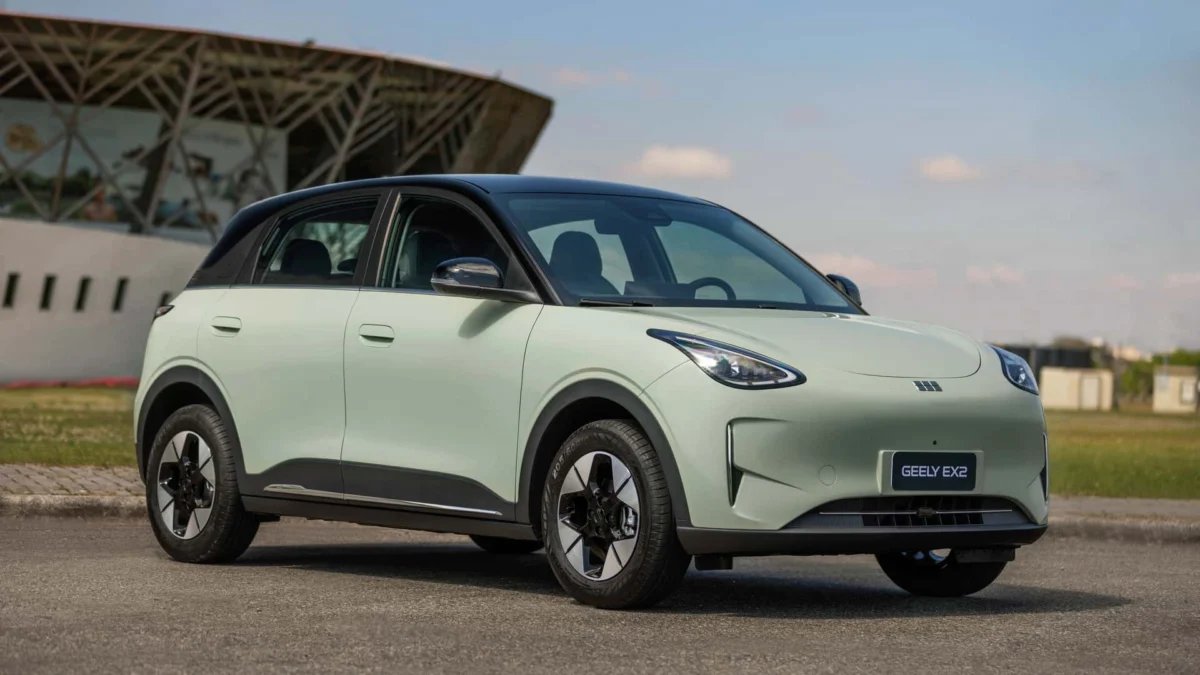
In the high-stakes theater of China’s automotive industry, where multi-billion dollar tech giants and legacy manufacturers clash, a quiet disruption is underway. It isn’t being led by a luxury SUV or a high-performance supercar, but by a compact, unassuming five-door hatchback. Meet the Geely E2—known variously in different markets as the Geely EX2, Galaxy Xingyuan, and Geome Xingyuan. It is, quite simply, the most successful vehicle in the world’s largest car market.
Having secured the title of China’s best-selling vehicle in 2025, the E2 is not resting on its laurels. According to preliminary industry data for the first half of 2026, the hatchback is maintaining its lead, moving approximately 244,000 units. In doing so, it has systematically outperformed established titans, leaving the Tesla Model Y (215,000 units), the Xiaomi SU7 (182,000 units), and the Leapmotor A10 (171,000 units) in its rearview mirror.
A Chronology of the E2’s Ascent
The rise of the Geely E2 is a study in precise market timing. While many manufacturers were racing to build increasingly complex, premium, and expensive electric vehicles, Geely identified a yawning gap in the entry-level to mid-range segment.
- Late 2024: Geely initiates a massive production ramp-up for the E2 platform, betting that Chinese consumers are shifting away from the "ultra-cheap" micro-EVs toward more practical, feature-rich compact vehicles.
- Q1 2025: The E2 begins hitting dealership floors nationwide. Initial reception is characterized by high praise for its interior space-to-footprint ratio.
- Mid-2025: The vehicle reaches mass-market saturation. It becomes the go-to choice for urban commuters and small families, eventually clinching the year-end sales crown.
- 2026 Strategy: Geely expands the branding strategy, marketing the car under the Galaxy and Geome sub-brands to reach diverse demographics, cementing its dominance through the first half of the year.
Supporting Data: Why the Numbers Add Up
To understand why the E2 is outperforming a Tesla, one must look at the math of the Chinese market. In a country where New Energy Vehicles (NEVs)—encompassing EVs, plug-ins, and range-extenders—account for nearly 63% of all new car sales, the competition is fierce. The E2 wins because it solves the "Value Paradox."
Dimensional Superiority
Measuring 162.0 inches in length, the E2 sits at the upper echelon of the B-segment. It is physically larger than European favorites like the Peugeot 208 or the Renault 5. Its 104.3-inch wheelbase provides a cabin experience that feels mid-size rather than compact, a crucial selling point for Chinese families who often rely on one vehicle for all their transportation needs.
The Pricing Strategy
The pricing structure is the E2’s "killer app." Starting at approximately ¥64,800 ($9,000 USD), it occupies a "Goldilocks" zone. It is significantly more capable than the ultra-budget Wuling Hongguang Mini EV (¥44,800 / $6,600), yet it provides a vastly more accessible entry point than the BYD Seagull (¥69,900 / $10,300). When compared to the Tesla Model Y, which commands a starting price of ¥263,500 ($38,900), the E2 looks like a financial masterstroke for the average consumer.
Design Philosophy: Modernity Without Alienation
One of the greatest hurdles for early electric vehicle adoption was "design anxiety"—the tendency of manufacturers to make EVs look like alien spaceships. The Geely E2 takes a different approach. It features clean, approachable lines and a silhouette that feels contemporary without being avant-garde.
Inside, the vehicle defies its low price tag. The cabin is headlined by an 8.8-inch digital instrument cluster and a massive 14.6-inch infotainment touchscreen. These are not merely "included" features; they are highly responsive, modern interfaces that cater to the tech-savvy Chinese consumer.
Practicality is also baked into the chassis. With 13.2 cubic feet of rear cargo space and a 2.5-cubic-foot "frunk" (front trunk), the E2 manages to be a daily workhorse. Safety and convenience are bolstered by standard features including full-LED headlights and adaptive cruise control—technologies that are often relegated to expensive optional packages in Western-market equivalents.
Official Perspectives and Industry Response
Geely’s strategy is a clear signal to the global automotive establishment. By leveraging LFP (Lithium Iron Phosphate) battery chemistry, Geely has managed to keep costs low while ensuring the batteries remain durable and safe. The E2’s range, which varies between 157 and 214 miles, is calibrated perfectly for the average urban commuter.
Analysts point out that Geely’s supply chain vertical integration is the key to this price point. By owning its battery production and platform architecture, Geely has minimized the margins lost to third-party suppliers.
When questioned about the potential for a global rollout, Geely executives have noted that while the car is currently tailored for the high-density urban environments of Asia, the platform is inherently scalable. In Italy, for instance, the model has begun to see limited import presence with pricing around €20,900—a figure that, while higher than the Chinese MSRP due to tariffs and logistics, remains highly competitive in the European B-segment.
The Broader Implications
The success of the Geely E2 carries profound implications for the global automotive industry:
- The Death of "Cheap" as "Low Quality": The E2 proves that consumers will reward a manufacturer that delivers high-quality tech and reliable range at a budget price. It shatters the myth that affordable EVs must be stripped-down, lackluster compliance cars.
- The Shift in Market Power: As China’s domestic brands continue to refine their craft, the pressure on legacy manufacturers in Europe and North America to innovate or exit the entry-level segment becomes existential. If a $9,000 car can offer a 14.6-inch screen and adaptive cruise control, the traditional automakers’ reliance on high-margin luxury features may no longer be a sustainable shield.
- The Range Efficiency Reality: The E2 highlights a growing consensus that for the majority of urban drivers, a 200-mile range is sufficient. By not over-engineering the battery capacity, Geely keeps the vehicle light, efficient, and—most importantly—affordable.
Conclusion: A Blueprint for the Future
The Geely E2 is not just a car; it is a manifestation of a market correction. It represents the point where the needs of the consumer—price, space, and technology—have finally converged with the capabilities of modern electric engineering.
For the rest of the world, the E2 stands as a warning and an invitation. It warns that if Western manufacturers do not find a way to democratize electric vehicle technology, they risk being bypassed by a wave of efficient, well-equipped, and aggressively priced vehicles from the East.
Ultimately, the E2 proves that simplicity, when executed with precision and scale, is the most powerful tool in the industry. As the world watches to see if this success can be replicated in Europe and beyond, one thing is certain: the era of the accessible, mass-market electric vehicle has arrived, and it is driving a Geely.