When X-Men ’97 arrived on Disney Plus, it did more than just trigger a wave of 90s nostalgia; it served as a masterclass in how to modernize a beloved property without losing its soul. While the revival maintained the vibrant, Saturday-morning aesthetic and the high-stakes soap opera drama of the original X-Men: The Animated Series, it took bold, transformative risks with its cast. Among these, perhaps no character underwent a more radical reinvention than Morph.
In the original series, Morph was a tragic figure—a jokey, snarky teammate who served as the first major casualty of the pilot, only to return as a brainwashed antagonist before eventually finding redemption. Today, in the hands of actor JP Karliak, Morph has been elevated into one of the most compelling and multidimensional characters in the Marvel animated pantheon.
In a recent conversation, Karliak sat down to unpack the complexities of his character, the nature of Morph’s evolving power set, and the truth behind the mutant’s most poignant moments.
The Legacy of Morph: From ’90s Plot Device to Modern Icon
To understand the weight of Morph’s current iteration, one must look at their origins. In the 1990s cartoon, Morph was essentially a stand-in for the comic book character Changeling. Voiced by Ron Rubin, the character was defined by his blue-and-yellow suit, his black hair, and a nasally, cackling laugh. He was a fan favorite largely because his death in the series premiere provided the emotional stakes necessary to ground the show’s more fantastical elements.
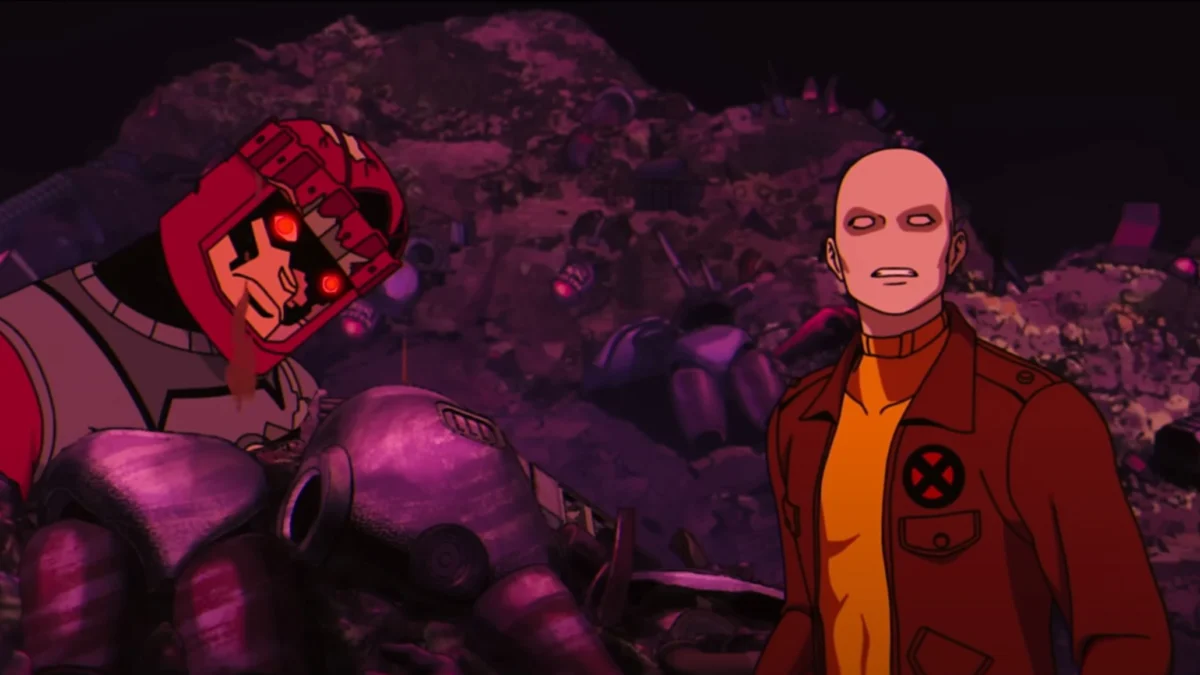
However, the Morph of the 1990s was a plot device. He was rarely given the room to develop a complex internal life. X-Men ’97 changed that dynamic entirely. The creative team, leaning into the character’s status as a shapeshifter, reimagined them as a nonbinary individual, a choice that feels like a natural evolution of their fluid nature. Visually, the team moved away from the 90s aesthetic, adopting the bald, blank-faced, and pale design popularized by The Exiles comic book series of the early 2000s.
JP Karliak, tasked with bringing this new version to life, didn’t try to replicate the specific cadence of the original actor. Instead, he brought his own natural voice to the role, though he admits the character’s legacy loomed large in the audition process. “That laugh was in the casting breakdown,” Karliak notes. “I didn’t have to do a soundalike for Ron specifically, but they did want the laugh, or at least an homage to the laugh, to still be there. It’s a signature piece of the character’s history.”
Defining the Limits: The Physics of Mutation
One of the most frequent points of contention among the X-Men ’97 fandom involves the logic behind Morph’s abilities. In the original series, Morph’s powers were straightforward: he looked like other people. It was a tactical, observational power. In the current series, however, Morph has been seen transforming into powerhouses like the Incredible Hulk, Colossus, and Doctor Octopus, appearing to inherit their physical capabilities.

This led to widespread speculation: Is Morph becoming a god-tier mutant? Karliak explains that there are, in fact, firm rules in place.
“I was also curious about that during interviews during season 1,” Karliak says. “When I talked to [producer] Jake Castorena, the explanation that I got is that Morph has the ability to replicate powers that are physical in nature. It’s very physics-based. Because Morph can alter their own density, mass, and the force behind their movements, they can replicate physical strength like Hulk or Colossus, or velocity like Quicksilver, or even flight like Angel.”
Crucially, this does not extend to the metaphysical or psionic realms. “No telepathy, no weather manipulation, no energy projection,” Karliak clarifies. “It’s strictly physical.”
However, in the world of comic book logic, ceilings are often meant to be broken. Karliak leaves the door open for future growth, hinting that the idea of a “secondary mutation”—a concept popularized in the comics where a mutant’s powers evolve unexpectedly—is not off the table for Morph.
The "I Love You" Conundrum: A Question of Intent
Perhaps the most discussed moment of the first season occurred in the penultimate episode, following the horrific events of Magneto’s assault on the X-Mansion. When Wolverine’s adamantium skeleton was ripped from his body, he was left in a state of catatonic agony. As he recovered, Morph transformed into Jean Grey to provide him with comfort, uttering the words, “I love you.”
The scene ignited a firestorm of fan theories. Was this a genuine confession of romantic love from Morph to Logan, or was it a compassionate lie intended to soothe a man in his darkest hour?
Former showrunner Beau DeMayo previously suggested the confession was intended to be romantic. Karliak, however, views the scene through a different, perhaps more heartbreaking lens. “I always took it as the former,” he explains, referring to the idea of comfort. “The person that my buddy would receive the most comfort from is the person that he’s in love with. I think delivering that message from Jean was an act of supreme comfort.”
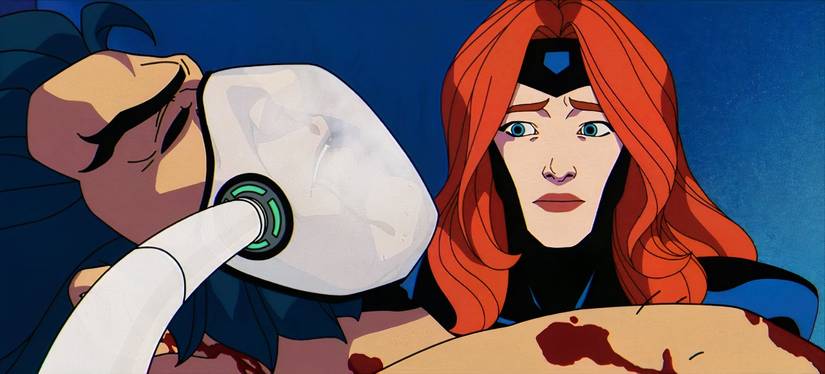
When pressed on whether Morph harbors genuine romantic feelings for the Wolverine, Karliak offers a nuanced take on the character’s emotional maturity. “I do think that Morph has some feelings for Wolverine, but I also think that Morph is emotionally competent enough to know that Wolverine is a lost cause romantically. Regardless of what people speculate Logan’s sexuality to be—like, ‘Oh, but he was with Hercules that one time!’—sure, but regardless, Logan is in love with Jean Grey and always will be. I think Morph is processing those emotions and finding ways to exist within that dynamic.”
The Shapeshifter’s Hierarchy: Morph vs. Mystique
The X-Men universe is populated by formidable shapeshifters, most notably the iconic villain Mystique. With her long history of infiltration and deception, she is often considered the gold standard for the ability. We asked Karliak to settle the debate: Who is the superior shapeshifter?
“Morph,” he says, without a moment’s hesitation.
He concedes that, on paper, they are evenly matched in terms of raw biological capability. However, the distinction lies in the application of the power. “I think it’s actually very equally matched,” Karliak admits. “But I do think Morph is much more—especially in this series—attuned to using their shapeshifting abilities to harness certain power sets or vary up their fighting styles. Rarely does Morph use their powers in this series for deception, whereas that’s Mystique’s whole thing. Morph does it every once in a while, but it’s mostly for power sets—or for a joke.”
Implications for the Future of the X-Men
The reinvention of Morph represents a broader shift in how superhero animation is being handled in the modern era. By grounding the character in authentic, nonbinary identity and giving them a clearly defined—yet flexible—power set, the creative team has ensured that Morph is no longer just a "legacy character" or a "redshirt."
Morph has become the emotional anchor of the team. Their ability to literally take on the form of others, combined with their sharp wit and deep capacity for empathy, makes them a unique lens through which to view the X-Men’s struggles. As the series moves into its subsequent seasons, the focus on Morph’s internal life and their relationship with the rest of the team will likely remain a pillar of the show’s narrative strength.
For JP Karliak, the journey is just beginning. By bringing a sense of human vulnerability to a character who can be anyone, he has helped turn Morph into someone we finally, truly know. As the X-Men face ever-increasing threats, one thing is certain: Morph is no longer just watching from the sidelines—they are at the very heart of the conflict, and they are here to stay.