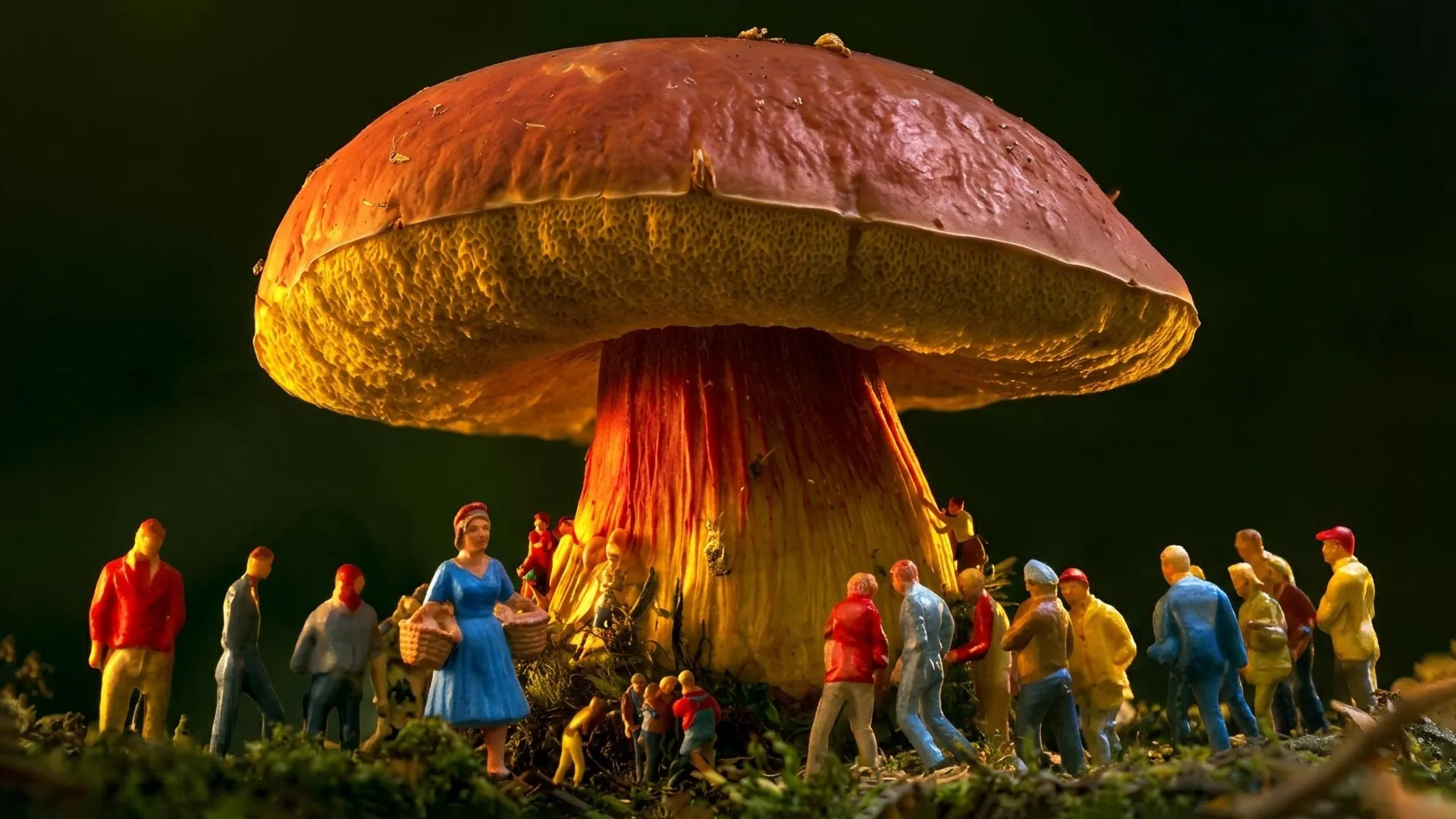
For nearly a century, travelers and anthropologists have returned from the remote corners of the globe—from the dense jungles of Papua New Guinea to the mountainous terrain of Southwest China and the Northern Cordillera of the Philippines—with a shared, unsettling tale. They describe the consumption of wild mushrooms followed by a singular, bizarre hallucination: the sudden appearance of tiny human figures, often only inches tall, moving through the environment with the autonomy of living beings.
For decades, the scientific community relegated these accounts to the realm of folklore, attributing the "Lilliputian hallucinations" to cultural suggestion or the power of collective imagination. However, a groundbreaking study led by researchers at the University of Utah (U) has shifted the paradigm. By utilizing advanced DNA sequencing, scientists have identified Lanmaoa asiatica as the common denominator behind these visions, suggesting that a potent, unidentified psychoactive compound—not cultural myth—is at work.
A Century-Old Mystery: From "Mushroom Madness" to Modern Science
The mystery of the tiny humans, or "Lilliputian hallucinations," traces its origins back to 1934, when Western observers first documented accounts in Papua New Guinea. Local populations reported a condition dubbed "mushroom madness," in which individuals experienced vivid, hyper-realistic visions of miniature beings. Throughout the mid-20th century, anthropologists attempted to solve the puzzle, often collecting specimens of bolete mushrooms suspected of being the culprits.
The investigation reached a dead end in the 1960s. Even the legendary chemist Albert Hofmann, the man who first synthesized LSD and isolated psilocybin, examined the samples. His failure to identify a psychoactive agent led many in the scientific community to abandon the theory of a chemical cause entirely. With no active ingredient identified, researchers began to favor sociological explanations: perhaps the hallucinations were simply the result of people seeing what they were raised to believe they would see.
The phenomenon remained dormant in the scientific literature until the 1990s, when reports of similar hallucinations surfaced in Yunnan, China, following the consumption of local bolete mushrooms known as Jian shou qing. The mystery finally found a contemporary anchor in 2024, when doctoral student Colin Domnauer discovered parallel accounts among Indigenous communities in the Philippines. These residents identified a local mushroom, Sedesdem, as the source of the same tiny, human-like visions.
The Investigative Methodology: DNA as the Key
To bridge the gap between these disparate geographies, Domnauer and his supervisor, mycologist Bryn Dentinger, launched a cross-continental investigation. The team traveled to Yunnan and the Philippines to conduct field interviews and collect biological samples. Their work represented the first systematic mycological survey in the northern Philippines, a region previously under-explored in the context of fungal biodiversity.
The methodology moved beyond the limitations of 20th-century chemistry. By employing modern DNA sequencing, the team compared the genetic signatures of the Chinese Jian shou qing and the Philippine Sedesdem. The results were startling: both were identified as Lanmaoa asiatica.
This revelation was profound. It proved that the same species was responsible for identical hallucinations in two geographically isolated cultures. While the researchers were unable to collect specimens from Papua New Guinea due to unfavorable weather conditions, the link between the China and Philippines populations provided a compelling biological argument for a shared, objective phenomenon.
The Hallucination Profile: Why the Visions are Unique
What separates these experiences from typical psychedelic episodes is the sheer structural consistency of the visions. While standard hallucinogens often induce abstract patterns, color shifts, or emotional distortion, L. asiatica produces highly specific, "solid" imagery.
According to Domnauer, approximately 90% of those affected describe dozens or even hundreds of miniature figures, ranging from 3 to 30 centimeters in height. These figures often appear as elves, clowns, or fairy-like beings in vibrant, detailed clothing. Crucially, they obey the laws of physics. They do not pass through walls or evaporate into mist; they walk around obstacles, climb surfaces, and exhibit deliberate, complex behaviors.
One harrowing account shared by a witness involved a bowl of soup. The individual reported seeing tiny humans jumping from a spoon into the broth, swimming, and remaining visible even after being ingested. Such reports indicate that the mushroom does not merely cloud the user’s judgment; it fundamentally alters their visual processing in a way that creates a coherent, interactive secondary reality.
The Chemical Frontier: A Missing Molecule
Perhaps the most significant finding of the University of Utah study is the total absence of known psychoactive compounds. The researchers subjected L. asiatica to exhaustive chemical testing and genetic screening, searching for psilocybin, psilocin, and other established alkaloids. They found none.
This absence is a paradox that excites modern neuropharmacologists. The fact that the mushroom produces such a distinct and consistent effect without the presence of known psychedelics suggests the existence of a novel, unidentified chemical structure.
"We are looking at an entirely unfamiliar hallucinogenic substance," the researchers noted. Identifying this compound is now the primary objective for the team. If successfully isolated, this chemical could serve as a "key" to unlocking how the brain creates visual perception. By observing how this specific substance interacts with the visual cortex, scientists may finally understand the mechanisms behind Lilliputian hallucinations—not just those induced by fungi, but those occurring naturally in patients with dementia, macular degeneration, or severe alcohol withdrawal.
Broadening the Scope: Fungal Biodiversity and New Discoveries
The investigation into L. asiatica also provided a broader contribution to the field of mycology. By conducting a comprehensive genomic analysis of the Lanmaoa genus, the team analyzed 53 specimens, including some pulled from historic fungarium collections.
The results were a testament to the untapped wealth of museum archives: the researchers identified 17 distinct species, four of which were entirely new to science. Two of these new species had been sitting in U.S. collections for years, misidentified and unrecognized until DNA sequencing revealed their true nature.
This discovery serves as a poignant reminder of the "hidden" world surrounding us. Fungi remain among the most mysterious and least explored organisms on Earth. Just as the discovery of penicillin in a common mold revolutionized medicine in the 20th century, the chemical secrets hidden within L. asiatica could have profound implications for neurology and pharmacology.
Implications for Neurological Science
The study, published in the journal Mycologia, suggests that the "mushroom madness" of the past is actually a gateway to the future of neuroscience. If a single, as-yet-unknown molecule can trigger the brain to hallucinate hyper-realistic, three-dimensional entities that adhere to Newtonian physics, then understanding that molecule is equivalent to understanding the architecture of our own consciousness.
The research team, supported by the National Science Foundation, plans to move forward with the isolation of the active compound. As they continue to bridge the gap between traditional Indigenous knowledge and cutting-edge molecular biology, the hope is to turn this "mystery of the tiny people" into a medical tool.
If researchers can map the pathways triggered by L. asiatica, they could potentially develop treatments for the millions of people worldwide who suffer from spontaneous, distressing visual disturbances. In this light, the strange, miniature inhabitants described by villagers in the Philippines and China may ultimately prove to be the most important, albeit elusive, subjects in modern brain science.
For now, the mystery remains: a small, unassuming mushroom holds the secret to why the human brain, when stimulated by the right molecule, chooses to populate its reality with tiny, walking, talking, and swimming figures. It is a reminder that the boundary between our perception of the world and the world itself is thinner, and perhaps stranger, than we ever dared to imagine.