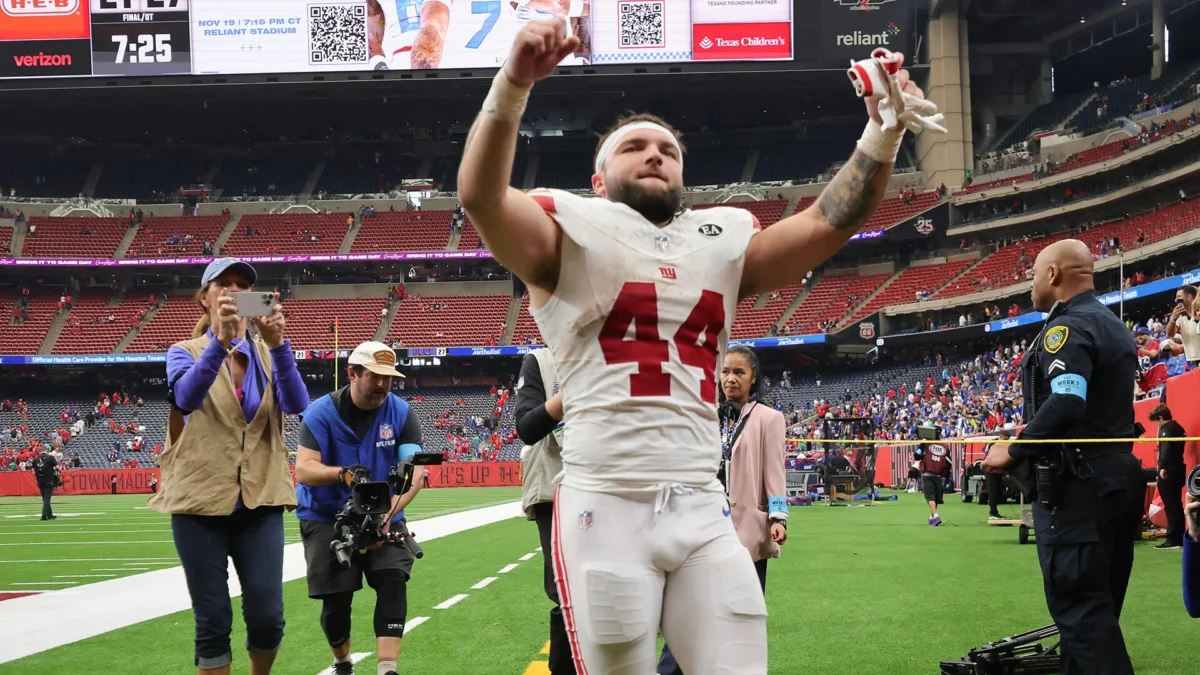
By John Breech
Updated: October 26, 2026
In the modern NFL, where the rulebook continues to evolve to prioritize player safety and limit high-velocity collisions, running backs are increasingly expected to display finesse, agility, and a refined sense of self-preservation. New York Giants running back Cam Skattebo, however, appears to be a relic of a more violent era—a player who views the defensive line not as an obstacle to be evaded, but as an object to be shattered.
Following the Giants’ dramatic 26-21 overtime victory against the Houston Texans on October 25, 2026, the conversation surrounding Skattebo shifted away from his impressive 124-yard rushing performance and toward a controversial officiating decision that could signal a looming conflict between the player’s identity and the league’s evolving standards.
The Incident: A Rare Flag in a Physical Game
The controversy erupted in the first quarter of Sunday’s matchup. During a routine carry, Skattebo lowered his helmet into a collision with a Texans defender. To the surprise of the fans at the stadium and viewers at home, the officiating crew whistled the play dead, assessing a 15-yard penalty for "lowering the head to make forcible contact."
The penalty is notoriously difficult to enforce and is rarely seen in professional football. It is a nuanced rule designed to prevent players from using their helmets as weapons, yet it is often mitigated by the fact that the act of "lowering the head" is an instinctive part of a running back’s drive for extra yardage.
Heading into Week 7 of the 2026 season, the league had thrown only four such flags across the entire NFL. Of those, only one was directed at an offensive player—Foster Moreau of the Houston Texans—and that was during a special teams play. Skattebo now stands alone as the only offensive player in the league this season to be penalized for the infraction while carrying the football, effectively placing him under a microscope for the remainder of the season.
Chronology of the Conflict
The friction between Skattebo and the league’s officiating body has been brewing for some time, though it reached a boiling point in Week 7.
- Week 6: Skattebo was held to zero touches, a significant drop in production that led to rumors of him being in the "doghouse" with head coach John Harbaugh.
- Early Week 7: In practices leading up to the Texans game, reports indicated that the coaching staff had been working with Skattebo on his pad level, perhaps anticipating that his aggressive style would eventually draw the attention of officials.
- The Texans Game: Skattebo silenced critics with a masterful 124-yard performance on 17 carries. However, the first-quarter penalty cast a shadow over his production, forcing the Giants to overcome a 15-yard deficit on a critical drive.
- Postgame: Skattebo addressed the media with a defiant tone, making it clear that the penalty would not result in a tactical shift.
A Style Built on Collision
To understand Skattebo’s resistance to changing his technique, one must understand his role in the Giants’ offensive scheme. He operates as a "human battering ram." In an era of the NFL where "making someone miss" is the hallmark of a premier back, Skattebo prefers to run through the chest of the defender.
Statistically, this approach has proven effective. His 124-yard performance against Houston demonstrated that even with the threat of penalties, his downhill style remains a potent weapon. By initiating contact, he forces defensive players to make business decisions, often wearing them down by the fourth quarter.
However, the statistical argument for his style is now being challenged by the legal realities of the NFL. If every carry carries the risk of a 15-yard penalty, his efficiency rating plummets. A 124-yard game becomes significantly less valuable if it is accompanied by 15-yard setbacks that stall drives and shift field position in favor of the opponent.
Official Responses and League Stance
The NFL has been clear in its directive to officiating crews: prioritize the reduction of helmet-to-helmet contact. While the rule is often criticized for being subjective, the league’s office argues that the long-term health of players—both offensive and defensive—depends on the elimination of the "lowering the head" technique.
When asked about the penalty, the officiating crew cited the "forcible contact" clause of the rulebook. They maintained that Skattebo’s action was not a incidental byproduct of a tackle, but a deliberate act of using the crown of his helmet to initiate the collision.
For the NFL, this is not just about one game; it is about setting a precedent. If they allow a high-profile player like Skattebo to repeatedly ignore the rule, it undermines the league’s broader safety initiatives. Expect the league to monitor Skattebo closely in the coming weeks, and potentially issue fines if he continues to initiate contact with his head.
The Harbaugh Factor: A Coach in a Bind
Perhaps the most significant implication of this situation is the relationship between Skattebo and head coach John Harbaugh. Harbaugh, a coach known for his discipline and tactical precision, is unlikely to appreciate a player who puts his team in a position to be penalized for preventable, "dumb" fouls.
Skattebo has already struggled to earn consistent playing time this season, as evidenced by his absence from the rotation in Week 6. His massive output against Houston was supposed to be his "redemption" game. Instead, the penalty has created a narrative that he is a "liability" in the eyes of the coaching staff.
If Skattebo continues to draw flags, Harbaugh will be faced with a difficult decision: keep his most physically imposing runner on the field and accept the inevitable 15-yard penalties, or bench him in favor of a player who adheres to the league’s safety guidelines. For a coach whose team is fighting for position in a crowded playoff race, the latter seems the more probable path.
Implications for the Remainder of the Season
As the Giants prepare for their next opponent, the "Skattebo Situation" has become a central storyline. If he remains unwilling to adjust his running style, the consequences will be twofold:
- Offensive Stagnation: The Giants’ offense cannot afford to lose 15 yards on first or second down due to discipline issues. If Skattebo persists, he will effectively be self-sabotaging the team’s ability to maintain drives.
- Reputational Targeting: Once a player is flagged for a specific rule, officials are psychologically primed to look for that infraction on subsequent plays. Skattebo will now be the focus of every referee on the field. He will not get the benefit of the doubt, and he will likely be flagged for hits that other players might get away with simply because he has already been identified as a "repeat offender."
Skattebo’s postgame comments—"If I’m going to continue to get flags for it or fined for it, guess I’m going to play for free"—suggest a martyr complex that may not sit well with the front office. While fans often admire such bravado, front offices view it as a lack of professionalism.
Ultimately, the NFL is a league of adaptation. The rules change, and the players who succeed are those who can adapt their skills to fit those parameters. If Cam Skattebo wants to remain a force in this league, he may have to learn that the most important skill isn’t just how hard you hit, but how effectively you can navigate the modern rulebook. If he refuses, he risks being remembered not as a star running back, but as a cautionary tale of a player who couldn’t—or wouldn’t—play by the rules of the modern game.