Deep beneath the rugged limestone landscape near Waitomo, on New Zealand’s North Island, scientists have unearthed a geological "time capsule" that is fundamentally altering our understanding of the evolution of Aotearoa’s unique wildlife. A collaborative team of researchers from Australia and New Zealand has discovered a treasure trove of fossilized remains—including ancient birds and frogs—that date back approximately one million years.
This discovery represents the first major collection of terrestrial vertebrate fossils from this period ever recovered in New Zealand. By providing a clear, dated window into an era long before human arrival, the site is filling a massive, 15-million-year gap in the nation’s fossil record, revealing a lost ecosystem shaped by cataclysmic volcanic activity and volatile climate shifts.
The Discovery: A Missing Volume of Natural History
For paleontologists, the fossil record is often described as a library of Earth’s history. In New Zealand, however, that library has long been missing some of its most critical volumes. While researchers have previously documented the life of Aotearoa between 20 and 16 million years ago through excavations at St Bathans in Central Otago, the period following that—until the arrival of humans roughly 750 years ago—has been notoriously blank.
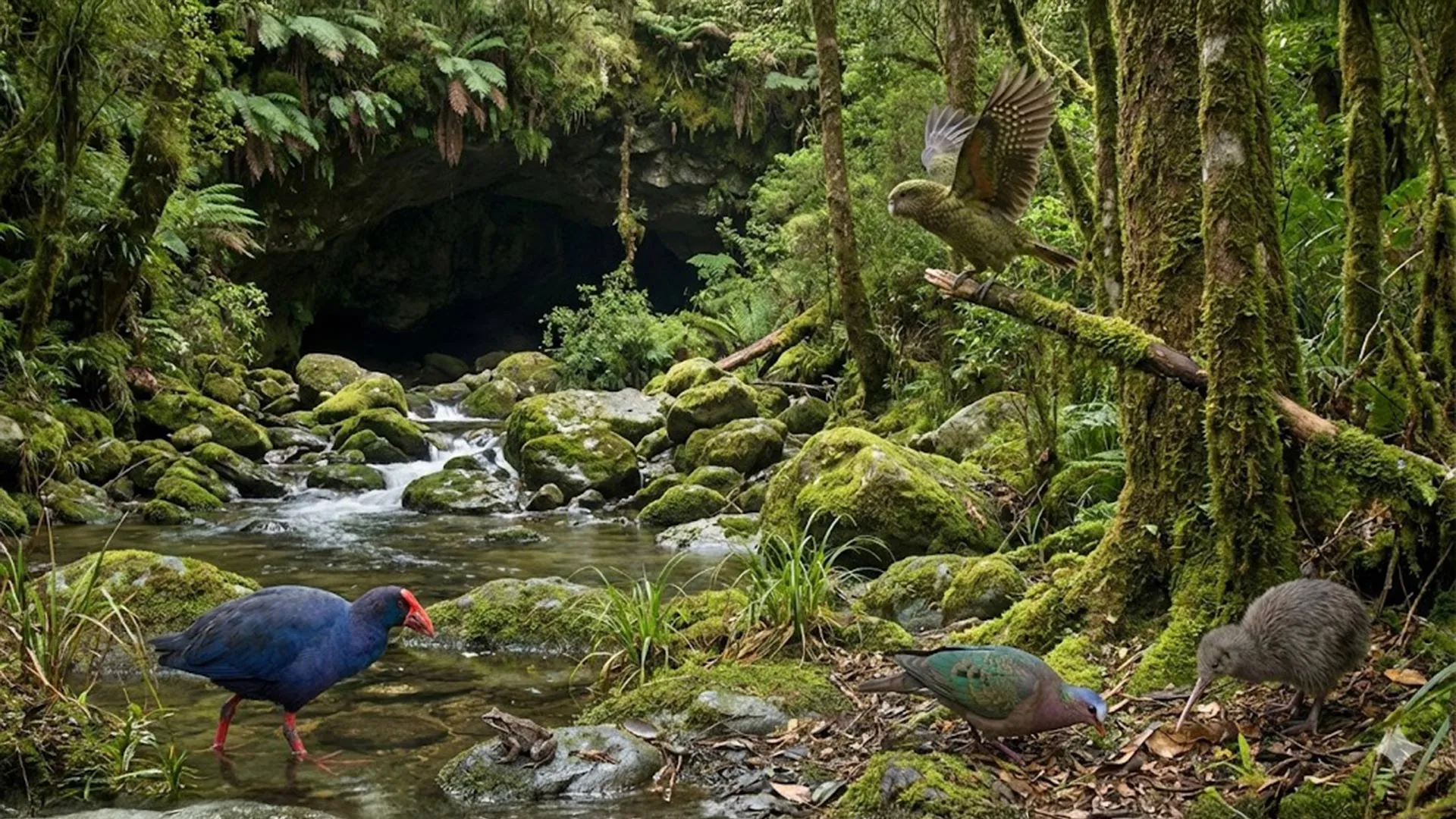
The Waitomo cave discovery changes this dynamic entirely. Preserved within the depths of the cave were the remains of 12 bird species and four frog species. Among these is a previously unknown relative of the kākāpō—the iconic, flightless, nocturnal parrot that has become a symbol of New Zealand’s conservation efforts.
Dr. Paul Scofield, Senior Curator of Natural History at the Canterbury Museum and a co-author of the study, describes the significance of the find in profound terms: "From our excavations at St Bathans, we have a snapshot of life in Aotearoa between 20 and 16 million years ago. These new findings cast light on the 15-million-year period from then to one million years ago, which is largely absent from the fossil record. This wasn’t a missing chapter in New Zealand’s ancient history; it was a missing volume."
Chronology: A Geological Sandwich
The precision of this discovery is as remarkable as its contents. The fossils were found trapped between two distinct layers of volcanic ash, acting as a "geological sandwich" that allows researchers to date the remains with exceptional accuracy.
The lower layer of ash originated from a massive volcanic eruption roughly 1.55 million years ago, while the upper layer was deposited by another cataclysmic event approximately 1 million years ago. This sandwich provides a concrete temporal boundary, placing the ecosystem’s existence squarely within the early Pleistocene epoch.
Furthermore, the site itself is of historic importance. The older ash layer confirms that this cave is the oldest known cave on the North Island of New Zealand, having survived the immense geological pressures and tectonic shifts that have defined the region for eons. The younger eruption, which occurred a million years ago, likely blanketed much of the North Island in meters of volcanic ash. While the vast majority of this material was stripped away by millennia of rain and erosion, the protective environment of the cave allowed a representative sample of the era’s fauna to endure.
Supporting Data: An Avifauna Lost to Time
The study, published in Alcheringa: An Australasian Journal of Palaeontology, highlights a stark reality: the New Zealand that existed a million years ago was fundamentally different from the one that greeted the first Polynesian settlers.
Associate Professor Trevor Worthy of Flinders University, the lead author of the study, notes that the fossils reveal an "avifauna"—the collective bird population of a specific region—that has been almost entirely replaced. "This is a newly recognized avifauna for New Zealand, one that was replaced by the one humans encountered a million years later," says Worthy. "This remarkable find suggests our ancient forests were once home to a diverse group of birds that did not survive the next million years."
Data from the cave suggests that between 33% and 50% of the species present in this ancient ecosystem vanished before humans ever set foot on the islands. The collection includes:
- Strigops insulaborealis: An ancient, potentially flying relative of the modern kākāpō.
- Extinct Takahē Ancestors: Early versions of the flightless swamphen that still survives in New Zealand today.
- Ancient Pigeons: A species closely related to the bronzewing pigeons of Australia, providing clues about historical trans-Tasman avian movement.
The Mystery of the Ancestral Kākāpō
Perhaps the most captivating find is Strigops insulaborealis. Today’s kākāpō is the world’s only flightless parrot, a heavy bird that has evolved to thrive on the forest floor. However, the fossilized bones of its ancestor tell a different story. Analysis indicates that S. insulaborealis possessed significantly weaker legs than its modern descendant. Because the modern kākāpō relies heavily on strong, muscular legs for climbing and navigating the forest canopy, the lack of such features in its ancestor suggests that this ancient parrot may have been a more aerial creature, perhaps retaining the power of flight before evolutionary pressures pushed the lineage toward a ground-dwelling lifestyle.
Official Responses and Ecological Implications
The research team, which includes paleontologists from Flinders University and the Canterbury Museum, as well as volcanologists Joel Baker (University of Auckland) and Simon Barker (Victoria University of Wellington), emphasizes that these extinctions were not the result of a single catastrophic event. Instead, they were the product of repeated, brutal environmental resets.
"These extinctions were driven by relatively rapid climate shifts and cataclysmic volcanic eruptions," Dr. Scofield explains. "The shifting forest and shrubland habitats forced a reset of the bird populations. We believe this was a major driver for the evolutionary diversification of birds and other fauna in the North Island."
These findings challenge the long-held narrative that New Zealand’s biodiversity was largely stable until the arrival of humans. For decades, the decline of New Zealand’s unique species was viewed almost exclusively through the lens of human-driven habitat destruction, predation by introduced mammals, and hunting. While these factors are undeniable contributors to modern extinctions, the Waitomo fossils demonstrate that natural forces—specifically, the "volcanic laboratory" of the North Island—had already been pruning the island’s evolutionary tree for hundreds of thousands of years.
Implications: A New Baseline for Conservation
By establishing a "missing baseline," the Waitomo discovery provides scientists with a benchmark for understanding how New Zealand’s wildlife has adapted to change. It clarifies that the species we view as "iconic" today are merely the survivors of a much larger, more diverse assembly that was sculpted by geological forces over millions of years.
This discovery serves as a cautionary tale and a beacon of hope. It reminds us that ecosystems are inherently dynamic and that the biodiversity we observe today is just one frame in a much longer cinematic history of the planet. As Associate Professor Worthy concludes, "For decades, the extinction of New Zealand’s birds was viewed primarily through the lens of human arrival 750 years ago. This study proves that natural forces like super-volcanoes and dramatic climate shifts were already sculpting the unique identity of our wildlife over a million years ago."
Moving forward, the research team intends to conduct further analysis on the Strigops insulaborealis remains to definitively determine whether the species could fly. As technology in isotopic analysis and DNA sequencing continues to advance, the bones recovered from this Waitomo cave will likely yield even more secrets, ensuring that the "missing volume" of New Zealand’s natural history is finally read, understood, and appreciated for the complex story it tells.
This fossil site is no longer just a collection of old bones; it is a vital bridge connecting the modern world to a wild, volatile, and long-vanished past, reminding us that in the story of life on Earth, change is the only constant.