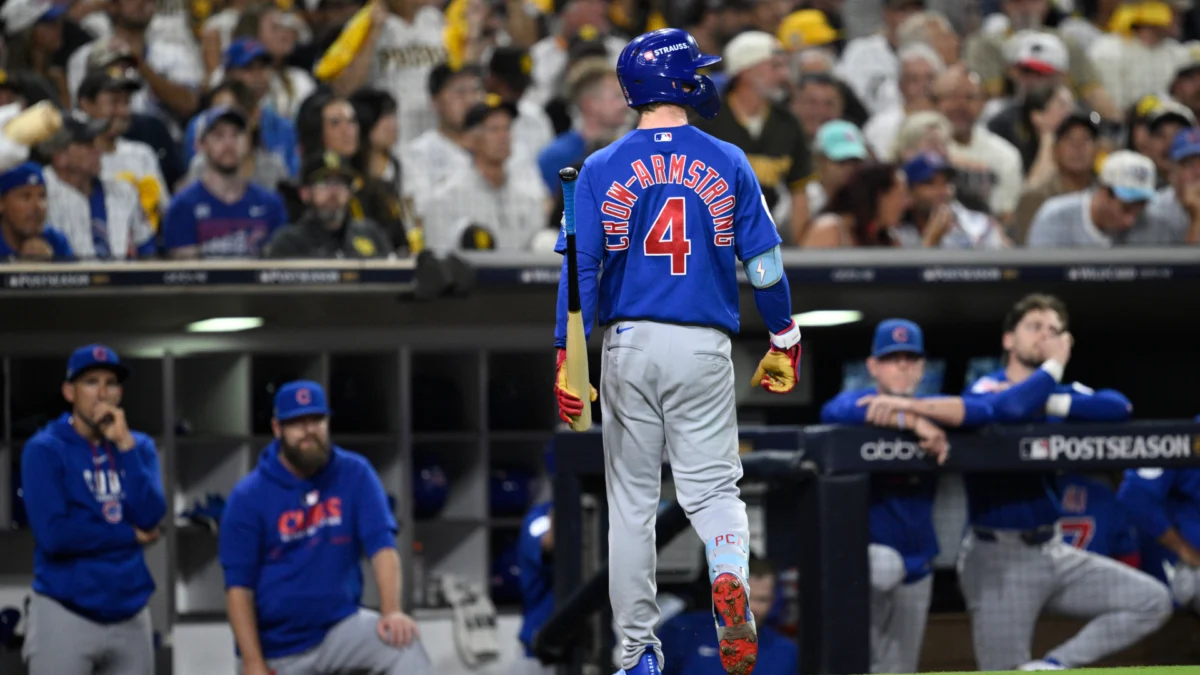
For the second consecutive season, the Chicago Cubs have found themselves on the outside looking in before the postseason truly began to heat up. After securing a National League Wild Card berth, the North Siders were promptly swept in a two-game series by the San Diego Padres, ending their 2026 campaign with a familiar, hollow thud.
This early exit marks a troubling trend. Last year, the Cubs managed to defeat the Padres in the Wild Card round before falling to the Milwaukee Brewers in the NLDS. This year, the regression was even more pronounced. Despite flashes of brilliance that suggested a team capable of reaching the Fall Classic, the Cubs ultimately lacked the depth, consistency, and pitching stability required to navigate the rigors of October baseball. As the organization pivots to a critical offseason, the franchise finds itself facing existential questions regarding its leadership, its roster construction, and its standing within the National League Central.
The Tale of Two Seasons: Brilliance and Collapse
To understand the frustration surrounding the 2026 Cubs, one must examine the volatility of their performance. In many respects, this was an elite offensive juggernaut. Between mid-April and early May, the club rattled off two separate 10-game winning streaks, propelling them to an MLB-best 27-12 record. They later surged on a 35-16 run from June 11 to August 12, looking every bit like a legitimate World Series contender.
The team’s statistics underscore just how lethal their lineup was. The Cubs led the majors in OPS and position-player WAR, anchored by a historic performance from Pete Crow-Armstrong. Crow-Armstrong’s 40-40 season—40 home runs and 40 stolen bases—was a singular achievement that will likely earn him the National League MVP. It stands as one of the greatest individual seasons in franchise history and one of the most productive by any player in the 21st century.
However, these highs were juxtaposed against a chaotic, often unraveled reality. The Cubs’ inability to maintain momentum was stark; their two 10-game winning streaks were immediately followed by a disastrous stretch where they lost 14 of 16 games, including a 10-game losing skid. By the time the calendar turned to mid-August, the pitching staff began a catastrophic melt-down, leading to a 17-22 finish to the regular season. This collapse cost the team home-field advantage in the Wild Card Series, forcing them to travel to San Diego—a journey from which they did not return.
The Great Disparity: Offensive Might vs. Pitching Fragility
The primary culprit for the Cubs’ regression is found in the box score, but not the one fans usually look at. While the position players led the league in multiple metrics, the pitching staff posted the worst cumulative WAR in all of Major League Baseball. To put that in perspective, they underperformed pitching staffs on bottom-tier teams like the Colorado Rockies and the Oakland Athletics.
A Pattern of Volatility
The team’s reliance on high-risk, high-reward pitching acquisitions became a liability. The front office’s penchant for signing injury-prone veterans or volatile arms—such as Edward Cabrera, Phil Maton, and Hunter Harvey—was intended to provide depth, but the strategy frequently backfired. When the injury bug inevitably hit, the depth was non-existent.
The injury list was a grim catalog:
- Cade Horton: The prized prospect was sidelined after just two starts.
- Ben Brown: A breakout talent, gone after June 19.
- Justin Steele: Still battling the long-term effects of his 2025 Tommy John surgery.
These absences forced a mid-season scramble that saw the club trade for David Peterson, Kevin Gausman, and Clay Holmes. While these moves were necessary, they were reactive rather than proactive, highlighting a lack of organizational stability.
Examining the Roster: The Impending Free Agency Crisis
As the Cubs look toward 2027, the front office faces two monumental tasks: replacing cornerstone outfielders and completely rebuilding a rotation that may lose nearly every member who finished the season.
The Corner Outfield Dilemma
Seiya Suzuki and Ian Happ, both 32, are entering free agency. The loss of either would be significant; the loss of both would create a void that internal prospects like Pedro Ramirez and Matt Shaw might struggle to fill immediately.
Happ, who has been a staple of the team, is coming off his worst statistical season since 2021. His struggles as a right-handed hitter were particularly glaring, batting just .145 from the right side. Conversely, Suzuki remains the team’s most consistent offensive threat, posting a career-best 5.1 WAR. Retaining Suzuki is logically the priority, but the market for a player of his caliber will be hyper-competitive.
The Rotation Void
The pitching situation is even more dire. Gausman, Imanaga, and Peterson are all free agents, and mutual or player options for Matthew Boyd and Clay Holmes leave the rotation’s future in total flux. The organization is banking on the health of Steele and a mid-season return for Horton, but relying on "hope" as a strategy has proven to be the team’s undoing over the past two years.
The Big Picture: Is the Status Quo Sufficient?
The most pressing question facing the Ricketts family and the front office—led by Jed Hoyer and Carter Hawkins—is whether the current trajectory is acceptable.
Since the post-2021 rebuild, the Cubs have fluctuated between mediocrity and fringe-contender status. They have yet to win the NL Central or advance to the National League Championship Series. When comparing this current regime to the era of Theo Epstein, the disparity is striking. In the early years of the previous administration, the Cubs built a foundation that resulted in multiple NLCS appearances and a World Series title. Today, the Cubs are consistently being outperformed by the Milwaukee Brewers, finishing 14 games back in the division this year.
Implications for Leadership
The lack of significant internal progress in player development is perhaps the most damning indictment of the current front office. If the organization must rely on constant external patching via free agency and trade-deadline gambles, the internal system is failing to provide the backbone of a championship team.
While there are currently no indications of immediate structural changes in the front office, the mounting evidence suggests that "good enough" is no longer working. Winning 89 to 92 games is a success for a rebuilding team, but for the Chicago Cubs—a franchise with massive resources and a storied fanbase—it is a disappointment.
The status quo is a slow drift toward irrelevance. To close the gap with the Brewers and become a true contender, the Cubs must address the systemic failures in their pitching infrastructure and move away from a model that prioritizes stop-gap solutions over long-term development. As the winter meetings approach, the pressure is squarely on the front office to stop managing a decline and start building a champion. The "Cubs Way" of the future must be defined by something other than what the team has produced over the last two years: a cycle of flashes of greatness followed by inevitable, preventable collapse.