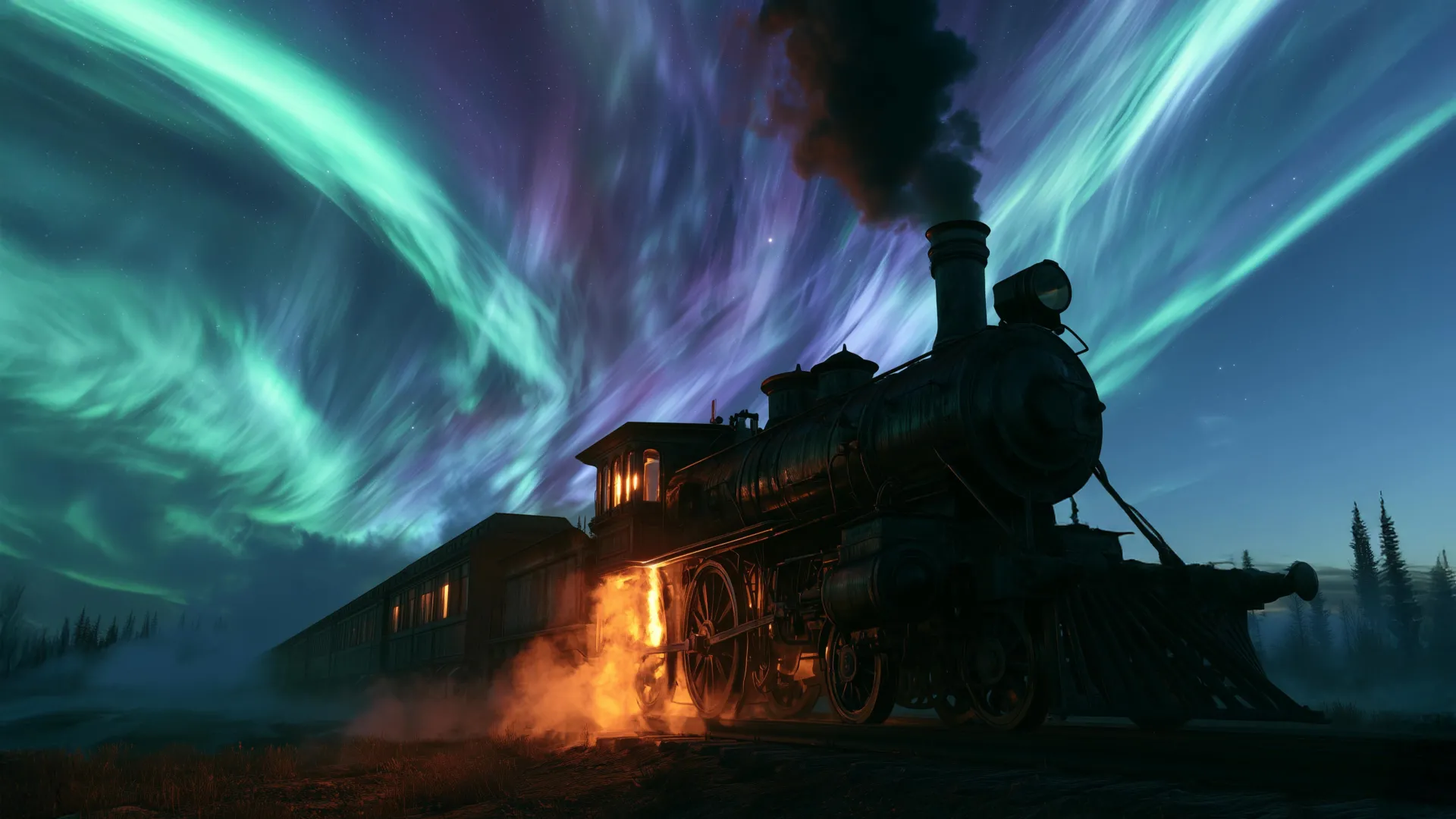
For nearly two centuries, historians and space scientists have pointed to an October evening in 1841 as the moment humanity first felt the disruptive power of the Sun. The narrative was simple: an intense magnetic disturbance paralyzed a train line in Exeter, England, marking the dawn of the space weather era. However, a team of modern-day "scientific detectives" has now unraveled this long-standing historical record, revealing that a simple clerical error had obscured the true timeline of how our technological civilization first collided with the cosmic environment.
In a landmark study published in the American Geophysical Union journal Space Weather, an international team of researchers—comprising experts from Lancaster University, RMIT University, the British Geological Survey, Natural Resources Canada, Baylor University, and the UK’s RAL Space—has corrected the historical record. By cross-referencing digitized magnetic field data, forgotten railway timetables, and 19th-century newspaper archives, the team has proven that the Exeter incident occurred not in 1841, but in 1848.
The correction serves as more than just an academic footnote; it underscores the fragility of our modern infrastructure in the face of solar activity and highlights the critical importance of historical data in predicting future technological catastrophes.
The Mystery of the Exeter Delay: A Chronology of Discovery
The original claim originated from an anonymous letter published in the scientific journal Nature in 1871. The author described a "very intense magnetic disturbance" that supposedly struck on October 18, 1841, causing a 16-minute delay for the 10:05 p.m. train departure from Exeter. For over 150 years, this account was accepted as the ur-text of space weather, the earliest documented instance where solar activity directly hindered human commerce and transport.
The Smoking Gun: An Impossible Railway
The investigation into the discrepancy began when Associate Professor Brett Carter of RMIT University began scrutinizing the historical evidence. While reviewing the technical details of the 1871 Nature report, a glaring inconsistency emerged: the Exeter-to-Starcross railway line mentioned in the account did not actually open until 1846.
"In this study, we effectively investigated what had to be a typo in a Nature paper from 1871," Professor Carter noted. "We know it was a typo because the Exeter-to-Starcross train line mentioned in that paper didn’t exist until 1846, which is five years afterwards."
Reconstructing the Timeline
To resolve the contradiction, the team launched a multi-disciplinary investigation. They looked beyond the erroneous report, scouring:
- Railway archives: Analyzing construction records and operational logs of the South Devon Railway.
- Magnetic records: Examining digitized observations of Earth’s magnetic field from the 1840s, which were recorded by early geomagnetic observatories.
- Contemporary Accounts: Reviewing period newspapers and solar observation logs.
The evidence converged on a new date: October 18, 1848. By shifting the event by exactly seven years, the researchers aligned the "magnetic disturbance" with known solar activity records, effectively reconciling the physics of the era with the logistical history of British rail.
The Solar Backdrop: From Carrington to the Present
To understand the magnitude of these early events, one must consider the solar environment of the 19th century. Solar storms—massive eruptions of charged particles and magnetic fields from the Sun—have been a constant in Earth’s history, but they only became "hazards" once humanity began stringing copper wires across the landscape.
The Carrington Event: The Gold Standard
The most famous precursor to modern space weather concerns is the Carrington Event of 1859. Named after British astronomer Richard Carrington, this solar superstorm was so powerful that it induced currents in telegraph lines globally, causing them to spark, shock operators, and even set fire to telegraph offices. In some instances, the induced current was so strong that telegraph systems continued to transmit messages despite having their batteries disconnected. The resulting auroras were seen as far south as Hawaii and the Caribbean, leading gold miners in the Rocky Mountains to wake up at 1:00 a.m. to prepare breakfast, believing the brilliant light of the northern lights to be the dawn.
The New "First": The 1847 Midland Incident
With the Exeter incident moved to 1848, it no longer holds the title of the earliest documented space weather impact on technology. That distinction now falls to an incident recorded in March 1847 on the Midland Railway in Britain. This discovery illustrates how the rise of the telegraph—a technology that acted like a giant antenna for solar-induced currents—brought humanity into direct, often painful, contact with the Sun’s volatile temper.
Expert Perspectives: The Detective Work of History
The study led by Professor Jim Wild of Lancaster University is being hailed as a triumph of "archival science." It demonstrates how modern analytical tools can breathe new life into centuries-old records, turning dusty ledgers and yellowing newspapers into high-precision data points.
The Value of Old Records
Dr. Mike Hapgood of RAL Space likened the process to a detective investigation. "It highlights the importance of preserving these older records, which give us the evidence base we need to interpret past events and strengthen future predictions," he said. By treating historical documents as scientific instruments, researchers can build a longer, more accurate baseline for solar activity than satellite data alone provides.
The "Technological Intersection"
Professor Wild emphasizes that the 1840s represented a critical turning point. Before this decade, solar storms were largely a visual phenomenon—a wonder of the night sky. By the end of the 1840s, they had become a tangible threat to the backbone of the Industrial Revolution. "What this research highlights is that space weather is not a new threat but a long-standing natural hazard," Wild stated. "Society has been experiencing the effects of space weather on technology for almost as long as electrical technologies have existed."
Implications for Modern Infrastructure
While the technology of the 1840s was limited to rudimentary telegraphs and basic railway signaling, the vulnerability remains identical in principle today. Modern society relies on vast, interconnected grids that are infinitely more sensitive to geomagnetic disturbances than the Victorian-era telegraph.
The Vulnerability of the Modern Grid
Today, a solar storm of the magnitude of the Carrington Event or the 1848 Exeter event could have catastrophic consequences. The primary risks include:
- Electrical Power Grids: Geomagnetically induced currents (GICs) can overload transformers, potentially leading to massive, long-term power outages.
- Satellite Navigation (GNSS): Ionospheric disturbances caused by solar activity can degrade or completely block GPS signals, disrupting everything from aviation and shipping to high-frequency financial trading.
- Railway Signaling: Just as in the 1840s, modern railway control systems utilize electrical circuits that can be corrupted by magnetic surges, creating potential safety hazards.
Preparing for the 2030s
The findings of the Lancaster-led team arrive at a poignant moment. As global reliance on satellite communication and space-based infrastructure grows, we are heading toward a decade of intense solar activity. The upcoming solar cycle in the 2030s will present a "stress test" for modern technology.
"Deepening our understanding of these events is essential for preparing for, and mitigating, the impacts of space weather," Dr. Hapgood added. By analyzing the 1848 incident, scientists are not just correcting a typo in a journal; they are refining the models that will protect global power grids, communication networks, and the burgeoning space economy.
Conclusion: Lessons from the Past
The story of the Exeter train delay serves as a reminder that history is rarely as static as the books suggest. Through the diligent application of modern forensic science, a simple historical error was corrected, and in doing so, we gained a clearer view of our ancestors’ first encounters with the power of the Sun.
As humanity looks toward a future of lunar bases, Mars missions, and an increasingly electrified global infrastructure, the "ghosts" in the 1848 telegraph wires serve as a prophetic warning. We are a species that has tied its prosperity to the electrical conductivity of our planet, and in doing so, we have made ourselves sensitive to the invisible, magnetic storms that dance across the solar system. The 178-year-old mystery is solved, but the challenge of living with our star has only just begun.