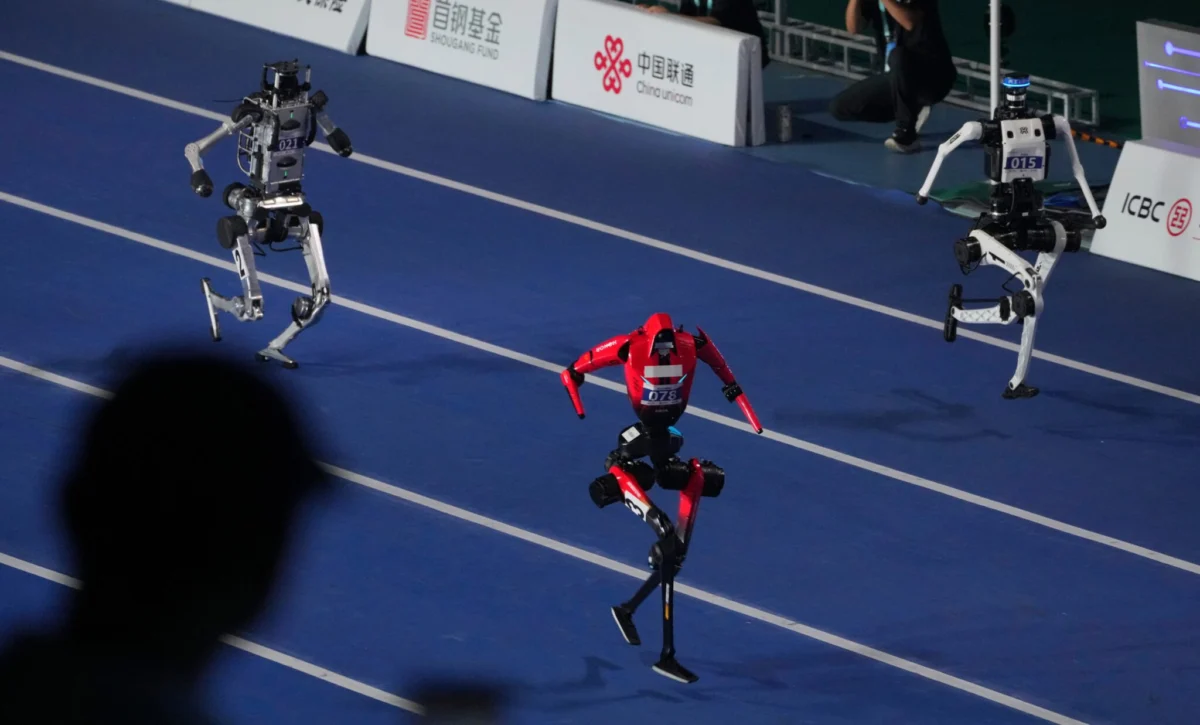
BEIJING — In a display that felt more like science fiction than a traditional sporting event, the opening day of the second annual World Humanoid Robot Games saw machines achieve what was once thought impossible: surpassing the pinnacle of human athletic performance. Within the cavernous National Speed Skating Oval—a venue originally built for the 2022 Winter Olympics—silicon and steel outpaced flesh and bone, as Chinese-made humanoid robots shattered world records previously held by legendary athletes like Usain Bolt and Javier Sotomayor.
The five-day event, which drew over 2,000 humanoid participants from 16 nations, serves as a high-stakes showcase of China’s rapidly accelerating robotics industry. As the technological rivalry between Beijing and Washington intensifies, these games offer a window into a future where artificial intelligence and advanced mechanical engineering redefine the boundaries of physical capability.
Chronology of a Mechanical Breakthrough
The path to this weekend’s record-breaking performances began earlier in the week at the 2026 World Robot Conference in Beijing. The conference acted as a precursor to the games, with over 3,000 products on display, signaling a massive industrial pivot toward humanoid forms. However, the true spectacle commenced on Saturday morning with a display of synchronized coordination that rivaled any Olympic opening ceremony.
Hundreds of humanoid robots marched onto the field in perfect formation, their movements governed by centralized AI clusters. The spectacle was designed to demonstrate not just individual agility, but the massive scale of China’s robotics ecosystem. Following the ceremony, the games moved quickly into the high-profile "track and field" events.
The most anticipated event was the 100-meter sprint. Spectators watched as a humanoid developed by the Beijing-based firm X-Humanoid took its place at the starting blocks. In a blur of rapid-fire mechanical strides, the robot crossed the finish line in a staggering 9.39 seconds. This performance effectively erased the long-standing human world record of 9.58 seconds, set by Jamaica’s Usain Bolt in 2009.
The momentum continued at the high jump pit. Just a year ago, at the inaugural edition of the games, the best humanoid high jump was a modest 0.95 meters. On Saturday, an X-Humanoid model cleared a bar set at 2.88 meters. To put this in perspective, the human world record, held by Cuba’s Javier Sotomayor since 1993, stands at 2.45 meters. The leap represented a nearly 200% improvement in mechanical performance in just twelve months.
Supporting Data: The Exponential Growth of Robotics
The data emerging from this year’s games underscores a trend of exponential improvement. While human athletic records are often broken by mere hundredths of a second or single centimeters over decades, robotic capabilities are leaping forward in massive increments.
Comparative Performance Table
| Event | Human World Record | 2023 Robot Record | 2024 Robot Record |
|---|---|---|---|
| 100m Sprint | 9.58s (Usain Bolt) | 14.2s | 9.32s* |
| High Jump | 2.45m (J. Sotomayor) | 0.95m | 2.88m |
| Participant Count | N/A | ~500 robots | 2,000+ robots |
*Recorded during pre-competition trials by a robot from Honor.
The 9.32-second sprint recorded by a robot from the smartphone giant Honor during trials is particularly noteworthy. According to company data, the unit reached a peak speed of 14.5 meters per second. These figures are driven by breakthroughs in "high-torque" actuators and "reinforcement learning" algorithms, which allow robots to adjust their balance and stride in real-time, far faster than a human nervous system can process sensory input.
Currently, China produces the vast majority of the world’s humanoid robots, leveraging its massive manufacturing infrastructure and a centralized push toward "New Quality Productive Forces"—a government initiative aimed at dominating high-tech sectors.
Official Responses and Geopolitical Friction
While the mood in Beijing was one of celebration, the international context remains fraught with tension. The rapid advancement of Chinese robotics has triggered significant alarm in Western capitals, particularly in Washington D.C., where the "dual-use" nature of this technology—applicable to both domestic labor and military operations—is a growing concern.
The U.S. Regulatory Crackdown
Just last month, the U.S. Federal Communications Commission (FCC) announced a sweeping ban on the import of new foreign-made humanoid robots, citing national security risks. The move was widely interpreted as a direct strike against Chinese manufacturers. Furthermore, the U.S. Department of Defense recently added Unitree—one of China’s most prominent robotics firms and a key participant in the Beijing games—to a blacklist of companies deemed to have close ties with the People’s Liberation Army (PLA).
The Pentagon’s concern centers on the possibility that the same balance and mobility algorithms used to win a soccer match or a sprint could be repurposed for autonomous bipedal weapon systems capable of navigating difficult terrain that wheeled or tracked vehicles cannot reach.
Beijing’s Rebuttal
The Chinese Ministry of Industry and Information Technology has hit back at these restrictions, labeling them as "technological protectionism" designed to stifle legitimate competition. During the games, organizers emphasized the peaceful and commercial potential of their creations.
"The goal of the World Humanoid Robot Games is to foster global cooperation and push the boundaries of what AI can do for humanity," said a spokesperson for the event. "To view these achievements through a purely military lens is to ignore the immense benefits these robots will bring to elderly care, disaster relief, and manufacturing."
Implications: From Spectacle to Social Shift
Despite the record-breaking speeds and heights achieved this weekend, experts caution that there is still a significant gap between a controlled "athletic" demonstration and real-world utility.
The Challenge of Mass Deployment
"What we are seeing today is the ‘Formula 1’ stage of robotics," says Dr. Chen Wei, a senior robotics researcher. "These robots are optimized for specific, high-performance tasks in a controlled environment. Moving them into a chaotic household or a dynamic construction site is the next great hurdle. Mass deployment will require not just speed, but extreme reliability and energy efficiency over long periods."
Public Perception and the "Uncanny Valley"
For the spectators in Beijing, the reaction was a mix of awe and existential anxiety. The sight of machines outperforming the greatest human athletes in history serves as a visceral reminder of the shifting labor landscape.
Li Yanfeng, a Beijing resident and education professional, admitted to feeling conflicted. "Initially, I was resistant to AI and robotics because I feared the displacement of human workers," she noted while watching the tug-of-war event. "But seeing them today, I realize this development is an unstoppable force. It is no longer a question of ‘if,’ but ‘how’ we will live alongside them."
Another spectator, Liu Tao, who brought his young son to the games, viewed the event as an educational necessity. "I want him to see the best robots China has to offer," Liu said. "His generation will be the one working with these machines every day. They need to understand the technology, not fear it."
The Economic Horizon
The implications for the global economy are profound. If a humanoid robot can run faster and jump higher than a human, it can theoretically perform any manual labor task with greater efficiency. The 51 events at the games—including table tennis, soccer, and weightlifting—are essentially stress tests for tasks like precision handling, teamwork, and load-bearing.
As China continues to refine these machines, the cost of production is expected to plummet. This could lead to a "robotics revolution" in the manufacturing sector, where humanoids replace traditional stationary robotic arms, offering a level of flexibility that allows factories to pivot between products in hours rather than weeks.
Conclusion
The 2026 World Humanoid Robot Games have proven that the physical limitations of the human body are no longer the ceiling for bipedal movement. By shattering records held by icons like Usain Bolt, China has signaled its intent to lead the "Century of the Robot."
However, as the robots head back to their labs and the National Speed Skating Oval empties, the questions left behind are more complex than simple scores and times. As the technology race with the U.S. continues to simmer, the world must now grapple with the reality of a new type of athlete—one that never tires, never ages, and is rapidly learning to outpace its creators.